
Learning at 1–2 years
Movement and language take off together. Household objects, songs and simple back-and-forth talk do more than any flashcard.
Check growth
Walking, first words and pointing usually arrive this year, in any order and on very different schedules. Most late walkers and late talkers catch up. The list below is what to notice; the red flags are the few things worth a conversation with your doctor.
Learning behaviours you will notice
- Points at things they want
- Says a handful of clear words
- Follows a simple instruction ("give me the cup")
- Stacks two or three objects
- Scribbles with a crayon
- Walks steadily and squats to pick things up
See the full checklist and tick it off on your device →
0 of 0 ticked on this device. Nothing is sent anywhere.
🩺 Worth a conversation with your paediatrician if…
- By eighteen months, is not walking, or has no clear words at allIAP
- By eighteen months, does not point to show you things or follow your pointingIAP
- By two years, is not putting two words together or does not copy your actionsIAP
- Does not seem to hear you when you are out of sight, or does not startle at loud soundsIAP
- Loses words or skills they once hadIAP
Children vary widely and normal ranges are wide. This list is a prompt to ask, not a diagnosis, and it is not a substitute for a doctor who knows your child. If something worries you, ask early — support is easier the sooner it starts.
Reviewed against: Indian Academy of Pediatrics · WHO Guidelines on physical activity, sedentary behaviour and sleep for under-5s (2019)
Mental & physical capability
Movement and language take off together. Nesting katoris, dropping rajma into a bottle, naming everything and reading the same chunky book again and again do more than any flashcard.

Creative Activities for 1–2 Year Olds at Home: 5 No-Mess Ideas Using What You Have
Five hands-on creative activities for 1–2 year olds using newspaper, dough, fabric scraps, and water—no products needed…
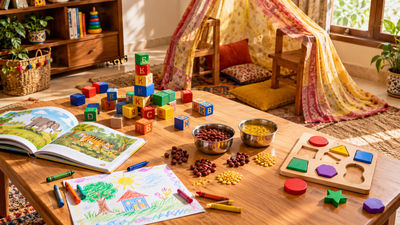
Shape Activities for 18 Month Old at Home: 5 No-Buy Games Using Household Items
Five zero-cost shape activities using kitchen tools, clothes and household items to teach circles, squares and triangle…

Early Literacy Activities for 1-2 Year Olds: 4 Book-Handling Skills with Household Items
Teach your 12-24 month old how books work with page-turning, label pointing and texture play. Four activities using onl…

Pre-Reading Activities for 1–2 Year Olds: 5 Household Activities for Print Awareness
Build print awareness at home before formal reading. Five simple activities using household items—food packets, newspap…
Reviewed against: National Curriculum Framework for the Foundational Stage (NCF-FS) 2022, NCERT · National Education Policy 2020, Ministry of Education
Improve attention span
Short bursts of absorbed play are the goal — posting, filling, stacking. A sand timer makes the end of a task visible, which is how a toddler learns to finish what they start.
One thing to try
Sand-timer tidyTurn a sand timer and put toys into a basket together until it runs out. The timer makes the end visible.
You need: a sand timer, a basket · about 5 minutes
More to try
Turn a sand timer and put toys into a basket together until it runs out. The timer makes the end visible.
Cut a slot in a shoebox lid and let your toddler post bottle caps or old cards through it, one at a time.
Reviewed against: WHO Guidelines on physical activity, sedentary behaviour and sleep for under-5s (2019) · Indian Academy of Pediatrics
Nurture better
Big feelings and few words. Naming the feeling out loud, staying calm and offering simple choices does more than any consequence. Putting toys to bed at the end of play is the first routine they can own.

Self-Care Skills for 1-2 Year Olds: 5 At-Home Activities to Build Independence
Teach your 12-24 month toddler self-care using household items: open-cup drinking, self-feeding, napkin use, and tidyin…

Self-Care Activities for 1–2 Year Olds: Build Independence at Home
Four simple household activities that teach your 1–2 year old to feed, drink, and dress themselves. No products needed—…
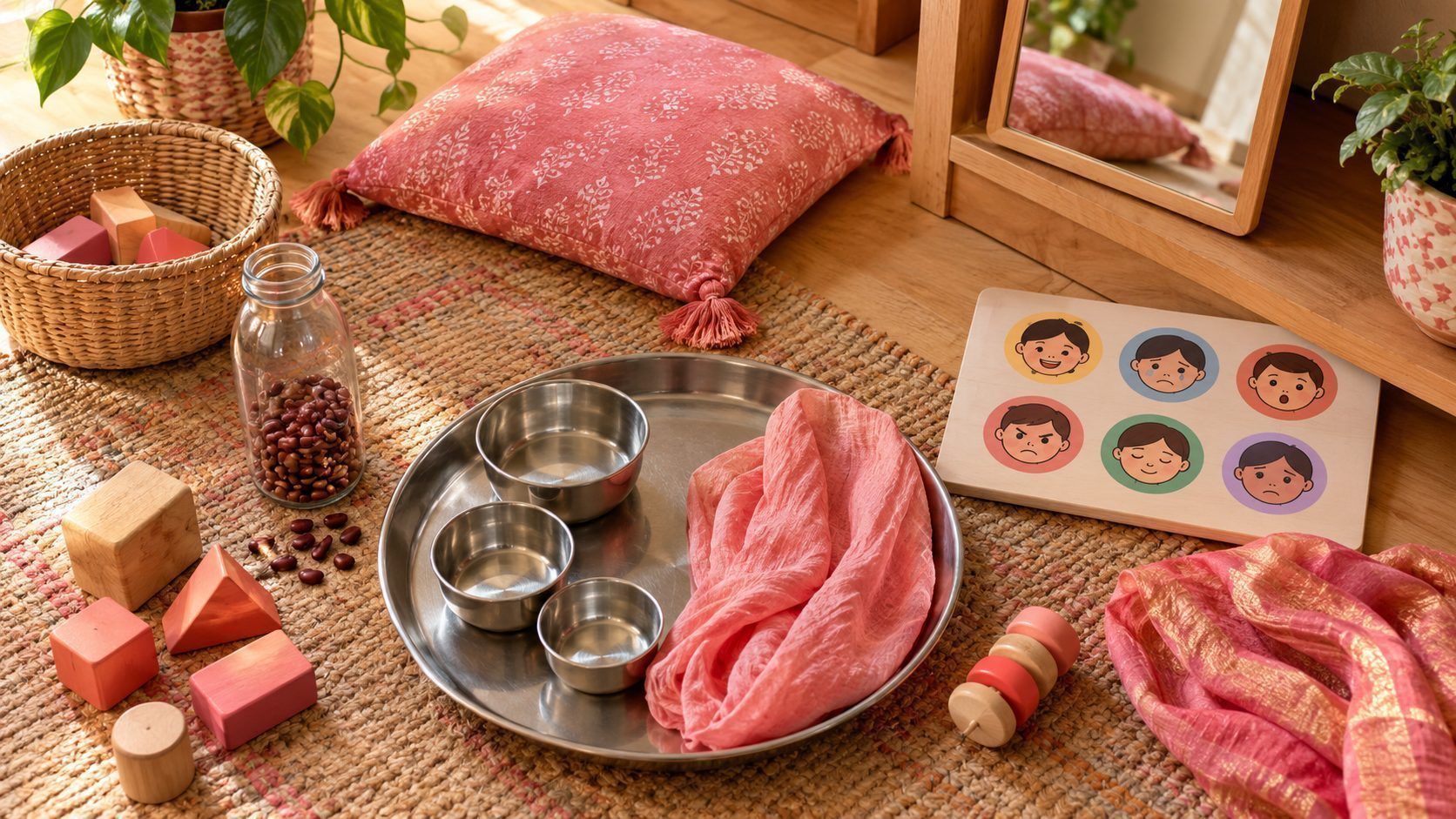
Social-Emotional Activities for 1-2 Year Olds: 4 At-Home Games That Build Name Recognition & Turn-Taking
4 zero-cost activities using mirrors, photos, and household objects to grow your toddler's name recognition, joint atte…

Social Skills Activities for 1-2 Year Olds at Home: 4 Games That Build Sharing & Empathy
Turn-taking, empathy, and sharing don't happen by accident. These 4 at-home games use toys, katoris, and family time to…
Reviewed against: Indian Academy of Pediatrics · National Curriculum Framework for the Foundational Stage (NCF-FS) 2022, NCERT