
Learning at 0–12 months
Your baby learns through your face, your voice and their own hands. Nothing needs teaching — responsive, playful attention is the whole curriculum.
Check growth
The first year is the fastest growth your child will ever have, and also the widest normal range. What matters is direction, not dates: rolling, then sitting, then reaching; cooing, then babbling. Use the checklist as things to notice, not a test, and bring any worry to the paediatrician early.
Learning behaviours you will notice
- Turns towards a familiar voice
- Babbles back when you talk
- Makes different sounds for different needs
- Reaches for and mouths objects
- Rolls over
- Brings hands together at midline
See the full checklist and tick it off on your device →
0 of 0 ticked on this device. Nothing is sent anywhere.
🩺 Worth a conversation with your paediatrician if…
- By around six months, is not smiling back, making eye contact or responding to your voiceIAP
- By around nine months, is not sitting with support, or is not babbling at allIAP
- By twelve months, does not respond to their name or look where you pointIAP
- Feels unusually stiff or floppy, or movement is very lopsidedWHO
- Loses a skill they clearly had, at any ageIAP
Children vary widely and normal ranges are wide. This list is a prompt to ask, not a diagnosis, and it is not a substitute for a doctor who knows your child. If something worries you, ask early — support is easier the sooner it starts.
Reviewed against: Indian Academy of Pediatrics · WHO Guidelines on physical activity, sedentary behaviour and sleep for under-5s (2019)
Mental & physical capability
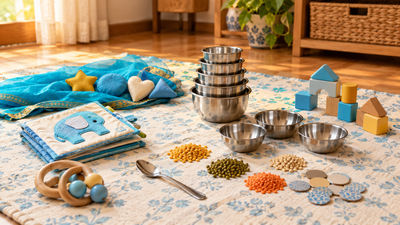
Everything is learning right now — faces, voices, hands and mouths. Tummy time builds the body, your talk builds the language, and a katori to bang teaches cause and effect. No toy does more than a responsive adult on the floor.
Early Math Activities for Babies 0-12 Months: Building Number Sense Through Rhythm and Pattern
4 no-buy activities using household items to build one-to-one correspondence and quantity awareness in babies under 1 y…

Creative Activities for Babies 0-12 Months at Home: 4 Sensory Play Ideas (No Mess)
Four safe, mess-free sensory activities for babies 0-12 months using household items: fabric texture boards, water squi…

Motor Skills Activities for 10–12 Month Crawlers: 5 Floor Games Using Home Items
Five safe floor activities using cushions, bowls, and dupattas to build gross motor strength and balance as your 10–12 …

Motor Skills Activities for 8-10 Month Babies: DIY Obstacle Courses at Home
4 obstacle-course activities using cushions, towels, and cardboard to build crawling strength, balance, and spatial awa…
Reviewed against: National Curriculum Framework for the Foundational Stage (NCF-FS) 2022, NCERT · National Education Policy 2020, Ministry of Education
Improve attention span
Attention starts as gazing and tracking. One object on the mat at a time, offered slowly and taken away when interest fades, is the entire curriculum. Screens off: WHO and IAP both advise none at all under two.
One thing to try
One toy on the matPut a single object on the play mat and let your baby explore it fully before offering another. One thing at a time is how attention starts.
You need: a play mat, one safe object · about 6 minutes
More to try
Put a single object on the play mat and let your baby explore it fully before offering another. One thing at a time is how attention starts.
Move a shiny steel katori slowly from side to side about 30 cm from your baby and let their eyes follow it. Stop when they look away.
Reviewed against: WHO Guidelines on physical activity, sedentary behaviour and sleep for under-5s (2019) · Indian Academy of Pediatrics
Nurture better
Warm, quick responses to crying are not spoiling — they build the security every later skill rests on. Simple routines around feeds, sleep and bath give the day a shape a baby can learn.
