
Learning at 2–3 years
Vocabulary doubles, "why" begins, and pretend play becomes the main way your child practises the world. Kitchens and balconies are the best classrooms.
Check growth
The language explosion year: two-word phrases, then sentences, then endless why. Pretend play arrives and becomes the main way your child practises the world. Tantrums peak because feelings still outrun words.
Learning behaviours you will notice
- Puts two words together ("more milk")
- Names familiar objects and people
- Follows a two-step instruction
- Enjoys the same book again and again
- Joins in on rhymes and songs
- Understands "one" versus "lots"
See the full checklist and tick it off on your device →
0 of 0 ticked on this device. Nothing is sent anywhere.
🩺 Worth a conversation with your paediatrician if…
- By three years, speech is very hard for family to understand, or there are no short sentencesIAP
- Does not play pretend at all, or does not play alongside other childrenNCF-FS
- Cannot follow a simple two-step instructionIAP
- Falls very often, or cannot manage stairs with a hand heldWHO
- Loses words or skills they once hadIAP
Children vary widely and normal ranges are wide. This list is a prompt to ask, not a diagnosis, and it is not a substitute for a doctor who knows your child. If something worries you, ask early — support is easier the sooner it starts.
Reviewed against: Indian Academy of Pediatrics · WHO Guidelines on physical activity, sedentary behaviour and sleep for under-5s (2019)
Mental & physical capability
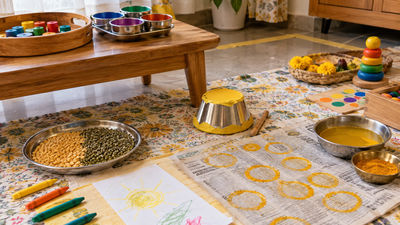
Kitchens and balconies are the best classrooms. Sorting dal, sink-or-float at bath time, a tape line to balance on, haldi stamps on newspaper — real materials, real learning, nothing to buy.

Literacy Activities for 2-3 Year Olds at Home: Build Print Awareness Without Screens
5 household activities that build pre-reading skills using things already in your home—newspapers, magazines, packaging…

Motor Skills Activities for 2-3 Year Olds: 5 No-Cost Home Games That Build Balance & Coordination
Five tested gross motor activities using household furniture—pillow courses, tape balance lines, soft ball throws, craw…
5 Creativity Activities for 2-3 Year Olds at Home (Open-Ended Art, No Setup)
Five no-mess, no-template art activities using things you already have at home. Water painting, paper tearing, finger p…
Teaching Colours to 2-3 Year Olds: 5 Sorting Activities That Work at Home
Forget flashcards. Teach colour recognition through sorting dal, laundry, and household items. Five hands-on activities…
Reviewed against: National Curriculum Framework for the Foundational Stage (NCF-FS) 2022, NCERT · National Education Policy 2020, Ministry of Education
Improve attention span
Listening games and stop-and-go play build the self-control attention rests on. Expect a few minutes at a time and treat every minute as a win. Keep any screen time to one short, agreed show.
One thing to try
Freeze danceDance to a song and freeze whenever the music stops. Stopping on cue is early self-control, which attention is built on.
You need: a song · about 8 minutes
More to try
Sit quietly together for a minute and name every sound you can hear — a fan, a crow, a pressure cooker. Then go and find one of them.
Dance to a song and freeze whenever the music stops. Stopping on cue is early self-control, which attention is built on.
Reviewed against: WHO Guidelines on physical activity, sedentary behaviour and sleep for under-5s (2019) · Indian Academy of Pediatrics
Nurture better
Coach through tantrums rather than punishing them: name the feeling, hold the limit kindly, wait. Own chappals on, own toys away — independence is a learning goal too.

Turn-Taking Games for 2-3 Year Olds: 5 Activities That Build Social Skills Before Preschool
Five simple turn-taking games using everyday household items that teach patience, sharing and cooperation. Build social…

Self-Care Skills for 2-3 Year Olds: 5 At-Home Activities That Actually Stick
Simple routines to teach dressing, handwashing, and independent eating using household items. Build confidence in 3-6 w…
Reviewed against: Indian Academy of Pediatrics · National Curriculum Framework for the Foundational Stage (NCF-FS) 2022, NCERT