
Learning at 5–8 years
Formal literacy and numeracy begin, at school or at home. What matters most now is reading together, real-life maths, and keeping curiosity alive.
Check growth
Formal reading and maths begin, at school or at home. Watch for confidence more than speed: a child who enjoys books will read; a child drilled on worksheets may not. The behaviours below are what to notice at home.
Learning behaviours you will notice
- Sounds out and reads simple words and sentences
- Writes their name and familiar words
- Retells a story with beginning, middle and end
- Adds and subtracts small numbers
- Understands time of day and simple money
- Recognises number patterns
See the full checklist and tick it off on your device →
0 of 0 ticked on this device. Nothing is sent anywhere.
🩺 Worth a conversation with your paediatrician if…
- By seven, still cannot recognise most letters or sound out simple words despite regular reading togetherNCF-FS
- Cannot sit through a short story or stay with a task for about ten minutes when restedIAP
- Very clumsy compared with peers, or handwriting is painful and slowWHO
- Big changes in sleep, appetite or mood that last more than a couple of weeksIAP
- Refuses school or friends persistently, or seems anxious most of the timeIAP
Children vary widely and normal ranges are wide. This list is a prompt to ask, not a diagnosis, and it is not a substitute for a doctor who knows your child. If something worries you, ask early — support is easier the sooner it starts.
Reviewed against: Indian Academy of Pediatrics · WHO Guidelines on physical activity, sedentary behaviour and sleep for under-5s (2019)
Mental & physical capability
Read and swap, the shopkeeper game, kitchen chemistry, a six-panel comic. Real-life maths and reading together every day matter more than any workbook.

Screen Time Alternatives for 5-8 Year Olds: 5 Kitchen Science Experiments
Replace screen time with hands-on kitchen science: 5 experiments using vinegar, baking soda, food colour and ice that b…

Screen-Free Storytelling for 5-Year-Olds: 5 Activities Using Kitchen Props
Build language and imagination without screens. Five storytelling games using household items, from chain tales to ridd…

Listening Activities for 5-8 Year Olds at Home: 5 Sound Games That Build Auditory Skills
Five everyday listening games using kitchen sounds, voice cues, and household items. Builds auditory memory and instruc…
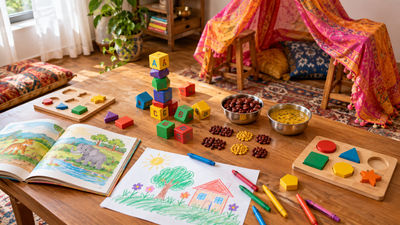
How to Teach a 5-Year-Old to Read at Home in India: Phonics Practice Without Pressure
Simple phonics activities using household items: sound hunts, spoon-tapping word segments, letter circles in newspapers…
Reviewed against: National Curriculum Framework for the Foundational Stage (NCF-FS) 2022, NCERT · National Education Policy 2020, Ministry of Education
Improve attention span
Fifteen-minute focus blocks: one task, a clear table, a visible timer, then a real break. Two short blocks beat one long battle. Memory-tray games stretch working memory.
One thing to try
One-job homework blockClear the table of everything except one task, set a sand timer for fifteen minutes, then take a real break. Two short blocks beat one long battle.
You need: a sand timer, a clear table · about 15 minutes

Reviewed against: WHO Guidelines on physical activity and sedentary behaviour (2020), ages 5–17 · Indian Academy of Pediatrics
Nurture better
Gratitude at dinner, packing their own tiffin, a weekly screen audit done together. Friendships and fairness start to matter; let them solve small disagreements with support.

Screen Time Rules for 5–8 Year Olds in India: 5 Home Routines That Actually Work
IAP 2026 limits recreational screen to 2 hours daily for 6–8 years. Five routines that work in small flats: device-free…
Screen Time Rules for 5-Year-Olds in 2026: IAP Guidelines & 5 Home Rules That Actually Work
IAP 2026 screen-time limits for 5-year-olds: 60-90 minutes daily maximum with mandatory co-viewing. Plus 5 practical ho…

6 Self-Care Skills for 5-6 Year Olds: Step-by-Step Home Practice Before Class 1
Shoe-tying, hand-washing, using the toilet lock, buttoning up—teach these 6 self-care activities for your 5-6 year old …
Reviewed against: Indian Academy of Pediatrics · National Curriculum Framework for the Foundational Stage (NCF-FS) 2022, NCERT