
How to Teach a 5-Year-Old to Read at Home in India: Phonics Practice Without Pressure
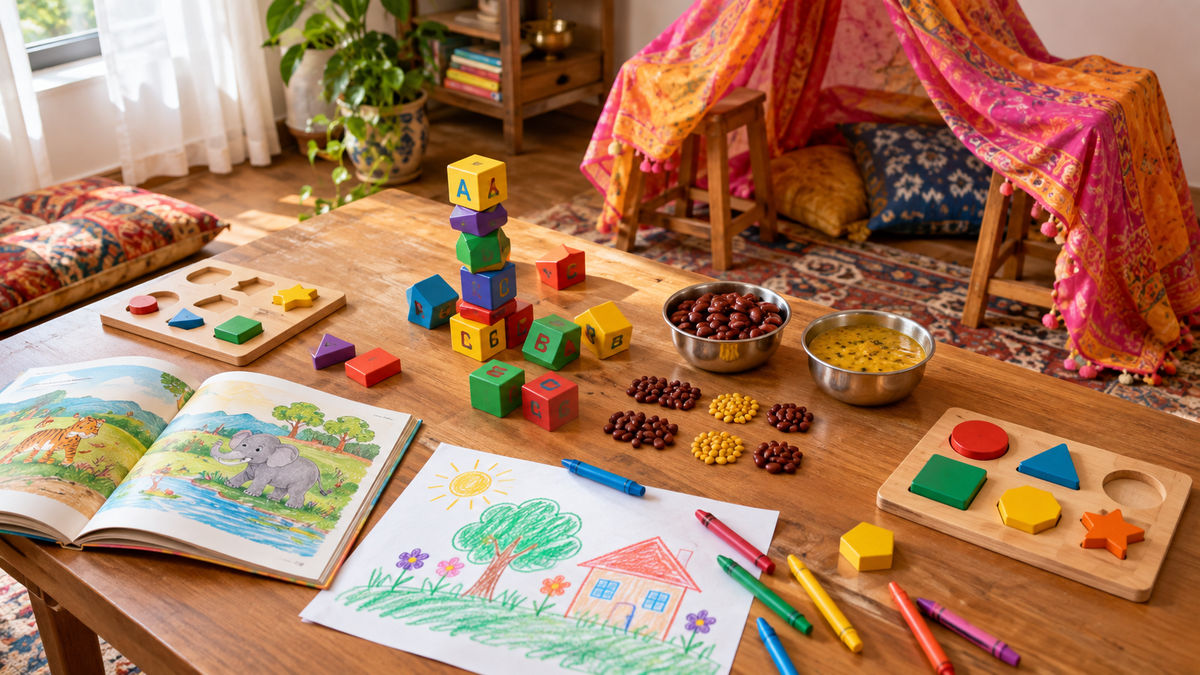
Start with sound blending (recognising individual letter sounds), move to segmenting words by tapping them out syllable-by-syllable, then decoding simple three-letter words like cat, bat, run. Use household items—steel katories, newspaper, dal grains, wooden spoons. Most 5-year-olds ready for this are already familiar with letter names; phonics teaches the sounds those letters make. Pressure kills it. If your child resists, wait three months and try again.
Your five-year-old knows the alphabet. She can point to letters on a cereal box. But ask her to sound out the word "cat" and she freezes—or she tries to remember it as a whole picture, which is how most Indian children are traditionally taught to read. How to teach a 5-year-old to read at home in India has shifted. Schools now blend phonics (sound-by-sound decoding) with whole-language methods, following the National Education Policy 2020. This matters because phonics builds phonemic awareness: the ability to hear, identify, and manipulate individual sounds in words. It's the foundation for fluent reading, and it's not something a child discovers on her own.
Daily baby tips, exclusive Amazon deals & real parent advice — free forever.
This guide walks you through four concrete activities using only things you have at home. No flashcards. No apps. No pressure. We'll cover why this age, why now, and—crucially—when to step back.
What's Happening at This Age
At five to five-and-a-half years, most children have strong letter recognition and can rhyme without help. Their brains are primed for phonological awareness—they can clap syllables, identify rhyming words, and notice that "cat" and "king" start with the same sound. The National Curriculum Framework for Foundational Stage (2022) emphasises this readiness: around this age, children can begin connecting letter symbols to letter sounds, which is the bridge between knowing letters and reading words.
Not every child develops this at the same pace. Some five-year-olds are ready; others won't be until six or even seven. If your child shows no interest or resists sound activities, that's normal. The goal here is playful exposure, not mastery.
Try This at Home
Activity 1: Sound Treasure Hunt
You need: A room in your house, household objects (wooden spoon, steel katori, dal grains, a toy block, a cushion—whatever you have).
How: Pick one sound, say /b/ (not "bee," just the sound). Tell your child you're hunting for five things in the house that start with that sound. Ball. Book. Bottle. Banana. Bath towel. Let her find them, touch them, and repeat the sound as she picks each one up. Do this for three minutes maximum. Next week, try /m/ or /s/.
What it builds: Sound recognition and the ability to isolate the first sound in a word. Your child begins to notice that different words share the same starting sound.
Easier: Start with just three objects and help her find them. Harder: Once she's confident, ask her to find objects by sound without you saying the word ("Find me something that starts with /t/").
Activity 2: Spoon-Tapping Word Segments
You need: A wooden spoon and a steel or ceramic bowl or plate, everyday words your child knows (cat, dog, book, mango, happy).
How: Say a word out loud, then tap the spoon on the bowl once for each syllable or sound. For "cat," tap three times: c-a-t. For "mango," tap four times: man-go (or m-a-n-go, depending on how you segment). Let your child tap along or take turns. Keep the rhythm slow and clear.
What it builds: Phonemic segmentation—the ability to break words into individual sounds. This is crucial for decoding unfamiliar words later.
Easier: Start with two-sound words like "go" or "up." Harder: Tap out the sounds without saying the word first, then ask her to guess the word.
Activity 3: Newspaper Letter Circles
You need: An old newspaper or printed page, a pencil or highlighter (or an old pen that works), one letter you want to focus on (start with "a" or "s").
How: Give your child a page of newspaper and ask her to find and circle all instances of the letter. She might not find every one (that's fine—you're building letter recognition, not perfection). Praise effort, not accuracy. Do one letter per sitting, spend five minutes max. Read one of the circled words aloud together afterward.
What it builds: Letter recognition, visual scanning, and the confidence that letters appear in real reading material—not just in books.
Easier: Use a printed page with larger text, or point out a letter and ask her to find one more like it. Harder: Ask her to circle a letter and then name the word it appears in.
Activity 4: Rhyming Games During Cooking
You need: Your kitchen and a simple activity—grinding masala, kneading dough, stirring dal. Any repetitive kitchen task.
How: While you're working side-by-side, play a rhyming game. You say a word ("cat"), and she says a word that rhymes ("bat," "mat," "sat"). No wrong answers. If she says something that doesn't rhyme, repeat your word and say, "That's a different sound. Can you try another one?" Keep it light. Make it a rhythm game—rhyme with each stir or knead.
What it builds: Phonological awareness, listening skills, and the ability to manipulate sounds playfully. Rhyming is one of the earliest phonological skills and leads directly into decoding.
Easier: You provide both words and ask if they rhyme: "Do 'cat' and 'bat' rhyme?" Harder: She starts by saying a word, and you both find rhymes together.
What "Getting It" Looks Like
Your child doesn't need to read a full sentence to be progressing. Look for these signs: she can identify the first sound in a word ("cat" starts with /c/), she can repeat a sound sequence after you tap it (c-a-t), she notices rhyming words without prompting, and she can point to the letter "a" when you name it. She might still not decode a three-letter word independently, and that's okay. Phonemic awareness comes before decoding. Patience here saves frustration later.
When to Move On, and When to Ask
After three to four weeks of these activities, your child should show interest or at least not resist. If she's happy and engaging, you're on track. If she's frustrated or avoids sound games entirely, pause for two months and return to it. Reading readiness isn't a fixed age—it's a developmental window.
Talk to your paediatrician if your child shows no interest in words or sounds by age six, has difficulty following sound sequences, or if a school assessment suggests speech or language concerns. These conversations are preventative, not alarming.
If You're Homeschooling
Weave these activities into your weekly rhythm without a separate "phonics time." One treasure hunt on Monday, spoon-tapping on Wednesday, newspaper circles on Friday—ten minutes total, woven into play or household routines. If you're teaching English while raising a Hindi or regional-language speaker, the same activities work for both: phonics principles are universal. Your child benefits from hearing sounds in multiple languages; this actually strengthens phonemic awareness overall.
What Paediatricians Say
The Indian Academy of Paediatrics (IAP) recognises phonological awareness as a key precursor to literacy. Key facts:
- Phonemic awareness at age five predicts reading fluency by age seven—long before formal reading instruction.
- Indian schools implementing NEP 2020 now blend phonics and whole-word methods, meaning your child's school is likely already teaching sound-based decoding alongside sight words.
📚 Reviewed against
This guide was checked against the sources below. It is general parenting guidance, not medical advice — for any concern about your child's development, talk to your paediatrician.
- National Education Policy (NEP) 2020 - Ministry of Education, India — Foundation stage literacy approach; phonics and whole-language integration mandate
- National Curriculum Framework for Foundational Stage (NCF-FS) 2022 — Indian readiness indicators for phonological awareness and literacy; syllable and sound segmentation guidelines
- Indian Academy of Pediatrics (IAP) - Child Development Guidelines — Phonemic awareness as predictor of reading fluency; developmental readiness markers
- WHO - Early Childhood Development and Learning (2020) — Foundation skills for literacy; phonological processing in early childhood
- Literacy Research Association - Phonological Awareness and Decoding — Evidence on syllable segmentation and rhyming as early phonemic skills
Last reviewed 17 Sep 2026
🛒 If you want to buy (optional)
Everything above works with what you already have at home. If you'd rather buy, these are the few things parents keep reaching for. Entirely optional — nothing on this page needs a purchase.
Wooden Spoon and Steel Katori Set
For tapping out syllable segmentation; creates clear, audible sound for phonemic awareness activity
At home instead: Any spoon you have and any metal or ceramic bowl
Coloured Pencils or Highlighters (Pack of 12)
For circling letters in newspaper activity; makes the task visually engaging
At home instead: Any old pen or pencil you have at home
Affiliate note: the Amazon links above may earn us a small commission, at no extra cost to you. It never changes what we recommend, and nothing on this page requires a purchase.
Frequently Asked Questions
At what age should I start teaching phonics to my child?
Should I teach my child the letter sound (/s/) or the letter name ("ess")?
My child speaks Hindi at home and English at school. Should I teach phonics in both languages?
How long should each phonics activity take?
What if my child resists sounding out words and insists on guessing whole words?
Do I need to buy flashcards or phonics apps for this to work?
Daily baby tips, exclusive Amazon deals & real parent advice — free forever.