
Screen Time Rules for 5-Year-Olds in 2026: IAP Guidelines & 5 Home Rules That Actually Work
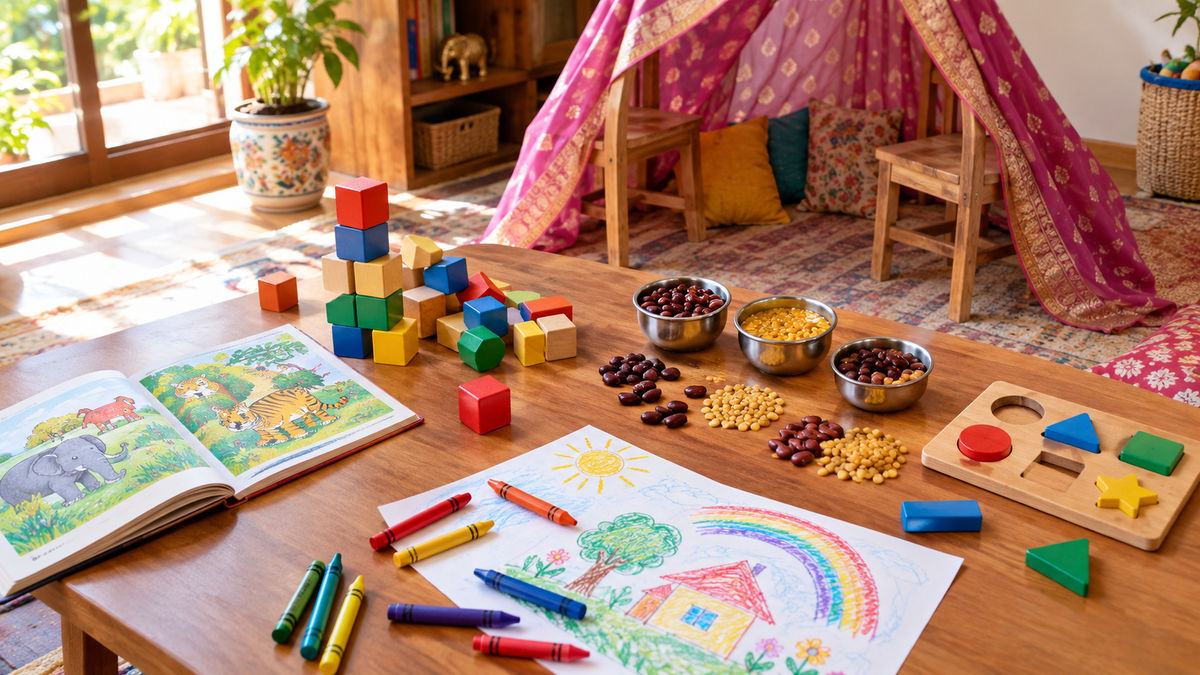
According to the Indian Academy of Pediatrics 2026 guidelines, 5-year-olds should have no more than 60–90 minutes of screen time daily, and it must always be co-viewed with a parent who explains the content. Solo screen use is not recommended. The key is intentional, educational viewing paired with real-world play—not passive consumption or screen-time as a babysitter.
If your 5-year-old is halfway through Class 1, you're navigating the trickiest screen-time age. Old enough to ask for screens, young enough to not regulate themselves. The National Education Policy 2020 frames digital literacy as a life skill, not a luxury—but that doesn't mean unlimited tablets. This guide translates the IAP 2026 recommendations into five rules that work in real Indian homes, with honest talk about when screens help phonics and when they hijack focus.
Daily baby tips, exclusive Amazon deals & real parent advice — free forever.
What the IAP 2026 Guidelines Actually Say
Screen-time limits for 5-year-olds: The Indian Academy of Pediatrics updated recommendations in 2026 specify a maximum of 60–90 minutes per day for children aged 5–8 years. This is not a target to reach; it's a ceiling not to breach. The NEP 2020 digital framework acknowledges that tech aids foundational literacy, but only if it's intentional and supervised. Passive consumption—sitting alone while YouTube autoplays cartoon after cartoon—contradicts both guidelines.
The mandated co-viewing rule is non-negotiable: every minute your child spends on a screen should have a parent or trusted caregiver actively watching, pausing to explain, and connecting what they see to real life. A 30-minute phonics app is screened at 30 minutes; a 10-minute storytelling video in your mother tongue is screened at 10 minutes. There are no "background" screens in the IAP framework.
Content quality matters as much as duration. Educational content—structured phonics apps, storytelling videos in regional languages, age-appropriate documentaries—counts differently from algorithmic feeds, ad-heavy games, or passive cartoon loops. IAP 2026 guidance separates learning screens from entertainment screens, and recommends a 60/40 split: at least 60% of screen time should be educational or co-creative (making something together while screens guide), with no more than 40% entertainment.
The 5 Home Rules That Protect Focus and Literacy
Rule 1: No Screens During Meals
The rule: Breakfast, lunch, dinner, snacks—all screen-free. This includes YouTube on the tablet beside the plate, phones propped at the table, or "just this one episode" while eating.
Why it matters: Eating is a sensory, social, and digestive act. When screens occupy attention, children don't taste food, don't chew thoroughly, and miss conversations that build language. IAP guidelines specifically flag distracted eating as a risk factor for both poor digestion and reduced family bonding, which supports healthy emotional development at this age.
How to enforce it: Place all screens (yours included) in another room during meals. Make this a household rule, not a punishment for your child alone. Many parents find that removing screens from the table drops mealtimes stress by 40% and increases vegetable acceptance simply because kids are tasting, not distracted.
Rule 2: Bedroom Ban – Sleep Hygiene Comes First
The rule: No screens in the bedroom, including tablets, phones, or TV. This applies equally to you—your child imitates your sleep habits.
Why it matters: Screen light (blue wavelength) disrupts melatonin production even 30 minutes before sleep. At age 5, circadian rhythm is still consolidating; irregular sleep compounds focus problems at school. NEP 2020 recognises that learning readiness depends on sleep. A 5-year-old needs 10–12 hours of continuous sleep to consolidate phonics and number recall. Bedroom screens steal this.
How to enforce it: Charge devices outside the bedroom. Use a physical bedside lamp or flashlight for bedtime stories instead. Set a household charging station in a common area after 7 p.m. If your child asks for a device before sleep, redirect to a book, drawing, or a parent-led storytelling ritual.
Rule 3: Co-Viewing Is Non-Negotiable—Parent as Translator
The rule: Every screen session includes you. You pause, you ask questions, you connect the story to their world. No "just this once" solo tablet time.
What co-viewing looks like: A phonics app runs for 15 minutes. You sit beside them. When a letter appears, you both say it aloud. When a word is formed, you ask: "Have you seen this word anywhere today?" When a storytelling video shows a character planting seeds, you pause and say: "Like Dadi's garden, remember?" This is not passive sitting; it's active scaffolding of learning.
Why it works: At age 5, the brain learns by connecting new information to lived experience. Solo screens are one-way broadcasts. Co-viewed screens become conversations. IAP research shows that co-viewed educational content improves vocabulary retention by 40% and phonics transfer (ability to apply letters to new words) by 35%, compared to solo viewing of the same content.
Rule 4: Creation Over Consumption – Draw What You Watched
The rule: After any educational screen session, spend 10–15 minutes creating something related to it. No screen during creation.
What this looks like: Your child watched a 10-minute story about monsoons. After the screen ends, hand them paper and coloured pencils. "Draw the raindrops we saw. What colour was the sky?" They draw. They narrate their drawing to you. You write their words underneath. Done. They've moved from passive consumption to active representation—which is where deep learning lives.
Why it protects focus: Passive consumption (watching) activates different neural pathways than creation (making). Creation cements memory and builds executive function—the ability to plan, decide, and follow through. A 5-year-old who watches 20 minutes of screens and then draws for 15 minutes learns more than a child who watches 35 minutes straight. NEP 2020 emphasises creative expression as foundational to literacy; screens can support it, but cannot replace hands-on making.
Rule 5: Outdoor Hour Per Screen Hour – The Rebalance
The rule: For every 60 minutes of screen time in a day, guarantee at least 60 minutes of unstructured outdoor or physical play, ideally before or right after the screen session.
What counts: Running in the park, climbing, digging in soil, playing with water, riding a tricycle, chasing birds, building with sticks. Unstructured, child-led, adult-supervised but not directed.
Why it matters: Screens are sedentary. Outdoor play activates gross motor skills, spatial reasoning, risk assessment, and emotional regulation—all foundational to Class 1 learning. A 5-year-old with 90 minutes of screen time needs 90 minutes of outdoor play to balance attention, impulse control, and physical literacy. Many Indian parents reduce screens naturally once this rule clicks: it's easier to say "yes, we can have 30 minutes of phonics apps after school, but then we're going to the park until dinner" than to negotiate every screen request throughout the day.
When Screens Actually Help Learning (and When They Don't)
Screens help learning when: They teach structured phonics (letter-sound correspondence with repetition and visual cues), show storytelling in the child's mother tongue (regional-language videos cement early literacy better than English alone), model a skill (how to hold scissors, how plants grow), or invite interaction (answering questions, following instructions). Apps like those endorsed by IAP for pre-literacy and early numeracy, or curated storytelling channels, fall here.
Screens harm focus when: They're ad-heavy (constant stimulus overload fragments attention), algorithmic (autoplay creates passive loop-watching), or used as behaviour management ("stop crying or no tablet"). They also harm when they replace outdoor play, unstructured drawing, or parent conversation. A 5-year-old watching a 20-minute animated cartoon with background music, laugh tracks, and no pauses to think is passively consuming, not learning.
The content quality filter: Before allowing any screen, ask: Does my child need to think, answer, or create during or after this? If yes, it's education-leaning. If it's just pretty pictures and sound, it's entertainment. Both have a place, but entertainment must not dominate the 60-90-minute daily budget.
What Paediatricians Say About Screen Time and Focus at This Age
What Paediatricians Say
IAP 2026 emphasises that 5-year-olds' brains are consolidating attention span (expected to reach 15–20 minutes of sustained focus by age 6). Excessive or solo screen time delays this consolidation by overstimulating the visual cortex and reducing time for unstructured play, which builds focus through boredom and problem-solving. Co-viewed, time-limited, creation-linked screens are compatible with Class 1 readiness. Passive, unlimited screens are not.
Two key facts:
- Children aged 5–6 who co-view educational content with a parent show 35% better phonics transfer than solo viewers of the same content.
- A 60-minute outdoor play session after screen time restores attention span faster than a 60-minute rest period, according to IAP motor-development research.
If You're Homeschooling or Supplementing School with Screens
NEP 2020 encourages blended learning at this age: part in-class, part home-based digital. If you're using educational apps to supplement phonics or numeracy, the 60-minute daily limit applies to this too. Block screen learning into one or two sessions (e.g., 30 min after breakfast, 30 min after school snack), co-view all of it, and follow each session with creation or outdoor play. This prevents screen time from fragmenting into constant "just five more minutes" across the day.
Handling the "But Everyone Has a Tablet" Conversation
At 5, your child is becoming aware of peers. Be honest: "Our family rule is screens only when Mummy or Daddy watch with you, because we want to talk about what you're learning." Frame it as a family value, not deprivation. Many parents find that after two weeks of consistent rules, children stop asking for solo screen time and instead request co-viewing sessions—a sign the rule is working.
If grandparents or caregivers are involved, share the 60-90-minute daily guideline and the co-viewing rule with them explicitly. Consistency across adults is more important than perfection in any single household member.
📚 Reviewed against
This guide was checked against the sources below. It is general parenting guidance, not medical advice — for any concern about your child's development, talk to your paediatrician.
- Indian Academy of Pediatrics (IAP) 2026 Guidelines on Screen Time — IAP 2026 updated recommendations: 60-90 min/day max for ages 5-8, mandatory co-viewing, no solo screens. Basis for screen-time limits and co-viewing mandate in this article.
- National Education Policy 2020 (NEP 2020) – Digital Literacy Framework — NEP 2020 positions digital literacy as foundational skill but emphasises intentional, supervised use. Supports integration of educational screens within structured learning, not passive consumption.
- AIIMS 2023 Study: Screen Time Patterns Among Indian Children — 2023 AIIMS research documenting average 2-3 hours daily screen time in Indian 5-8 year-olds, highlighting gap between practice and IAP/NEP guidelines. Urban vs tier-2 variance cited.
- WHO Guidelines on Screen Time and Physical Activity (2019, reaffirmed 2024) — WHO emphasises outdoor play as equal counterweight to screen exposure for motor development and attention. Supports Rule 5 (outdoor hour per screen hour) logic.
- National Curriculum Framework for Foundation Stage (NCF-FS 2022) — NCF-FS 2022 aligns with NEP 2020: recognises digital tools as supports for early literacy and numeracy, but prioritises unstructured play, creation, and direct adult-child interaction as primary learning modes for ages 3-8.
Last reviewed 12 Sep 2026
Frequently Asked Questions
What is the 3-6-9-12 rule for screen time?
What are the IAP guidelines for screen time in children?
What is the average screen time for children in India by age group?
How do I know if my 5-year-old is getting too much screen time?
Can educational apps help my child learn phonics faster?
What should I do if my child has been watching screens alone and I want to switch to co-viewing?
Daily baby tips, exclusive Amazon deals & real parent advice — free forever.