
How Your Baby Learns in the First Year (and What Actually Helps)
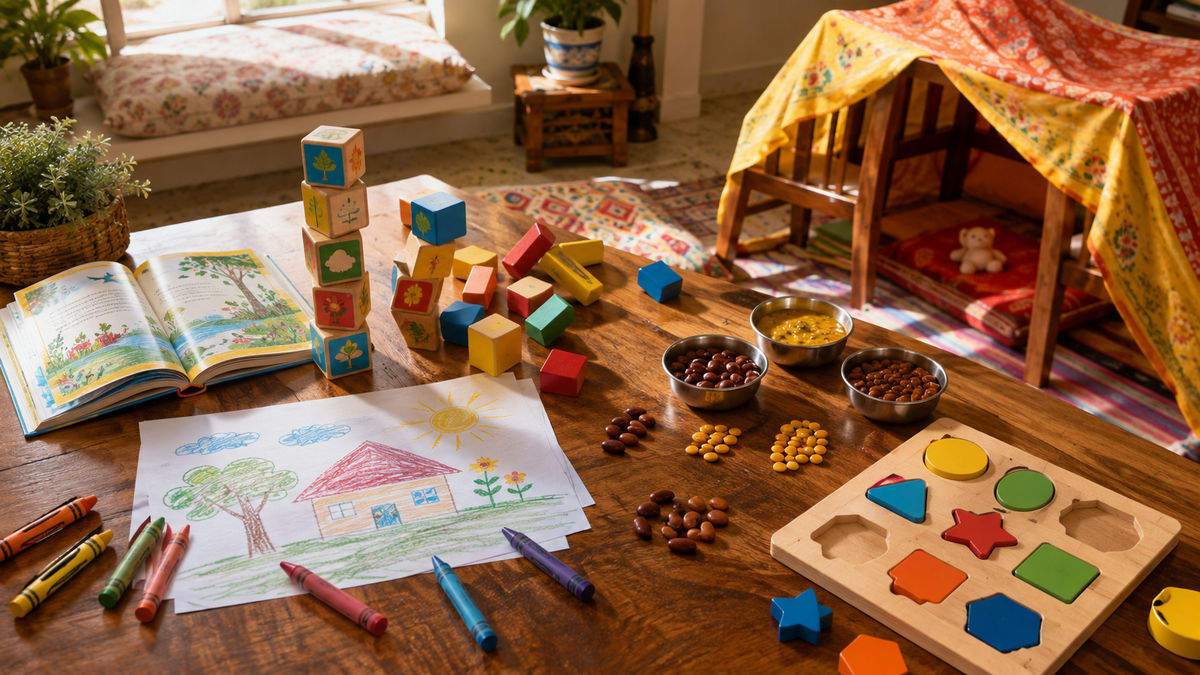
In the first year, babies learn mostly from responsive, face-to-face attention. Talking, holding, playing peek-a-boo and letting them explore safely does more than any toy or flashcard. You are your baby's best learning material.
⚡ In a hurry? Our quick picks

The first year can feel like it is all feeding, sleeping and nappies, with no "learning" in sight. In fact your baby is doing the fastest learning of their whole life. Their brain is forming connections at a staggering pace, and almost all of it is powered by the ordinary, loving things you already do. You do not need to teach, and you certainly do not need to buy anything. You just need to be present and responsive.
🏆 Quick comparison: our top picks
| Product | Award | Rating | Price | |
|---|---|---|---|---|
|
The Curious Bees - High Contrast New Born Anti-Glare Flash Cards | 36 Objects for Visual Stimulation, Cognitive & Sensory Development of 0-6 Month Old Infants
|
🏆 Editor's Choice | ★ 4.4 1,500 reviews |
₹283 | Check price → |
 Skillmatics Cloth Puppet Book - Old Macdonald Had a Farm, Finger Puppets Skillmatics Cloth Puppet Book - Old Macdonald Had a Farm, Finger Puppets
|
💰 Best Value | ★ 4.4 302 reviews |
₹796 | Check price → |
🛒 Our Top Picks
Best-reviewed overall, 4.4★ across 1,500 ratings.
The Curious Bees - High Contrast New Born Anti-Glare Flash Cards | 36 Objects for Visual Stimulation, Cognitive & Sensory Development of 0-6 Month Old Infants
- ✓ Why it fits: Guides structured talk-through-day activities with prompt images that encourage parent narration and language exposure.
* We earn a small commission — at no extra cost to you.
Top rating for the price, 4.4★ at ₹796.
Skillmatics Cloth Puppet Book - Old Macdonald Had a Farm, Finger Puppets
- ✓ Why it fits: Engages baby during peek-a-boo play and makes voices/sounds that build early language recognition.
* We earn a small commission — at no extra cost to you.
Daily baby tips, exclusive Amazon deals & real parent advice — free forever.
What's happening at this age
A newborn sees best at about 20 to 30 centimetres, roughly the distance to your face during a feed, and prefers faces to anything else. Over the year they learn to track moving things, reach and grasp, sit, babble, and understand that people and objects still exist when they cannot see them. India's National Curriculum Framework for the Foundational Stage treats these early years as home-based care built on warm relationships, not lessons. The World Health Organization recommends no screen time at all for children under one, and plenty of floor time and interaction instead.
Try this at home
Talk through your day
You need: just your voice.
How: narrate whatever you are doing, in your home language: "Now we pour the water, now we wash the katori." Pause after you speak so your baby can "reply" with a coo or gurgle, then respond as if it were a real turn.
What it builds: language, listening and the back-and-forth rhythm of conversation.
Tummy time with a target
You need: a firm mat and a bright spoon or cloth.
How: lay your baby on their tummy while awake and place a steel spoon or coloured dupatta just out of reach so they lift their head and stretch towards it. Start with a minute or two and build up.
What it builds: the neck, shoulder and back strength that later powers sitting and crawling.
Peek-a-boo
You need: a dupatta or your own hands.
How: hide your face, then reveal it with a happy "boo!". Later, hide a small toy under the cloth and bring it back.
What it builds: object permanence, the big idea that things still exist when they are out of sight.
Kitchen sounds
You need: a katori and a wooden spoon.
How: once your baby can sit and grasp, let them bang a katori. Try different vessels for different sounds and copy their rhythm back.
What it builds: cause and effect, and the joy of making something happen.
What "getting it" looks like
You will notice your baby turning to your voice, holding your gaze during a feed, reaching for a toy on purpose, passing an object from one hand to the other, and later looking for a toy you have hidden. Babbling that sounds almost like conversation, with rising and falling tone, is a wonderful sign that language is taking root.
When to move on, and when to ask
Every baby is different and the normal range is wide, so treat all of this as things to enjoy rather than a checklist to pass. Our milestone tracker covers the medical picture from 0 to 24 months. Talk to your paediatrician if your baby does not respond to sound, does not make eye contact, or is not using their hands or babbling by around the ages your doctor mentions at check-ups.
If you're homeschooling
For a baby, there is no separate "school" to plan. A gentle daily rhythm of feeds, floor play, singing, being carried and talked to, and plenty of rest is the entire curriculum. Keep screens away and keep yourself close.
📚 Reviewed against
This guide was checked against the sources below. It is general parenting guidance, not medical advice — for any concern about your child's development, talk to your paediatrician.
- National Curriculum Framework for the Foundational Stage (NCF-FS) 2022, NCERT — Home-based early care and development for ages 0-3
- WHO Guidelines on physical activity, sedentary behaviour and sleep for children under 5 years of age (2019) — No screen time under 1; interactive floor-based play recommended
- National Education Policy 2020, Ministry of Education — Foundational Stage principles
Last reviewed 03 Sep 2026
Frequently Asked Questions
Do flashcards help babies learn?
How much tummy time does a baby need?
Is screen time bad for babies under one?
My baby doesn't play with toys much. Is that a problem?
What is object permanence?
Which language should I speak to my baby?
Daily baby tips, exclusive Amazon deals & real parent advice — free forever.