
How Your Toddler Learns at 1-2: Walking, Words and Curiosity
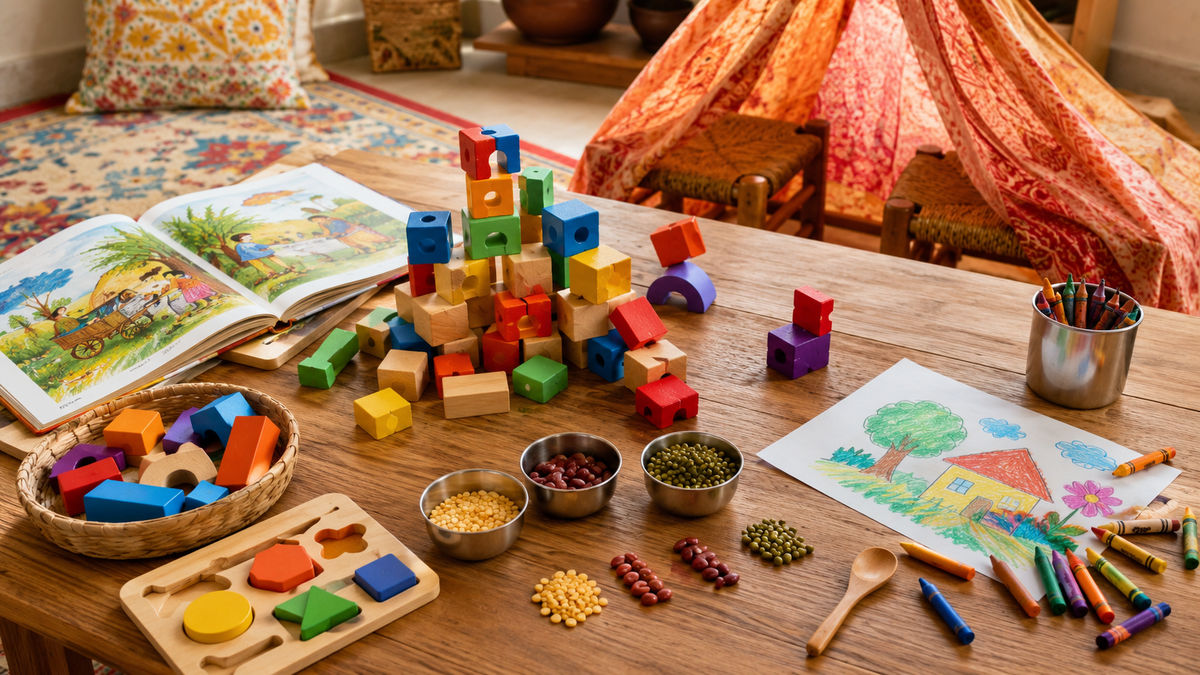
From one to two, toddlers learn through movement, imitation and constant hands-on exploration. Naming things, letting them help with real tasks, and giving them safe household objects to explore builds language and thinking far better than any electronic toy.
⚡ In a hurry? Our quick picks

The year from one to two is a whirlwind. Your child goes from wobbly first steps to confident walking, from a handful of words to dozens, and from watching you to copying everything you do. It can be exhausting, because a toddler learns by touching, tasting, dropping and climbing on absolutely everything. That mess is the learning. Your job is not to teach lessons but to keep them safe, talk to them constantly, and let them explore.
🏆 Quick comparison: our top picks
| Product | Award | Rating | Price | |
|---|---|---|---|---|
 Skillmatics Peek-a-Boo Jungle Book – Soft Cloth Baby Book Skillmatics Peek-a-Boo Jungle Book – Soft Cloth Baby Book
|
🏆 Editor's Choice | ★ 4.1 1,800 reviews |
₹899 | Check price → |
|
Chi-Chimpu Toyss Giraffe Hand Puppet 22 cm | Cute Animal Hand Puppet for Kids | Soft Plush Storytelling Puppet Toy | Interactive Pretend Play Puppet for Boys & Girls | Educational Learning
|
💰 Best Value | ★ 4.1 66 reviews |
₹281 | Check price → |
 Hide-and-Seek, Baby Shark! Doo Doo Doo Doo Doo Doo Hide-and-Seek, Baby Shark! Doo Doo Doo Doo Doo Doo
|
★ 4.7 437 reviews |
₹0 | Check price → |
🛒 Our Top Picks
Best-reviewed overall, 4.1★ across 1,800 ratings.
Skillmatics Peek-a-Boo Jungle Book – Soft Cloth Baby Book
- ✓ Why it fits: Builds vocabulary through sensory word association and responsive sounds during naming activities.
* We earn a small commission — at no extra cost to you.

Top rating for the price, 4.1★ at ₹281.
Chi-Chimpu Toyss Giraffe Hand Puppet 22 cm | Cute Animal Hand Puppet for Kids | Soft Plush Storytelling Puppet Toy | Interactive Pretend Play Puppet for Boys & Girls | Educational Learning
- ✓ Why it fits: Encourages conversation and word repetition through interactive puppet play during story activities.
* We earn a small commission — at no extra cost to you.
Hide-and-Seek, Baby Shark! Doo Doo Doo Doo Doo Doo
- ✓ Why it fits: Supports name-and-fetch language play with culturally familiar images and durable pages for 12-24 month handling.
* We earn a small commission — at no extra cost to you.
Daily baby tips, exclusive Amazon deals & real parent advice — free forever.
What's happening at this age
Toddlers at this stage are driven to move and to imitate. They point at what they want, follow simple instructions, and begin to understand that words stand for things. Putting objects in and out of containers, stacking and knocking down, and "helping" with chores are all serious cognitive work. India's Foundational Stage framework describes this as play-based, home-centred learning, and the WHO recommends at least three hours of active movement spread through the day and no more than a rare, brief bit of screen time for this age.
Try this at home
Name and fetch
You need: familiar household objects.
How: ask "can you bring me the spoon?" starting with things your toddler knows. Celebrate every attempt, even a wrong one, and name whatever they bring.
What it builds: vocabulary and the link between words and objects.
Katori nesting
You need: three different-sized katoris.
How: let your toddler stack and nest them, saying "big, medium, small" as they go.
What it builds: size, sequence and early maths thinking.
Atta dough play
You need: a little atta and water.
How: knead a small ball of dough together and let them poke, roll and squash it. There is no shape to make; the squishing is the point.
What it builds: hand strength and sensory exploration.
Let them help
You need: a real, safe chore.
How: let your toddler drop clothes into a bucket, carry an unbreakable vessel, or wipe a table. It will be slower and messier than doing it yourself.
What it builds: independence, coordination and a sense of belonging.
What "getting it" looks like
You will hear new words appearing week by week, see your toddler copy actions like sweeping or talking on the phone, watch them follow a simple instruction, and notice them showing you things they find interesting. Walking, climbing and carrying objects around are all signs of a busy, learning brain.
When to move on, and when to ask
Children vary enormously in when they walk and talk, so enjoy this rather than measuring it. For the medical view of milestones, use our milestone tracker. Mention it to your paediatrician if your toddler is not walking by around 18 months, has no clear words, or has stopped using skills they once had.
If you're homeschooling
A toddler needs no formal schooling. A predictable daily rhythm of meals, active play, being read to, helping with chores and plenty of rest is the whole plan. Follow their interests; a child who loves pouring water is doing real science.
📚 Reviewed against
This guide was checked against the sources below. It is general parenting guidance, not medical advice — for any concern about your child's development, talk to your paediatrician.
- National Curriculum Framework for the Foundational Stage (NCF-FS) 2022, NCERT — Play-based learning for young children
- WHO Guidelines on physical activity, sedentary behaviour and sleep for children under 5 years of age (2019) — Movement and screen-time guidance for 1-2 year olds
- National Education Policy 2020, Ministry of Education — Foundational Stage principles
Last reviewed 03 Sep 2026
Frequently Asked Questions
Why does my toddler put everything in their mouth?
How many words should a two-year-old have?
Are electronic learning toys worth it?
Is it okay to let my toddler help with chores?
How much screen time is okay at this age?
My toddler throws everything. Why?
Daily baby tips, exclusive Amazon deals & real parent advice — free forever.