
Learning at 2-3 Years: The Language Explosion and Play
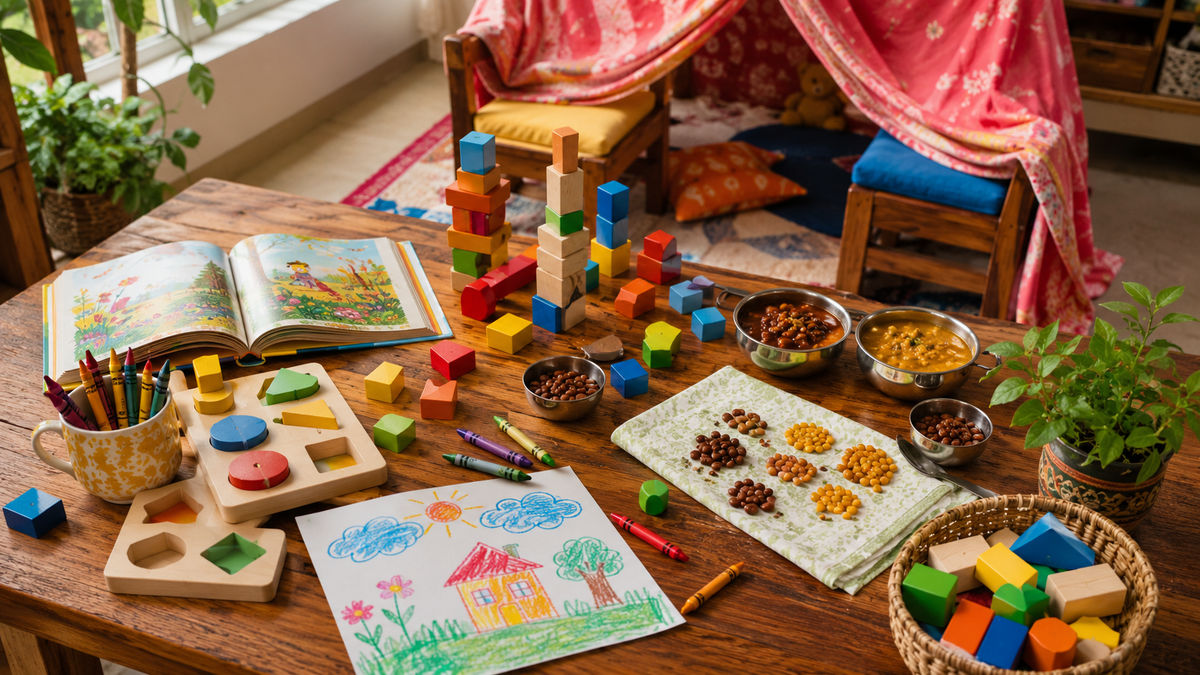
Between two and three, children learn through talking, pretend play and hands-on exploration. Rich conversation, sorting and counting real objects, and plenty of pretend play do far more than worksheets, which are not needed at this age.
The years around two and three are when your child truly becomes a little talker. Vocabulary can double in months, "why?" arrives and never leaves, and pretend play, feeding a doll, cooking in a toy kitchen, becoming a bus driver, becomes the main way they make sense of the world. This is exactly the play-based, activity-based learning that India's National Education Policy 2020 asks for in the years before formal school. There is no need to start worksheets; your kitchen and your conversation are the classroom.
Daily baby tips, exclusive Amazon deals & real parent advice — free forever.
What's happening at this age
Two to three year olds are building sentences, sorting and comparing, and beginning to understand quantity, sequence and simple rules. Pretend play lets them practise language, empathy and problem-solving all at once. NEP 2020 and NCF-FS 2022 both stress mother-tongue conversation, stories and play over early academics, and the WHO still advises keeping screen time to about an hour a day at most, with less being better.
Try this at home
Sort the dals
You need: two kinds of dal and two katoris.
How: mix a little of each dal on a plate and sort them into separate katoris, counting aloud as you go.
What it builds: sorting, counting and concentration, the roots of maths.
Story from a photo
You need: any family photo.
How: show a photo and ask "what is happening here?". Extend every answer with one more sentence and a question.
What it builds: storytelling, vocabulary and memory.
Sink or float
You need: a bucket of water and small safe objects.
How: at bath time, guess together whether a spoon, a leaf or a cup will sink or float, then test each one.
What it builds: early science thinking and prediction.
Rhyme of the day
You need: your voice.
How: sing one rhyme in your home language and clap on the words that rhyme.
What it builds: the sound awareness that later powers reading.
What "getting it" looks like
You will hear longer sentences and endless questions, see rich pretend play with toys and household objects, watch your child sort things by colour or size, and notice them enjoying the same story again and again. All of this is deep learning, even though none of it looks like a lesson.
When to move on, and when to ask
Children move through this stage at very different speeds, so follow your child's interest rather than a timetable. For the medical picture, see our milestone tracker. Speak to your paediatrician if by around three your child is not putting words together, is very hard to understand, or does not play pretend at all. Our guide on a two-year-old who isn't talking yet covers this in more detail.
If you're homeschooling
A gentle daily rhythm works well: outdoor play, a shared story, a hands-on activity like sorting or art, pretend play, and lots of conversation. Keep any "sit-down" time to a few minutes and keep it playful.
📚 Reviewed against
This guide was checked against the sources below. It is general parenting guidance, not medical advice — for any concern about your child's development, talk to your paediatrician.
- National Education Policy 2020, Ministry of Education — Play-based, mother-tongue Foundational Stage
- National Curriculum Framework for the Foundational Stage (NCF-FS) 2022, NCERT — Learning outcomes and pedagogy for early years
- WHO Guidelines on physical activity, sedentary behaviour and sleep for children under 5 years of age (2019) — Up to one hour of screen time for 2-4 year olds
Last reviewed 03 Sep 2026
Frequently Asked Questions
Should my 2-3 year old be doing worksheets?
How can I encourage talking?
Is pretend play actually learning?
How much screen time is okay for a two or three year old?
My child asks 'why' constantly. How should I respond?
Which language should we use at home?
Daily baby tips, exclusive Amazon deals & real parent advice — free forever.