
Learning at 3-5 at Home: The NEP Foundational Years
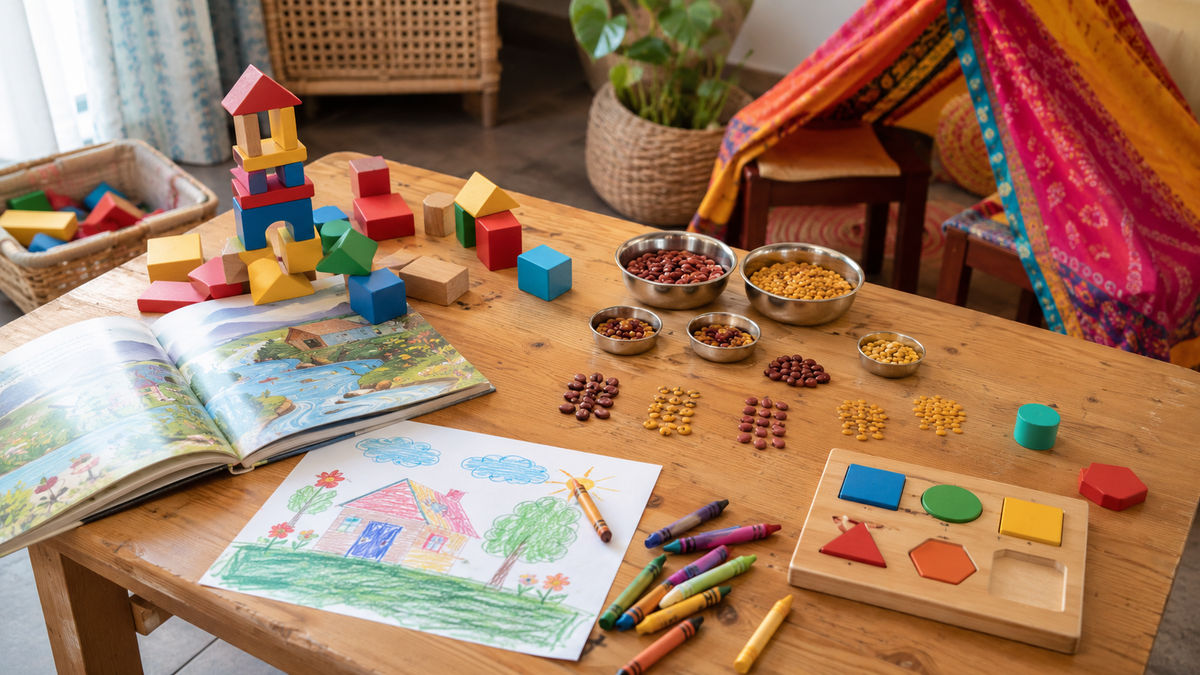
From three to five, children get ready for school through play, stories, real-life maths and growing independence, not through worksheets. NEP 2020 calls for exactly this play-based, activity-based approach, and it works just as well at home.
⚡ In a hurry? Our quick picks

![My First Big Book Boxset-Volume 1 (5 Books): A Pizza Box of 5 Large Font Illustrated Board Books on Alphabet, Numbers, Colors, Shapes & Transport | Vocabulary Builder for Preschool Kids, Toddlers I Perfect Gift Set I Ages 1+ [Select Learning]](https://m.media-amazon.com/images/I/71Fo3Wv+nrL._AC_UY218_.jpg)
Three to five is when many Indian children start nursery, LKG and UKG, and when parents feel the first pressure to "get them ahead" with writing drills and worksheets. Yet NEP 2020's Foundational Stage is deliberately built the other way: on play, stories, art, conversation and hands-on activity, with formal reading and writing kept light until around five or six. The good news is that everything schools should be doing, you can do at home with almost nothing.
🏆 Quick comparison: our top picks
| Product | Award | Rating | Price | |
|---|---|---|---|---|
|
My First Book of Patterns Pencil Control: Patterns Practice book for kids (Pattern Writing) |Best Selling Tracing Book for Kids in India | Early Learning | Tracing Lines & Pattern Writing Activities | Premium Quality Return Gift | Ages 2 - 5 Years | 1.5 h
|
🏆 Editor's Choice | ★ 4.4 34,000 reviews |
₹99 | Check price → |
|
My First Big Book Boxset-Volume 1 (5 Books): A Pizza Box of 5 Large Font Illustrated Board Books on Alphabet, Numbers, Colors, Shapes & Transport | Vocabulary Builder for Preschool Kids, Toddlers I Perfect Gift Set I Ages 1+ [Select Learning]
|
💰 Best Value | ★ 4.5 73 reviews |
₹405 | Check price → |
🛒 Our Top Picks
Best-reviewed overall, 4.4★ across 34,000 ratings.
My First Book of Patterns Pencil Control: Patterns Practice book for kids (Pattern Writing) |Best Selling Tracing Book for Kids in India | Early Learning | Tracing Lines & Pattern Writing Activities | Premium Quality Return Gift | Ages 2 - 5 Years | 1.5 h
- ✓ Why it fits: Enables letter hunt and pattern recognition skills central to NEP foundational learning.
* We earn a small commission — at no extra cost to you.
Top rating for the price, 4.5★ at ₹405.
My First Big Book Boxset-Volume 1 (5 Books): A Pizza Box of 5 Large Font Illustrated Board Books on Alphabet, Numbers, Colors, Shapes & Transport | Vocabulary Builder for Preschool Kids, Toddlers I Perfect Gift Set I Ages 1+ [Select Learning]
- ✓ Why it fits: Builds fine motor control through guided cutting, drawing, and matching tasks aligned with school-readiness.
* We earn a small commission — at no extra cost to you.
Daily baby tips, exclusive Amazon deals & real parent advice — free forever.
What's happening at this age
At this stage children speak in full sentences, tell stories, recognise some letters and numbers, count small groups, and grow more independent in dressing, eating and tidying. Their fine motor control is developing towards holding a pencil, but it is built through cutting, threading and play rather than tracing sheets. NEP 2020 and NCF-FS 2022 both frame this as the foundation for later literacy and numeracy, targeting reading and basic maths by Grade 3, not by nursery.
Try this at home
Letter hunt
You need: the world around you.
How: pick one letter, especially one from your child's name, and hunt for it on packets, signboards and number plates during the day.
What it builds: letter recognition and the idea that print is everywhere.
Set-the-table maths
You need: plates and spoons.
How: "we are four today, how many plates? How many spoons?" Let your child count out the right number.
What it builds: counting with meaning and one-to-one matching.
Cutting practice
You need: old paper and children's scissors.
How: draw thick lines on old paper and let your child cut along them, always supervised.
What it builds: the hand strength and control that later make writing easy.
Grow a dal
You need: a moong bean, cotton and a katori.
How: soak the bean on wet cotton and check it together each day, talking about what a plant needs.
What it builds: curiosity, observation and patience.
What "getting it" looks like
You will hear clear sentences and stories, see your child recognise letters in their name, watch them count out objects accurately, and notice them dressing and tidying with less help. A child who loves being read to and asks questions about the world is exactly on track.
When to move on, and when to ask
Try not to compare your child to others; the range is wide and pushing academics early can backfire. Our learning milestone checklist shows the behaviours to look for. Talk to your paediatrician if your child is very hard to understand, cannot follow simple instructions, or does not join in play with others. If sitting still to "study" is the worry, our guide on a four-year-old who won't sit and learn may help.
If you're homeschooling
A relaxed daily rhythm suits this age: outdoor play, a story, one hands-on activity, art or building, and a short, playful five to ten minutes of letters or numbers folded into real life. Follow your child's interests and keep it joyful; there is no syllabus to rush.
📚 Reviewed against
This guide was checked against the sources below. It is general parenting guidance, not medical advice — for any concern about your child's development, talk to your paediatrician.
- National Education Policy 2020, Ministry of Education — Foundational Stage: play-based, no early formal academics
- National Curriculum Framework for the Foundational Stage (NCF-FS) 2022, NCERT — Learning outcomes for ages 3-6
- WHO Guidelines on physical activity, sedentary behaviour and sleep for children under 5 years of age (2019) — Screen-time guidance for 3-4 year olds
Last reviewed 03 Sep 2026
Frequently Asked Questions
Should my child be writing and reading before starting school?
Are worksheets bad for a 4-year-old?
How do I build pencil grip?
What is school readiness, really?
My child mixes two languages. Is that a problem?
How much screen time is okay at 3-5?
Daily baby tips, exclusive Amazon deals & real parent advice — free forever.