
Teaching Colours at Home for 18-24 Month Toddlers: 4 Activities with Household Items
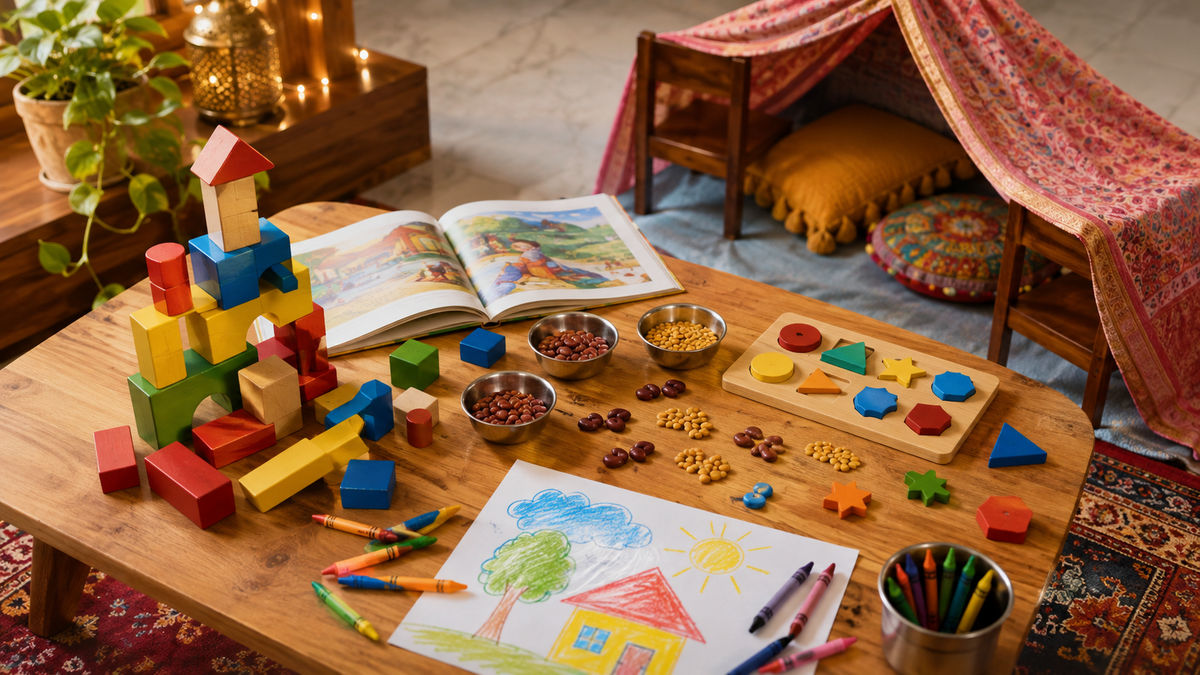
An 18-24 month toddler is ready to understand colour words when they start sorting objects by colour and pointing at familiar colours on request. You can teach colours using four household activities: sorting clothes by colour, colour treasure hunts around the room, naming fruit by its colour, and water play with food colouring—all in both English and Hindi/regional language to build dual-language vocabulary.
Between 18 and 24 months, your toddler's brain is wiring up for category understanding—the mental skill that lets them group things that belong together. Colour is one of the first visual categories they learn to name. This is also the age when receptive language (what they understand) races ahead of expressive language (what they say), so they might know red, blue and yellow long before they can say the words clearly. Teaching colours isn't about flashcards or expensive toys—it's about noticing colours together in daily life and using consistent, simple words in both English and your home language.
Daily baby tips, exclusive Amazon deals & real parent advice — free forever.
What's Happening at This Age
Between 18 and 24 months, your toddler is building what categorisation—the ability to group objects by a shared property, such as colour or shape. According to the National Education Policy (NEP) 2020, learning through sensory exploration and classification is one of the foundational early literacy and numeracy skills in this age group. Your child's eyes can now distinguish colours as well as an adult's, but their brain is still learning to notice colour as a label and remember that label consistently.
At this age, toddlers usually understand 10–50 words receptively (they know what you mean) but may only say 5–20 words expressive (they actually say them). This gap is completely normal. Your 18-month-old might understand "Where's the red dupatta?" and point to it correctly, but won't say "red" for another 6–12 months. Bilingual exposure (Hindi + English, or English + Tamil, Marathi, etc.) doesn't confuse this process—it strengthens categorisation because the child learns that the same colour has multiple names, which deepens understanding. By 24 months, many toddlers start naming colours spontaneously if they've heard colours named consistently during play.
Try This at Home
Activity 1: Colour-Sorting Clothing Game
You need: Clean laundry you're folding anyway—red dupatta, blue towel, white shirt, any single-colour items. A basket for each colour group (or just pile them separately on the floor).
How: Sit with your toddler and the pile of clean clothes. Hold up one item and name it: "Look, red dupatta. Red." Fold it and put it in the red pile. Hand your child the next red item and say, "Can you put the red towel here?" As they get the idea, mix colours: "Find another red one." Use both English and Hindi: "Laal—red. Neela—blue."
What it builds: Visual matching, colour vocabulary in two languages, fine motor control (folding), and the concept that one colour can appear on different objects.
Easier: Start with just two colours (red and blue). Harder: Once they're confident, add a third colour and ask them to sort while you narrate: "Where does the blue go?"
Activity 2: Colour Treasure Hunt Around the Room
You need: Your living room, kitchen, or bedroom. No materials needed.
How: Pick one colour—say, yellow. Say, "Let's find yellow things." Walk around the room together and point: "Yellow! The banana. Yellow. The cushion. Yellow." Let your child touch each item. Once they spot one, celebrate: "Yes! Yellow ball!" Do it again with a different colour (red, blue, green). Keep each hunt to 5–10 minutes so attention stays high.
What it builds: Colour recognition in context, spatial awareness, the understanding that one colour appears many places, and vocabulary linking colours to real objects.
Easier: Do one colour per day. Harder: Bring items back to a pile and ask, "Can you find something blue?" (without pointing first).
Activity 3: Fruit Naming by Colour
You need: Fruit bowl or fridge fruit—banana, apple, mango, papaya, or any coloured fruit you have. A small plate or katori.
How: Pick a fruit and name it with its colour: "This is a yellow banana. Yellow. Pila kela." Let your toddler touch it, smell it, feel the texture. Peel a small piece and offer a taste (if age-appropriate and you've introduced the fruit before). Do the same with another fruit: "Red apple. Red. Laal seb." Over days, they'll start linking the colour word to the fruit's appearance. Simple, real, and delicious.
What it builds: Colour vocabulary paired with taste, smell, and touch; understanding that colours have names; dual-language fluency around everyday objects.
Easier: Just show and name one fruit per day. Harder: Ask, "Can you find the yellow one?" when two fruits are in front of them.
Activity 4: Water Play with Food Colouring
You need: Two or three steel bowls (or plastic if you have them), water, food colouring (the kind from any kirana store), a jug or cup for pouring. Old towel underneath for spills.
How: Pour water into each bowl. Add one drop of food colouring (red, yellow, blue) to each bowl, one colour per bowl. Let your toddler watch the colour spread through the water. Say, "The water is red now. Red. Laal." Let them pour water from one bowl to another with a cup (messy, but sensory-rich), or dip their hands in (supervise). The colour change is mesmerising and helps them link the word "red" or "blue" to the visual change they're watching happen in real time.
What it builds: Colour recognition, cause-and-effect thinking (drop colour, water changes), vocabulary, and fine motor practice (pouring, squeezing).
Easier: Just add one colour and let them explore. Harder: Hide a toy in the bowl and say, "Find the toy in the blue water."
What 'Getting It' Looks Like
You'll know your toddler is understanding colours when they start pointing at coloured objects without being prompted—"Look, red!" Even if the word comes out as "reh" or "wed," they're connecting the colour word to the sight. They might also start pointing at colours in picture books or outside: "Neela cycle!" Another sign is sorting: when they group coloured items together without being asked, they're applying the category in their head. By 24 months, some toddlers name at least one colour spontaneously and can point to two colours on request. If they're not saying colour words yet, that's normal—understanding comes first, speaking comes later.
When to Move On, and When to Ask
Most toddlers are ready to expand to shape naming (circle, square) around 2 years, after they've got 3–4 colours solid. You can layer shapes into the activities—"red circle," "blue square"—without starting a whole new game. If your 24-month-old shows no interest in colours (doesn't point at or sort them after 2–3 months of regular play), or if they're not understanding spoken colour words at all, mention it at your next paediatrician visit. This usually isn't a concern, but it's worth checking, especially if they're also not following other simple one-step instructions ("Get your shoe"). Your paediatrician can rule out hearing or vision issues and advise next steps.
If You're Homeschooling
Fit colour activities into the rhythm you've already got: sort laundry every third day, treasure hunts once a week, fruit naming at meals, and water play once a week during bath or outdoor time. Colour learning doesn't need a separate lesson—it threads through everyday routines. Use both languages consistently so bilingual children build dual vocabulary naturally. Track which colours they understand and respond to, but don't test them formally; keep it playful.
What Paediatricians Say
The Indian Academy of Pediatrics (IAP) emphasises that language development at 18–24 months happens fastest through play-based, context-rich exposure rather than formal instruction. Toddlers learn colour names fastest when adults name colours during everyday activities—getting dressed, eating, playing—rather than during isolated teaching time. Bilingual exposure (English + Hindi or another Indian language) is associated with stronger categorisation skills, not delays, so using colour words in both languages supports rather than hinders learning.
- Receptive language (understanding) races ahead of expressive language (speaking) at this age—your child likely understands far more colours than they can say.
- Repetition across contexts is key—the same colour word paired with different objects (red dupatta, red apple, red ball) builds the category faster than seeing the same object repeatedly.
Quick FAQs
Can an 18-month-old learn colours? Yes. Most 18-month-olds understand the concept of colour as a category and can match colours (finding two red things) and follow simple colour instructions ("Find the blue ball"). Speaking colour words usually comes between 22–30 months.
How can I teach my toddler about colours? The most effective way is to name colours during everyday activities—while folding clothes, eating fruit, playing outside, or during water play. Pair the colour word with the object consistently, use both English and your home language, and keep it playful rather than formal.
What is the best way to teach colours to toddlers? Use real objects, not flashcards. Let them touch, explore, and play with coloured items. Repeat the colour word every time they see it. Play colour games (hunts, sorting) but keep sessions short (5–10 minutes). Use both languages if your family is bilingual.
At what age can children typically start identifying colours? Most toddlers can match colours correctly (finding two items of the same colour) by 18–20 months. Naming colours usually starts between 22–30 months, with red and yellow typically coming first, then blue and green.
Should I worry if my 24-month-old isn't naming colours yet? No, if they understand colour instructions ("Find the red one") and can sort or match colours. Expressive language (speaking) comes later than receptive language (understanding) at this age. Mention it to your paediatrician if they show no interest in colours at all or aren't following other simple instructions.
Does teaching colours in two languages confuse toddlers? No. Research shows bilingual children actually develop stronger categorisation skills because they learn that the same colour has multiple names, which deepens their understanding of what a colour is. Use colour words in both languages consistently during play.
📚 Reviewed against
This guide was checked against the sources below. It is general parenting guidance, not medical advice — for any concern about your child's development, talk to your paediatrician.
- National Education Policy 2020 – Early Childhood Care and Education (ECCE) — Foundational framework for sensory exploration and categorisation as core early learning skills for ages 3–6; referenced for 18–24 month developmental alignment.
- National Curriculum Framework for Foundational Stage (NCF-FS) 2022 — Details language development through play-based learning and bilingual exposure for toddlers; supports context-rich colour naming approach.
- Indian Academy of Pediatrics (IAP) – Developmental Milestones (2021 revised) — Standard reference for 18–24 month language and cognitive milestones; supports receptive vs. expressive language timing.
- WHO – Early Child Development: A Powerful Equaliser (2023) — Emphasises play-based, context-embedded learning as the most effective early language strategy; bilingual exposure supports, not delays, development.
- Gopnik, A., & Kuhl, P. – 'The Scientist in the Crib' Research (Peer-Reviewed) — Foundational research on how toddlers learn categories through real-world object exploration; supports household-item-based colour learning.
Last reviewed 18 Sep 2026
🛒 If you want to buy (optional)
Everything above works with what you already have at home. If you'd rather buy, these are the few things parents keep reaching for. Entirely optional — nothing on this page needs a purchase.
Food Colouring (Small Bottle Set)
Makes water-play colour activity more vivid and memorable; helps toddler link colour words to visual change in real time.
At home instead: Turmeric (yellow) or beetroot juice (red) mixed into water—safe if not ingested, creates natural colour.
Affiliate note: the Amazon links above may earn us a small commission, at no extra cost to you. It never changes what we recommend, and nothing on this page requires a purchase.
Frequently Asked Questions
Can an 18-month-old learn colours?
How can I teach my toddler about colours?
What is the best way to teach colours to toddlers?
At what age can children typically start identifying colours?
Should I worry if my 24-month-old isn't naming colours yet?
Does teaching colours in two languages confuse toddlers?
Daily baby tips, exclusive Amazon deals & real parent advice — free forever.