
Sensory Activities for 6–9 Month Babies at Home: Texture Play With Kitchen Items
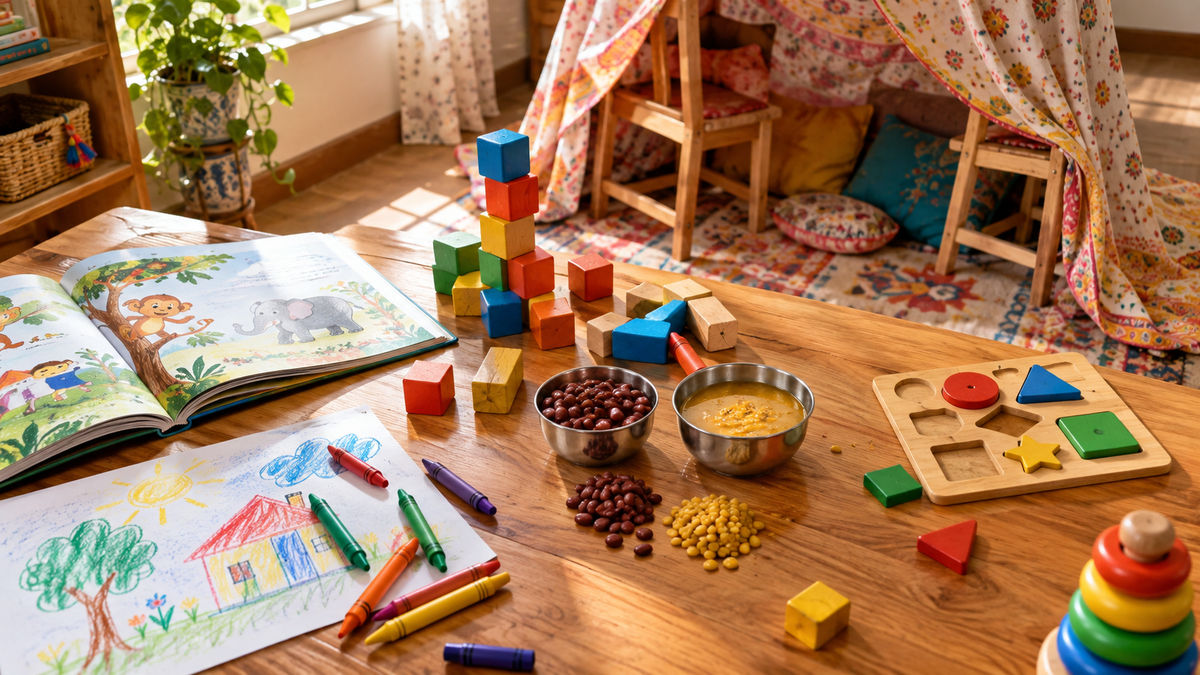
At 6–9 months, babies learn by touching. Steel bowls (cool, smooth), cotton duppatta (soft), wooden spoons (hard), wet sponge (squishy), and dry moong dal in sealed containers teach texture discrimination and hand control. Supervise always, avoid small loose pieces, and watch for mouthing milestones.
Between 6 and 9 months, your baby's brain is wiring up for touch. Not just feeling things randomly—but beginning to discriminate: this bowl is cold and hard, that cloth is warm and soft. This is happening right now while they sit, explore with their hands, and mouth everything in sight. That mouthing? It's not a bad habit. It's a sensory pathway to their growing brain.
Daily baby tips, exclusive Amazon deals & real parent advice — free forever.
The good news: you don't need to buy anything. Your kitchen and a bundle of cloth have everything your baby needs to build the neural pathways that will, eventually, separate from language, help them understand the physical world. This article is about five texture activities that fit into a sitting baby's day—no products, no Instagram setup, just real exploration that paediatricians quietly call tactile discrimination development: the ability to tell hard from soft, smooth from rough, and warm from cool through touch alone.
What's Happening at This Age
At 6 months, your baby began sitting with support. By 9 months, many babies can sit alone for short stretches. This shift—from lying down to upright—is massive for sensory learning. Their hands are suddenly free, their visual field expands, and their brain's somatosensory cortex (the region mapping touch sensations) is in a growth spurt.
According to India's National Early Childhood Care and Education Framework (NCF-FS 2022), sensory exploration during the sitting stage is essential for fine motor development and cognitive mapping. Babies at this age are also mouthing almost everything—not a phase to stop, but a primary sensory tool. The mouth has more sensory receptors than the hands and is still a safe way for them to gather texture information.
What you're watching for: reaching toward objects with intent, transferring things from one hand to the other, and bringing objects to the mouth deliberately (not just accidentally). These are signs their sensory circuits are lighting up.
Try This at Home
Steel Bowl Exploration: Cool and Smooth
You need: Two steel bowls (katori or larger mixing bowl), water tap nearby. That's it.
How: Sit your baby on a mat or in your lap. Place one steel bowl in front of them. Let them touch it, mouth the rim, and explore the inside. If they're interested, fill the other bowl with cool water (test it on your wrist first—lukewarm at most) and let them dip a finger in. Watch them notice the temperature change.
What it builds: Temperature and texture discrimination. Steel conducts heat quickly, so babies feel the coolness distinctly. The smooth surface teaches them that 'smooth' has a specific feel—preparing neural pathways for understanding material properties.
Easier: Just the dry bowl. Harder: Bowl with a little water, exploring floating cloth or sponge pieces inside.
Cotton Dupatta Softness: Texture Contrast
You need: An old cotton dupatta, saree, or soft cloth (worn clean). One steel bowl from above.
How: Drape the cloth loosely over the steel bowl so your baby sees both. Let them touch the cloth, press it into the bowl, scrunch it, and mouth it. Then guide their hand back to the steel bowl beneath. Repeat the contrast a few times: soft cloth, hard bowl, soft cloth, hard bowl.
What it builds: Texture comparison and hand-brain mapping. By repeatedly contrasting soft against hard, their somatosensory cortex begins to code these as distinct categories—a foundational step before language names them 'soft' and 'hard'.
Easier: Just the cloth, no contrast. Harder: Introduce three textures (cloth, steel, wooden spoon—see below) in sequence.
Wooden Spoon: Hard and Purposeful
You need: One wooden spoon (dal ka chamcha) from your kitchen, clean and dry.
How: Sit with your baby and hand them the wooden spoon. Let them mouth it, tap it against the steel bowl to create sound (yes, it's loud—that's the learning), and explore the handle and head separately. You can also let them feel the spoon against their cheek and forehead to introduce temperature and texture variation on different body parts.
What it builds: Hard-texture memory and cause-and-effect understanding. Tapping the spoon against the bowl creates immediate auditory feedback, linking sound to action—an early link between sensory input and motor output.
Easier: Just holding and mouthing. Harder: Let them 'stir' an empty bowl with your hand guiding theirs.
Wet Sponge: Squishy and Temperature-Aware
You need: One new kitchen sponge (never used for harsh scrubbing), wet with cool water and wrung out so it's not dripping.
How: Place the wet sponge in their hands. Watch them squeeze it, mouth it, and feel the water. Let them press it against the steel bowl and feel the difference between the sponge and the metal. You can gently guide their fingers to squeeze and release, teaching them the connection between their grip and the sponge's response.
What it builds: Moisture discrimination and pressure-response learning. Squeezing a wet sponge teaches cause-and-effect at a tactile level: grip harder, water comes out more. This builds hand-strength awareness and fine motor control.
Easier: Dry sponge first. Harder: Alternate wet and dry sponges so they feel the contrast.
Moong Dal in a Sealed Container: Grainy and Noisy
You need: A clean plastic container with a secure, childproof lid. Fill it halfway with dry moong dal. Shake it to test—it should make a gentle rattling sound, and the lid must not come loose under baby pressure.
How: Sit your baby on a mat with the sealed container in front of them. They can shake it, roll it, and feel the grains shifting inside without ever accessing the loose dal. The sound is the primary sensory input here—texture comes from feeling the container's surface vibrate as they move it.
What it builds: Auditory-tactile linkage. The vibration they feel in their hands connects to the sound they hear, building neural pathways that integrate multiple senses at once.
⚠️ Safety critical: The lid must be completely sealed and unbreakable. Never offer loose dal—choking risk is real at this age.
Easier: Empty plastic container they can mouth. Harder: Two sealed containers with different contents (dal in one, dry rice in another) to compare sounds.
What 'Getting It' Looks Like
You're not looking for perfection or specific outcomes. Watch for these signs that exploration is happening:
- Reaching deliberately toward a texture, not accidental contact.
- Transferring objects hand-to-hand and mouthing them with clear intention.
- Noticing when textures change—pausing or refocusing when you introduce a new object.
- Repeating actions (squeezing, tapping, rubbing) that create sensation or sound.
- Pulling hands away from something too hot or uncomfortable (protective response).
By 9 months, many babies also begin to understand that different textures belong to different objects and places—steel is on the bowl, softness is on the cloth. This categorization is silent brain work happening right now.
When to Move On, and When to Ask
By 10 months, most babies begin to lose interest in pure texture exploration and shift toward object permanence games and cause-and-effect play. If your baby still isn't reaching or mouthing intentionally by 8 months, or if they avoid certain textures despite repeated exposure, a chat with your paediatrician is worthwhile—not alarming, just a quick check-in. Similarly, if your baby is extremely averse to mouthing by 9 months (all objects rejected), mention it at the next visit. These are developmental variations, not deficits, but early attention is always wise.
If You're Homeschooling
Texture play fits naturally into a weekly rhythm. Dedicate one weekday morning (say, Tuesday) to 15 minutes of texture exploration while your older child does independent reading. Rotate textures weekly: Week 1 is steel and cloth. Week 2 introduces wood and sponge. Week 3 brings back contrasts. This rhythm keeps the activity fresh and gives your baby's brain time to consolidate each texture before moving on.
What Paediatricians Say
The Indian Academy of Pediatrics (IAP) affirms that unsupervised mouthing of safe objects is developmentally normal and essential for sensory mapping between 6 and 12 months. Paediatricians recommend ensuring all objects are clean, too large to fit entirely in the mouth (larger than a toilet paper tube), and free of small detachable parts. Texture variety during this window supports cognitive development and hand-eye coordination milestones.
- Safe mouthing: Steel, wood, cotton, natural sponge—all fine if clean and large enough.
- Watch for: Loose dal, small beads, or thin plastic that can separate.
📚 Reviewed against
This guide was checked against the sources below. It is general parenting guidance, not medical advice — for any concern about your child's development, talk to your paediatrician.
- National Early Childhood Care and Education Framework (NCF-FS 2022) — Outlines sensory exploration milestones and fine motor development stages for infants 6–12 months.
- Indian Academy of Pediatrics (IAP) – Developmental Milestones and Safety Guidelines — Recommends supervised mouthing as safe and necessary for sensory development; provides choking prevention standards.
- WHO Guidelines on Early Child Development — Confirms tactile discrimination and sensory mapping as core developmental competencies between 6 and 12 months.
- Developmental Psychology: Infancy and Early Childhood (peer-reviewed) — Somatosensory cortex development and texture discrimination learning in sitting-stage infants.
Last reviewed 16 Sep 2026
🛒 If you want to buy (optional)
Everything above works with what you already have at home. If you'd rather buy, these are the few things parents keep reaching for. Entirely optional — nothing on this page needs a purchase.
Food-Grade Silicone Sponge (optional upgrade)
More durable and easier to clean than natural sponges; gentle on gums. The household alternative is a new natural kitchen sponge, wrung out.
At home instead: New kitchen sponge, food-safe, wrung dry
Affiliate note: the Amazon links above may earn us a small commission, at no extra cost to you. It never changes what we recommend, and nothing on this page requires a purchase.
Frequently Asked Questions
What are some good sensory activities for a 6-month-old baby?
What are some good sensory activities for a 9-month-old baby?
What are some ideas for sensory play at home for babies?
What are some examples of sensory activities for babies?
Is mouthing objects at 6–9 months normal and safe?
When should I introduce more complex sensory activities?
Daily baby tips, exclusive Amazon deals & real parent advice — free forever.