
Teaching Colours to 2-3 Year Olds: 5 Sorting Activities That Work at Home
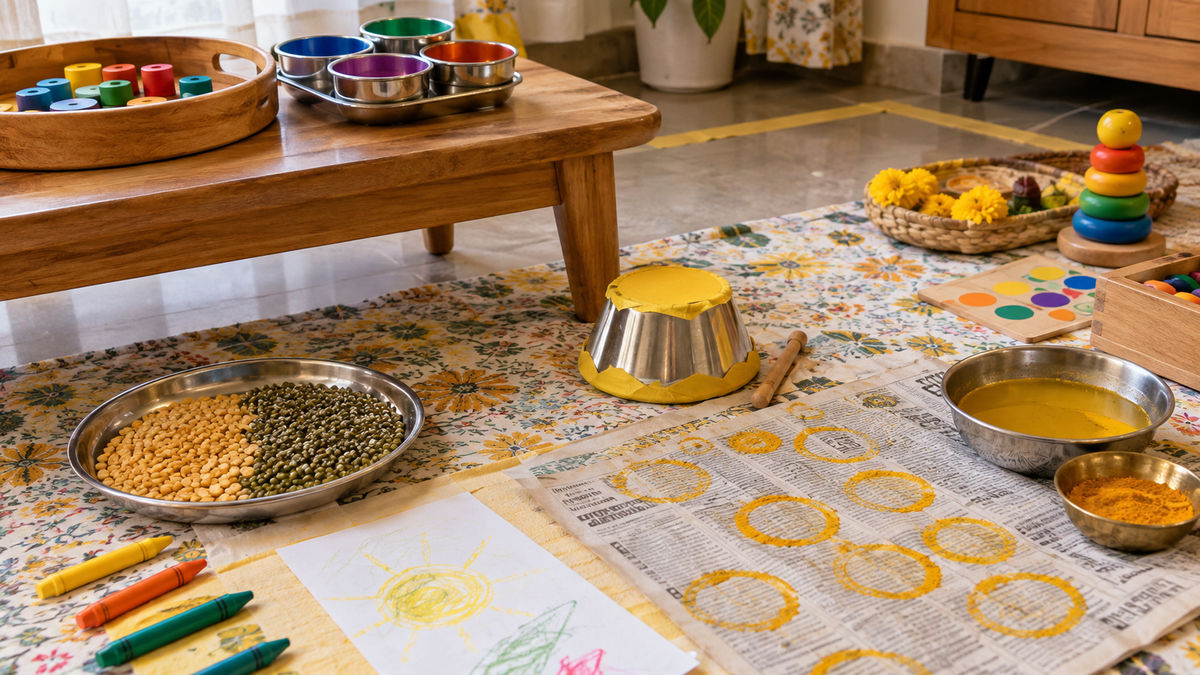
Toddlers learn colours through sorting and matching real objects, not flashcards. Start with red, blue, yellow, and green. Use household items—dal, laundry, katoris—to build recognition first; naming comes naturally after. Five activities: item collection, laundry sorting, pulse sorting, stacked containers, and nature walks.
Your 2-year-old brings you a blue pen and a red dupatta, then looks confused when you ask him to point to "the blue one." It's not laziness or poor memory—his brain is still sorting visual information through touch and movement, not labels. Colour activities for 2-3 year olds work best when they involve sorting, matching, and hands-on manipulation, not rote memorisation or abstract worksheets.
Daily baby tips, exclusive Amazon deals & real parent advice — free forever.
According to the National Curriculum Framework for Foundation Stage (NCF-FS 2022), toddlers in this age group develop visual discrimination through sensory exploration: the ability to notice, group, and categorise objects by observable features. Colour recognition is one of the earliest of these skills, but it builds from sorting ("put all red things here") to matching ("find another one like this") to naming ("this is red"). Most parents skip straight to naming, then wonder why their child doesn't seem to "get it."
What's happening at this age
Between 2 and 3 years, your child's visual cortex is rapidly connecting colour perception to memory and fine motor control. This is the sweet spot for colour learning—not through instruction, but through repeated, playful sorting of real objects.
Two-year-olds typically recognise and group two primary colours (often red and blue) by age 24 months. By 3 years, most children can sort or match three to four colours (red, blue, yellow, green) and are beginning to name them—though naming often lags 2-3 months behind recognition. This is normal development, not a sign of delay. Importantly, children this age learn through concrete experience: they need to touch, manipulate, and see objects change position. Abstract worksheets or pointing tasks bore them and teach nothing.
The National Education Policy (NEP 2020) emphasises that foundational learning at this stage should be play-based and sensory-rich. Colour sorting fits this perfectly: it combines visual learning, fine motor practice, and practical life skills in one activity.
Try this at home
1. Collect Red, Blue, and Yellow Items from Around the House
You need: Items you already own—a red dupatta, blue cushion cover, yellow dal container, red pen, blue shirt, yellow spoon. Gather 5–6 items in each colour.
How: Sit with your child and say, "Let's find all the red things." Pick up the dupatta, name it ("Red dupatta"), and place it on a cloth or tray. Invite your child to find another red thing. Don't correct if he picks something orange or pink—he's learning the spectrum. After 5–8 items, pause. The next day, do the same with blue. After a week, mix two colours and sort together.
What it builds: Real-world colour association, vocabulary in context, and the habit of noticing colour in everyday life.
Easier: Start with just two colours, and pick very different shades (bright red vs. bright blue). Harder: Mix in similar shades (red vs. orange, blue vs. purple) and let him experiment with "close but not quite."
2. Sort Laundry by Colour into Three Baskets
You need: Clean laundry (whites, darks, colours), three baskets or cloth bags, and 10 minutes before fold time.
How: Pull out a white item (a t-shirt), place it in the white basket, and say, "This white one goes here." Hand your child a piece and guide his hand into the right basket. Let him drop it. Repeat with darks and colours. Don't expect sorting perfection—a pink shirt in the "colours" basket is close enough. He'll begin to see the pattern: whites together, darks together, colours together.
What it builds: Fine motor control, colour grouping logic, and a real household responsibility that makes the learning functional.
Easier: Use just two baskets (lights and darks) and larger items like pillow covers. Harder: Add a fourth basket for pastels and let him decide where borderline items go.
3. Sort Dried Pulses by Colour on a Plate or Tray
You need: A mix of dried lentils—moong (green), rajma (red), chana (yellow), and masoor (orange-red). A large plate or tray. Four small katoris or bowls.
How: Scatter a handful of mixed pulses on the plate. Point to a green moong and say, "Green moong goes here," placing it in one katori. Hand your child a pulse and ask, "Where does this one go?" Let him drop it. This activity combines fine motor precision (using fingers to pick up small objects) with visual sorting and tactile feedback. The weight and texture of each pulse adds sensory richness.
What it builds: Pincer grip (thumb and forefinger control), visual discrimination of similar but distinct colours, and concentration.
Easier: Use just two colours of pulses and two katoris. Harder: Time him loosely ("Can you finish before the song ends?") or add a fifth colour, like black urad.
4. Stack Katoris and Containers by Colour
You need: Plastic or steel katoris in four colours—red, blue, yellow, green. Ensure they nest or stack safely without sharp edges.
How: Show your child how to stack the red katori inside another red one, then place it on the table. Say, "Red on red." Invite him to do the same with blue on blue. This teaches exact colour matching and hand-eye coordination as he judges whether one katori will fit inside another. Once he's comfortable, introduce a pattern: "Red, then blue, then red."
What it builds: Colour matching precision, spatial reasoning, and fine motor control through placement and pressure adjustment.
Easier: Use just two colours and larger, lightweight containers. Harder: Create alternating patterns (red-blue-red-blue) or ask him to remember a sequence after you hide one container.
5. Nature Walk: Find Green, Brown, and Yellow
You need: A park, garden, or tree-lined street. A small basket or cloth bag. 15 minutes.
How: Before the walk, say, "Today we're looking for green leaves." Point to a few and let your child collect one or two. Then shift: "Now find something brown." Gather a small twig or dried leaf. Move to yellow (a flower, if in season). Back home, lay out the collected items on a sheet and sort them by colour. This adds real-world, seasonal context to colour learning.
What it builds: Colour recognition in nature (not just in the home), gross motor activity, and observation skills.
Easier: Focus on just one colour per walk. Harder: Introduce secondary colours—orange flowers, dark green vs. light green leaves—and ask him to find "the brightest green."
What 'getting it' looks like
Your child doesn't need to say "blue" perfectly to show he understands colour. Watch for these signs: he sorts two items of the same colour into a pile without prompting; he picks a red pen when you ask for "something red" (even if he can't name it); he notices and points out colours in his environment ("Red car!"); he corrects you gently when you mislabel ("No, green"). These are stronger proof of learning than a perfect verbal answer.
When to move on, and when to ask
By age 3, most children recognise and can sort four primary colours reliably. If your child is still not grouping colours by 3.5 years, or if he shows no interest in visual sorting games, mention it at the next paediatrician visit—not out of alarm, but to rule out colour blindness or visual processing differences that can be identified early. Colour blindness affects roughly 1 in 12 boys and 1 in 200 girls and is manageable with awareness and adapted teaching. Talk to your paediatrician if your child consistently avoids visual tasks or seems to have trouble following moving objects.
If you're homeschooling
Weave colour sorting into your weekly rhythm: Monday's laundry sort, Wednesday's pulse sorting during dal prep, Friday's nature walk. These aren't "lessons"—they're life. Spend 5–10 minutes, no more. Consistency matters far more than duration. Over 8–12 weeks, your child will move from sorting to matching to naming without effort.
What Paediatricians Say
The Indian Academy of Paediatrics (IAP) notes that colour recognition develops alongside fine motor skills and is strengthened through sensory play rather than formal instruction. Sorting and matching activities are recommended as foundational learning tools because they activate multiple areas of the brain—visual cortex, motor planning, and memory—simultaneously. If a child shows no interest in sorting or grouping activities by age 3, or struggles with visual tracking, early assessment by a developmental paediatrician is helpful.
📚 Reviewed against
This guide was checked against the sources below. It is general parenting guidance, not medical advice — for any concern about your child's development, talk to your paediatrician.
- National Curriculum Framework for Foundation Stage (NCF-FS 2022), NCERT — Framework for early learning in India; defines sensory exploration and visual discrimination as core competencies for ages 2–3.
- National Education Policy (NEP 2020), Ministry of Education, Government of India — Policy emphasising play-based, sensory-rich learning in foundational stages.
- Indian Academy of Paediatrics (IAP) Developmental Milestones Guidelines — Reference for colour recognition and visual processing milestones in Indian children.
- WHO Early Childhood Development Standards — Global reference for developmental norms; colour sorting aligns with fine motor and cognitive milestones for age 2–3.
- Colour Blindness in Children: Detection and Management, Pediatric Ophthalmology Review — Reference for understanding colour vision deficiency prevalence and early identification in toddlers.
Last reviewed 21 Sep 2026
Frequently Asked Questions
At what age should my child start learning colours?
Why don't flashcards or worksheets work for this age?
My 2.5-year-old can name colours but won't sort them. Is this normal?
How many colours should a 2-year-old learn at once?
What if my child mixes up red and orange, or blue and purple?
Can colour sorting help with fine motor skills, or is it only for colour learning?
Daily baby tips, exclusive Amazon deals & real parent advice — free forever.