
Build Number Sense in Babies 0–12 Months: 4 Early Numeracy Activities Using Rhythm & Repetition
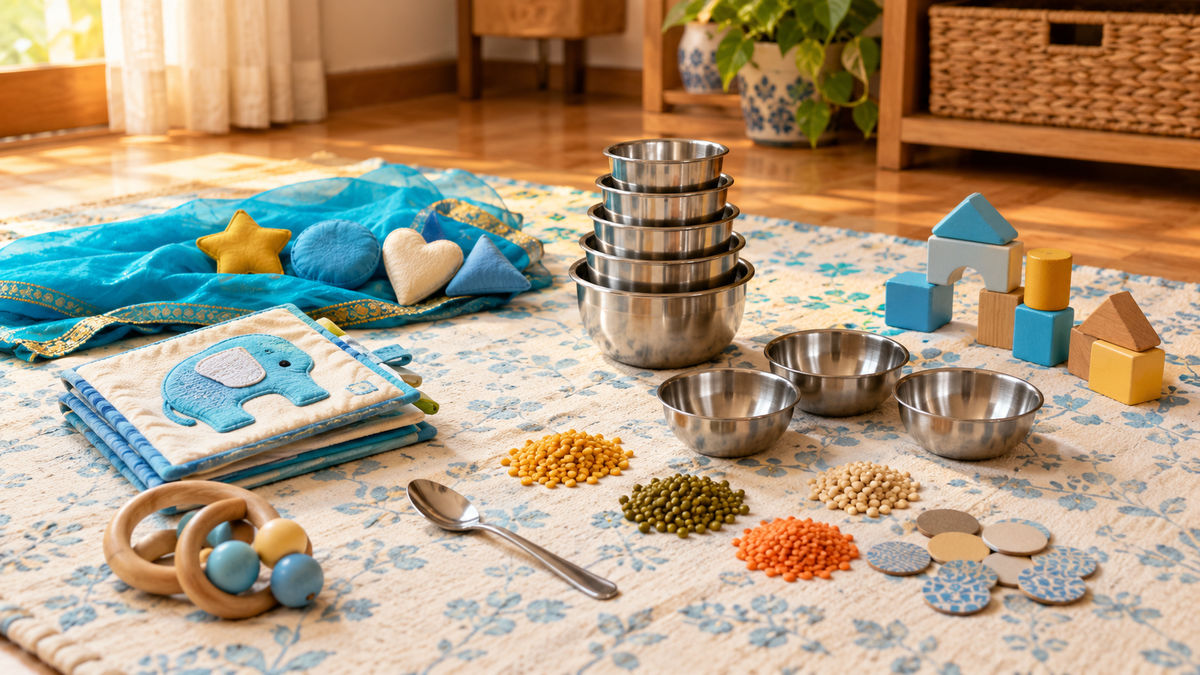
Babies don't learn numbers from flashcards—they learn through rhythm, repetition, and touch. Clapping patterns, counting toes during nappy changes, stacking bowls while saying numbers aloud, and drumming spoons on steel plates introduce sequence and quantity concepts naturally between birth and 12 months, building the brain's foundational math circuits.
Most parents think numeracy starts with flashcards at age three. Wrong. Early numeracy skills: the ability to understand quantity, sequence, and pattern—are developing right now, from birth onwards. According to the National Curriculum Framework for Foundational Stage (NCF-FS 2022), infants build these pre-math concepts through sensory exploration, rhythm, and repetition long before they can count. Your baby doesn't need a toy; they need your voice, a steel bowl, and your toes.
Daily baby tips, exclusive Amazon deals & real parent advice — free forever.
What's Happening at This Age
Between birth and 12 months, your baby's brain is wiring itself for number sense. In the first three months, newborns can notice differences between small quantities—they prefer looking at three dots over two. By six months, babies are learning cause and effect: they clap, something happens, they clap again. By nine months, they're tracking repetition and beginning to anticipate patterns ("Mummy claps three times, then I clap once").
The Indian Academy of Pediatrics (IAP) emphasizes that this early learning happens through multi-sensory input—sound, touch, and movement together. Rhythm is a language babies understand before words. When you clap a pattern and your baby watches your hands, their brain is building neural pathways for sequencing. When you count your baby's toes slowly during a nappy change, you're anchoring the word "one, two, three" to a physical sensation they can feel. This isn't academic; it's how the infant brain naturally learns.
Try This at Home
Activity 1: Clapping Rhythms (1–2–3 Claps)
You need: Your hands, your voice, and nothing else.
How: Sit facing your baby on a mat or bed. Clap your hands slowly three times while saying "one, two, three" aloud. Pause. Do it again. After a few repetitions, let your baby watch as you slow down and exaggerate each clap. By six months, many babies will start to open and close their fists in imitation. By nine months, some will clap along. That's the brain learning sequence.
What it builds: Rhythm recognition, anticipation of sequence, hand-eye coordination, and the auditory foundation for counting.
Easier: Just clap once slowly and wait for your baby to react. Harder: Clap two different rhythms—three fast claps, then two slow claps—and see if your baby notices the change.
Activity 2: Stacking and Counting (Steel Katoris)
You need: Three to five steel bowls or katoris of different sizes, a clean floor or mat.
How: At around six months, when your baby can sit, give them one katori to hold. As they play, slowly stack two katoris in front of them while saying "one, two." After a few weeks, add a third and say "one, two, three." Let them knock them down. This teaches cause-and-effect and introduces the sequence of numbers tied to visible objects.
What it builds: One-to-one correspondence (the idea that each number word matches one object), spatial awareness, and the concept of "more" and "less."
Easier: Just let your baby bang one katori on the floor and listen to the sound. Harder: Stack the katoris and ask your baby to knock down "two" or "three"—don't expect an answer, just watch if they understand.
Activity 3: Toe-Counting During Nappy Changes
You need: Your baby's feet (always available) and your voice.
How: During every nappy change, gently touch each of your baby's toes one at a time while saying "one, two, three, four, five." Do it slowly. Pause on each toe. Babies love this because it's playful, rhythmic, and it feels good. By nine months, your baby will anticipate the routine and might giggle or try to wiggle their toes in sync. Repeat this daily—consistency is everything for infants.
What it builds: Understanding of number sequence, body awareness, and the strong connection between counting words and physical touch (which is how young children naturally learn).
Easier: Just touch the toes without counting—let the touch be the focus. Harder: After counting once, count backward: "five, four, three, two, one." Your baby won't understand the direction yet, but they're hearing a different pattern.
Activity 4: Spoon-Drumming on Steel Thali
You need: One steel spoon and one steel thali (dinner plate), placed safely on a low table or mat.
How: From about seven months onward (when your baby can sit and grasp intentionally), let them hold a spoon and tap it on a steel plate. The sound is loud, clear, and instantly reinforcing—babies love it. You tap three times slowly while saying "one, two, three." Then let your baby try. The repetition of the action plus the immediate sound feedback is powerfully engaging. This teaches cause-and-effect and rhythm simultaneously.
What it builds: Rhythm recognition, cause-and-effect understanding, fine motor control, and auditory pattern learning.
Easier: Just let your baby bang freely without counting—the sound is the reward. Harder: Tap a rhythm (tap-tap, pause, tap-tap) and see if your baby copies the pattern.
What "Getting It" Looks Like
Don't expect your six-month-old to count or understand "three" as an abstract number. Instead, watch for these observable behaviours: your baby anticipates the clapping rhythm and opens their hands before you clap. They knock down the stacked katoris deliberately after watching you build them. They giggle or wiggle their toes in advance when they see you reaching for their feet during a nappy change. They deliberately tap the spoon on the thali and look at you for your reaction. These are signs their brain is connecting the rhythm, the repetition, and the reward.
When to Move On, and When to Ask
By 12 months, your baby should be showing interest in repetition and anticipating familiar patterns. If your baby seems uninterested in sounds, rhythms, or repetitive play by ten months, or if they're not responding to their name by 12 months, mention it to your paediatrician—this can be a sign of developmental delays in auditory processing or attention. Most babies naturally progress; there's no hurry. Every baby is different, and the goal is joyful repetition, not milestone anxiety.
If You're Homeschooling
Early numeracy activities for infants under one fit naturally into daily routines, not scheduled lessons. Weave clapping rhythms into playtime three or four times a week. Count toes at every nappy change. Leave the katoris and spoon accessible during floor play. The repetition happens naturally across the week—consistency matters more than intensity.
What Paediatricians Say
The Indian Academy of Pediatrics emphasises that infants build mathematical thinking through sensory-motor play and rhythm, not formal instruction. Repetition in familiar, joyful routines—like counting toes or clapping patterns—strengthens the neural pathways underlying number sense, setting the stage for later formal maths learning at age three and beyond.
📚 Reviewed against
This guide was checked against the sources below. It is general parenting guidance, not medical advice — for any concern about your child's development, talk to your paediatrician.
- National Curriculum Framework for Foundational Stage (NCF-FS 2022), Ministry of Education, Government of India — Official framework defining early learning outcomes including mathematical thinking and numeracy in infants and young children.
- Indian Academy of Pediatrics (IAP) Developmental Milestones and Guidelines — IAP guidelines on sensory-motor development and auditory learning in infants 0–12 months.
- WHO Early Childhood Development: Physical, Cognitive, and Socio-Emotional Development — WHO framework on infant cognitive and sensory development, including rhythm and pattern recognition.
- National Education Policy (NEP 2020) – Foundational Literacy and Numeracy — Government of India's policy on foundational numeracy skills development beginning from infancy.
- Dehaene, S. 'The Number Sense: How the Mind Creates Mathematics' (2011) – Cognitive Science of Number Development — Evidence on how infants develop quantity recognition and numerical cognition through sensory input and repetition.
Last reviewed 20 Sep 2026
🛒 If you want to buy (optional)
Everything above works with what you already have at home. If you'd rather buy, these are the few things parents keep reaching for. Entirely optional — nothing on this page needs a purchase.
Steel Katoris (Set of 5, Stainless Steel)
Different sizes teach visual comparison and stacking skill; steel is safe, durable, and already in most Indian homes.
At home instead: Use any bowls or cups you already own—no purchase needed.
Affiliate note: the Amazon links above may earn us a small commission, at no extra cost to you. It never changes what we recommend, and nothing on this page requires a purchase.
Frequently Asked Questions
What are early numeracy skills?
What are some activities for infants between 0 and 12 months old?
How do babies learn numbers before they can talk?
Can I teach numeracy to a newborn?
What household items can I use for early numeracy activities?
When should I be concerned if my baby isn't responding to rhythms?
Daily baby tips, exclusive Amazon deals & real parent advice — free forever.