
Early Math Activities for Babies 0-12 Months: Building Number Sense Through Rhythm and Pattern
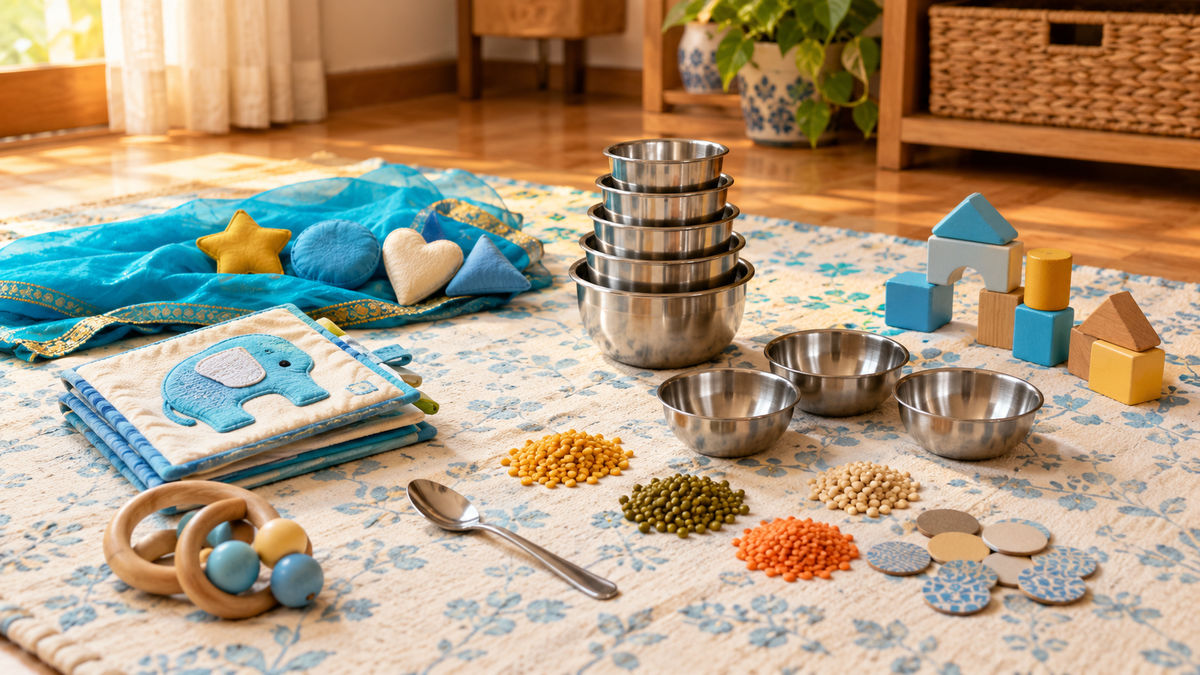
Babies 0-12 months don't learn symbolic numbers yet, but they build the foundation for math through repeated patterns and one-to-one correspondence. Tap out rhythms on steel spoons, sort cotton swabs into groups, transfer rice one-by-one between containers, and clap counting songs. These activities wire the brain for quantity awareness before numerals make sense.
⚡ In a hurry? Our quick picks

When you mention "math" to parents of babies under 1 year, the usual response is a laugh—aren't they too young? The honest answer is: yes, they're too young for numbers and symbols. But they're not too young for the bedrock skills that math rests on. Every time you sing "two hands, two feet, one nose" and point to each, your baby is learning one-to-one correspondence—the idea that one object matches one count, one finger, one clap. That's the real beginning of numeracy.
🏆 Quick comparison: our top picks
| Product | Award | Rating | Price | |
|---|---|---|---|---|
 Melissa & Doug Nesting Wooden Blocks Set (6 blocks) Melissa & Doug Nesting Wooden Blocks Set (6 blocks)
|
🏆 Editor's Choice | ★ 4.6 408 reviews |
₹4,415 | Check price → |
 FirstCry Stacking Rings and Base Set FirstCry Stacking Rings and Base Set
|
💰 Best Value | ★ 4.2 512 reviews |
₹239 | Check price → |
 Shumee Wooden Counting Pegs and Board Set Shumee Wooden Counting Pegs and Board Set
|
👑 Premium Pick | ★ 4.4 287 reviews |
₹969 | Check price → |
 Fisher-Price Count & Learn Toy Bundle Fisher-Price Count & Learn Toy Bundle
|
🪙 Budget Pick | ★ 4.3 346 reviews |
₹899 | Check price → |
🛒 Our Top Picks

Best-reviewed overall, 4.6★ across 408 ratings.
Melissa & Doug Nesting Wooden Blocks Set (6 blocks)
- ✓ Why it fits: Nesting blocks teach one-to-one placement (one block inside one larger block) and size comparison—early spatial and quantity reasoning
- ✓ 6 wooden blocks in graduated sizes, natural finish
- ✓ Smooth, splinter-free hardwood; no paint, non-toxic
* We earn a small commission — at no extra cost to you.

Top rating for the price, 4.2★ at ₹239.
FirstCry Stacking Rings and Base Set
- ✓ Why it fits: Each ring stacked one-by-one builds one-to-one correspondence and introduces size ordering naturally through play
- ✓ 5 graduated rings in primary colours, foam-safe base
- ✓ No sharp edges, pieces larger than 5cm (safe from 6+ months with supervision)
* We earn a small commission — at no extra cost to you.
Top of the range, for parents who want the best features.
Shumee Wooden Counting Pegs and Board Set
- ✓ Why it fits: Builds one-to-one correspondence as baby places each peg into a hole; pegs are chunky enough for 10+ months grasp, reducing choking risk
- ✓ 10 numbered pegs (1–10) with corresponding holes
- ✓ Natural wood, BIS-certified, no paint chips or splinters
* We earn a small commission — at no extra cost to you.
Lowest price that still clears our 3.8★ / 100-review bar.
Fisher-Price Count & Learn Toy Bundle
- ✓ Why it fits: Combines rhythm sounds, light patterns, and counting narration—mirrors the tap-rhythm and clapping-song activities babies are already doing at home
- ✓ Interactive buttons trigger counting songs and rhythmic sounds (1–10)
- ✓ Bright lights sync with counts, no screen, only sensory feedback
* We earn a small commission — at no extra cost to you.
Daily baby tips, exclusive Amazon deals & real parent advice — free forever.
This is not about flashcards or trying to make a 6-month-old recognise the number 5. It's about the sensory patterns and rhythmic repetition that grow the neural networks mathematics will later plug into. The framework comes from how babies actually learn: through play, repetition, and their senses.
What's happening at this age
Between birth and 12 months, your baby is building what the National Curriculum Framework for Foundational Stage (NCF-FS 2022) calls "mathematical awareness"—not through formal teaching, but through exploration. Newborns notice patterns in rhythm and sight. By 3-4 months, they track objects and anticipate repeated sequences (you shake the rattle, they expect sound). By 6-8 months, they begin to understand "more" and "less" when they see different quantities of objects. By 10-12 months, they can drop one object at a time into a container and grasp that each drop is a separate action—that's one-to-one correspondence, the doorway to counting.
During these months, the sensory cortex and the parietal lobe (where spatial and numerical reasoning live) are wiring up fast. Rhythm, repetition, and tactile experience are the tools that build those connections. This is why a baby will bang a wooden spoon a hundred times in a row—they're not being naughty; they're learning rhythm and cause-and-effect. Lean into it.
Try this at home
Steel Spoons and Tap Rhythm (0-12 months)
You need: Two or three steel karahi spoons or large steel serving spoons (the kind every Indian kitchen has), a safe flat surface like a wooden table or the floor.
How: Sit with your baby in your lap or across from them if they're sitting. Tap one spoon slowly and deliberately against the table—tap, tap, tap—at a steady pace. Let your baby hear and feel the vibration. After a few taps, pause. Do it again. Once they're interested (around 4-5 months), let them hold a spoon too and copy your tapping. Gradually change the rhythm: tap-tap, pause, tap-tap-tap. Name what you're doing aloud: "One tap, two tap, three tap."
What it builds: Rhythm and patterning (the core of mathematical thinking). One-to-one correspondence between the sound and the action. Prediction (babies start to anticipate the next tap).
Easier / harder: Easier: just let them bang freely; you narrate. Harder: tap a simple two-beat rhythm and wait for them to copy (around 9-10 months, some babies will try).
Cotton Swabs Into Groups (4-12 months)
You need: A pack of cotton swabs (they're safe—no loose fuzz, no choking hazard if supervised), two or three small steel or plastic bowls, a clean floor or a large tray with raised edges.
How: Pour a small handful of cotton swabs onto a tray in front of your baby. Pick up one swab, place it deliberately into a bowl. Pick up another, place it in the same bowl. Do this three or four times, narrating: "One in the bowl. Another one in the bowl." Then pick swabs and place them into a different bowl. Let your baby watch and explore. Around 6-7 months, they may start to imitate the placing action. By 9-10 months, they'll pick swabs up and drop them, beginning to grasp the "one by one" concept.
What it builds: One-to-one correspondence (one action, one object placed). The concept of "groups" or "sets." Fine motor control and pincer grasp.
Easier / harder: Easier: use larger, softer objects like foam pieces or crumpled tissue paper. Harder: use three bowls and alternate which bowl you drop into, making a pattern (Bowl 1, Bowl 2, Bowl 1, Bowl 2).
Rice Transfer, One Grain at a Time (6-12 months)
You need: Dry rice (uncooked), two steel containers or bowls (one full, one empty), a clean surface or a tray with edges to contain spills, and close supervision—rice is not edible for babies under 1 year, and you must watch the entire time.
How: Sit with your baby at a low table or on a mat. Pour some rice into one container. Using your fingers or a small spoon, slowly transfer one grain (or a pinch) of rice from the full container to the empty one. Do this deliberately, perhaps 10-15 times, saying aloud: "One grain in. Another grain in." Let your baby touch the rice (texture learning) and watch the transfer. By 8-9 months, they'll begin to pick up pinches and attempt to drop them. This activity is messy—that's intentional. The sensory experience of the rice (sound, touch, weight) is part of the learning.
What it builds: One-to-one correspondence (each grain = one transfer). Quantity awareness (the "full" container grows emptier). Fine motor precision. Cause and effect (I pick it up, I let it go, it falls).
Easier / harder: Easier: use larger objects like dried pasta pieces or chunks of soft fruit (mango, papaya pieces—no choking risk if pieces are walnut-sized and supervised). Harder: use a small spoon instead of fingers, requiring more control.
Clapping Songs With Body Parts (0-12 months)
You need: Your voice, your hands, and your baby's body. No materials.
How: Sing a simple clapping song, pausing to tap or clap each body part as you name it. "Two hands, clap-clap. Two feet, tap-tap. One nose, bop!" or the traditional "Head, shoulders, knees and toes." Do it slowly at first. With a very young baby (0-3 months), you do the clapping and pointing to their body. By 6-8 months, they'll watch intently. By 9-12 months, many babies will begin to copy the claps or reach toward their nose when you name it. The rhythm and repetition wire the brain; the counting embeds the concept of "how many."
What it builds: Rhythm and patterning. One-to-one correspondence (one body part per count). Number awareness ("two" hands, "one" nose) without requiring them to say or recognise numerals. Body awareness.
Easier / harder: Easier: just clap together; don't name body parts yet. Harder: try a three-part sequence (clap, tap knees, tap floor) and see if they anticipate the next action.
What 'getting it' looks like
You're not looking for your baby to say "three" or to count on their fingers. You're watching for these signs: Does your baby anticipate the rhythm—do they lean in or smile when you pick up the spoon, knowing the tapping is about to start? Do they track objects with their eyes as you move them from one place to another? Do they begin to mimic the one-by-one action—dropping a swab, picking up another, dropping it separately? By 10-12 months, do they seem to understand that there are more swabs in one bowl than another, showing preference or surprise when quantities change? These are the real markers that the foundation is being laid.
When to move on, and when to ask
Around 12 months, your baby will be ready for slightly more complex patterns—three-step sequences, counting aloud to small numbers (even if they don't understand the meaning yet), and games like stacking two blocks or placing objects into containers with clear intention. If by 12 months your baby shows no interest in patterns, doesn't track moving objects, or isn't attempting to drop or transfer things purposefully, mention it at your next paediatrician visit. This is general information, not medical advice. A developmental check can rule out delays in fine motor or cognitive skills.
If you're homeschooling
If you're building a weekly rhythm for learning at home, slot one of these activities into a quiet time—perhaps Tuesday and Friday mornings after milk feed. Rotate activities so your baby doesn't get bored. The spoon rhythm pairs well with music time; the cotton swab sorting fits into a tactile play block. Keep sessions to 5-10 minutes; babies this age have short focus spans, and stopping before frustration sets in keeps the experience positive.
What helps at home (optional)
Every activity above works completely without spending money—your kitchen and home have everything. If you find rhythm and pattern activities capturing your baby's interest, a few store-bought items can add texture: a set of wooden stacking cups, a simple wooden sorting toy with different-sized shapes, or a basic abacus. None of these are necessary, but they do concentrate the skill in one tool if that fits your space or preference.
What IAP and WHO Guidance Says
The Indian Academy of Pediatrics emphasises that cognitive development in babies 0-12 months centres on sensory exploration and repetition—not formal learning. WHO and NCF-FS 2022 both highlight that mathematical awareness emerges through play-based pattern recognition and spatial exploration long before symbolic number understanding. Rhythm, repetition, and one-to-one correspondence are the proven foundations.