
Turn-Taking Games for 3-Year-Olds: 5 Activities That Build Patience & Classroom Skills at Home
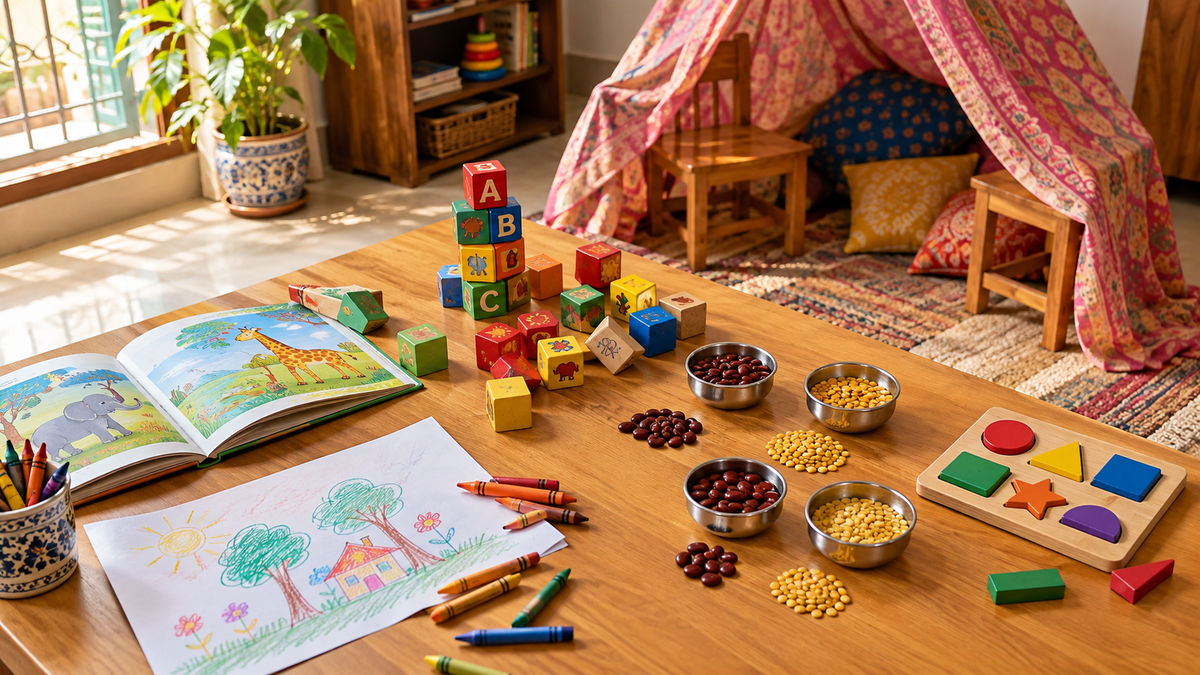
Turn-taking games teach your 3-year-old to wait, manage frustration, and cooperate—skills that determine how well they adjust to school more than academics do. Use a kitchen timer, stacking cups, a rolling ball, and a spoon to practise impulse control through play every day. Five structured games take 10–15 minutes and work with any child.
At three, your child's brain is ready to learn patience, but it doesn't happen by lecturing. It happens through turn-taking: the practice of waiting while someone else acts, then having your turn respected in return. This skill—impulse control—predicts classroom readiness better than counting or letter knowledge. Yet most homes don't teach it deliberately.
Daily baby tips, exclusive Amazon deals & real parent advice — free forever.
Social emotional activities for 3 year old at home don't need fancy toys. A timer, a few cups, a ball, and a spoon create the perfect classroom of patience. Here are five games that build waiting skills, frustration tolerance, and cooperative play—all things your child will need on day one of nursery class.
What's Happening at This Age
Between three and four, your child's prefrontal cortex (the part of the brain that controls impulse and planning) is wiring itself. They're biologically moving from "I want it now" to "I can wait a little." But this doesn't happen on its own—it happens through repeated, positive practice. The National Curriculum Framework for Foundational Stage (NCF-FS, 2022) emphasizes that turn-taking and cooperative play are core to this age group's social-emotional development, not optional extras. Children who practise waiting with adults and peers develop better classroom behaviour, friendships, and frustration tolerance by age five. In Indian homes, this often happens informally during games with older siblings or cousins, but deliberate, structured practice makes it stick faster.
Try This at Home
Game 1: Timer Turns (Patience Training)
You need: A kitchen timer (or smartphone timer), a toy or object your child loves, a small treat like a raisin or cashew.
How: Sit together. You hold the object and set the timer for 30 seconds. Tell your child: "When the timer rings, it's your turn. You wait and watch me play." Play with the object (roll it, tap it, make it 'dance') while they watch. When the timer rings, swap. Now they play while you wait. Repeat three rounds. Gradually extend the timer to 45 seconds, then 60 seconds over weeks. End with a small reward (raisin, a clap, a laugh together).
What it builds: Impulse control, the ability to watch without grabbing, waiting skills. Also teaches that waiting has an end—it's not forever.
Easier: Start with 15 seconds. Harder: Introduce two children—three-way turns. Or remove the reward after week two, so waiting is the reward.
Game 2: Cup Stack Race (Turn-Based Competing)
You need: 10–15 plastic cups or steel katoris, a flat surface (the floor or a low table), a toy coin or button.
How: Show your child how to stack cups into a pyramid. Tell them: "First, I stack three cups. Then you stack three cups. We go one-by-one until all cups are stacked." You place your three, then hand the next three to your child. Keep the rhythm calm and celebratory ("My turn!" "Your turn!"). If the tower falls, laugh and restart together. The goal is not perfection—it's taking turns while something is happening, managing the temptation to grab and do it all yourself.
What it builds: Patience within a shared task, cooperative play, managing the desire to control the outcome, frustration tolerance when things fail.
Easier: Use just five cups and sit side by side. Harder: Add a third person (sibling, parent's partner, friend)—introduce waiting for your turn when there are multiple people.
Game 3: Rolling Ball Back-and-Forth (Predictable Turn Exchange)
You need: A soft ball, a flat floor, two people sitting 1–2 metres apart.
How: Sit facing your child. Roll the ball gently to them. Say, "Your turn!" They roll it back. You receive it and say, "Now my turn!" Keep a rhythm: roll, receive, roll, receive. After 10 exchanges, try not saying the words—just watch their eyes to see if they anticipate the rhythm. Play for three to five minutes. This is deceptively powerful: it teaches turn prediction and the social rhythm of play.
What it builds: Turn prediction, reading social cues, the joy of shared rhythm, anticipation ("It's coming to me").
Easier: Push the ball instead of rolling it. Harder: Increase distance to 3 metres, or roll two balls and make it faster.
Game 4: Spoon-and-Dal Race (Impulse Control Under Mild Pressure)
You need: A spoon (dessert or serving), a bowl of dry dal (any lentil), an empty bowl, a timer.
How: Show your child the challenge: "You use the spoon to scoop dal from this bowl to that bowl. I'll time you. You can scoop as much as you want in 30 seconds. Go!" Let them scoop freely. Don't correct; just watch and count how many scoops. Then it's your turn. The game isn't about speed—it's about the anticipation of waiting while someone else works, and the impulse to interrupt them. After two rounds, ask: "Did you want to help me scoop?" This opens a conversation about waiting and impulses.
What it builds: Impulse control, the ability to watch and resist grabbing, understanding that other people have a turn and you don't interrupt.
Easier: Use bigger scoops of dry rice. Harder: Make the time limit shorter (20 seconds) or use smaller dal like moong dal.
Game 5: Picture-Turn Story (Collaborative Imagination)
You need: A picture book or even a crayon drawing on paper, two people, your voice.
How: Look at a picture together. You describe one thing you see: "I see a big tree." Then your child says one thing: "I see a bird!" Keep alternating. After five exchanges each, ask them to make a story together: "What is the bird doing in the tree?" You say one sentence, they say one sentence. This is scaffolded turn-taking in conversation—harder than physical games because it requires listening and thinking before you speak.
What it builds: Conversational turn-taking, listening skills, impulse control in speech (not blurting out), collaborative imagination.
Easier: Use a familiar picture (family photo) and just label things. Harder: Make a story with a problem and a solution: "The bird lost its nest. What should we do?" (you ask), "It can build a new one!" (they answer).
What 'Getting It' Looks Like
Your child is developing turn-taking skills when they can wait for 60 seconds without grabbing, watch you play and laugh instead of crying, and predict the rhythm of back-and-forth games (they're ready to roll before you ask). They may still struggle—three-year-olds have good days and hard days—but the struggle is smaller, and they recover faster. They begin to say "My turn?" instead of snatching. They notice when a sibling takes a turn and point it out. These are signs the games are working.
When to Move On, and When to Ask
After four to six weeks of daily five-minute games, most three-year-olds show noticeably better patience. If your child is still unable to wait even 20 seconds, or is having physical meltdowns during turn-taking games (hitting, throwing), mention it at their next paediatrician visit. This isn't a diagnosis—it's information that helps your doctor assess development. Most children just need more practice and patience from adults. Frustration is normal; aggression or extreme distress is worth discussing.
If You're Homeschooling
Fit one turn-taking game into your rhythm two to three times a week. If you have multiple children, they naturally teach each other turn-taking through play—sibling games are powerful. If you're one-on-one with your child, invite another child (a cousin, neighbourhood friend, or playdate partner) once a week to show your child how turn-taking works with peers, not just adults.
What Paediatricians Say
The Indian Academy of Pediatrics (IAP) emphasizes that social-emotional regulation—including impulse control and cooperative play—is a major developmental milestone by age four. Research shows children who practise turn-taking and cooperative play adjust to school faster and have fewer behavioural difficulties. There's no app or toy that teaches this better than a parent's undivided attention and a simple game.
📚 Reviewed against
This guide was checked against the sources below. It is general parenting guidance, not medical advice — for any concern about your child's development, talk to your paediatrician.
- National Curriculum Framework for Foundational Stage (NCF-FS 2022) — Government of India framework emphasizing social-emotional development as core to preschool readiness.
- Indian Academy of Pediatrics (IAP) – Child Development Guidelines — IAP provides developmental milestones and social-emotional competency benchmarks for Indian children age 3–5.
- WHO Early Child Development: A Powerful Equalizer — WHO evidence on why early social-emotional learning predicts school adjustment and lifelong outcomes.
- Durlak, Weissberg et al. – The Impact of Enhancing Students' Social and Emotional Learning — Meta-analysis showing impulse control and cooperative play directly predict academic success and classroom behaviour.
- SAMHSA National Child Traumatic Stress Network – Social-Emotional Competency in Preschool — Framework for understanding turn-taking and emotion regulation as protective factors in early childhood.
Last reviewed 16 Sep 2026
🛒 If you want to buy (optional)
Everything above works with what you already have at home. If you'd rather buy, these are the few things parents keep reaching for. Entirely optional — nothing on this page needs a purchase.
Kitchen Timer or Stopwatch
Teaches waiting with a visible endpoint. A timer removes parental judgment and makes waiting feel fair and predictable.
At home instead: Use your phone's timer app—free and in every Indian home.
Plastic Stacking Cups or Steel Katoris
Safe, stackable, and perfect for turn-based building. Steel katoris are even better—they're already in your kitchen.
At home instead: Use steel bowls or katoris from your kitchen. Free and unbreakable.
Soft Ball (Fabric or Foam)
Light, soft, and safe for indoor rolling. Prevents injury if it hits furniture or your child.
At home instead: Roll a sock stuffed with fabric scraps, or use a light plastic ball. Zero cost.
Spoon and Dry Dal or Rice
Develops fine motor control while teaching patience. Dry goods are food-safe and sensory-rich.
At home instead: Any spoon from your kitchen drawer and any dry lentil or rice from the pantry.
Affiliate note: the Amazon links above may earn us a small commission, at no extra cost to you. It never changes what we recommend, and nothing on this page requires a purchase.
Frequently Asked Questions
What are some good social and emotional activities for a 3-year-old?
What social emotional skills should a 3-year-old have?
What activities should a 3-year-old be doing at home?
How long should I play these turn-taking games with my 3-year-old?
What if my 3-year-old refuses to take turns or gets angry?
Do I need toys or apps to teach turn-taking?
Daily baby tips, exclusive Amazon deals & real parent advice — free forever.