
Turn-Taking Activities for 2-3 Year Olds at Home: 5 Games Using Things You Have
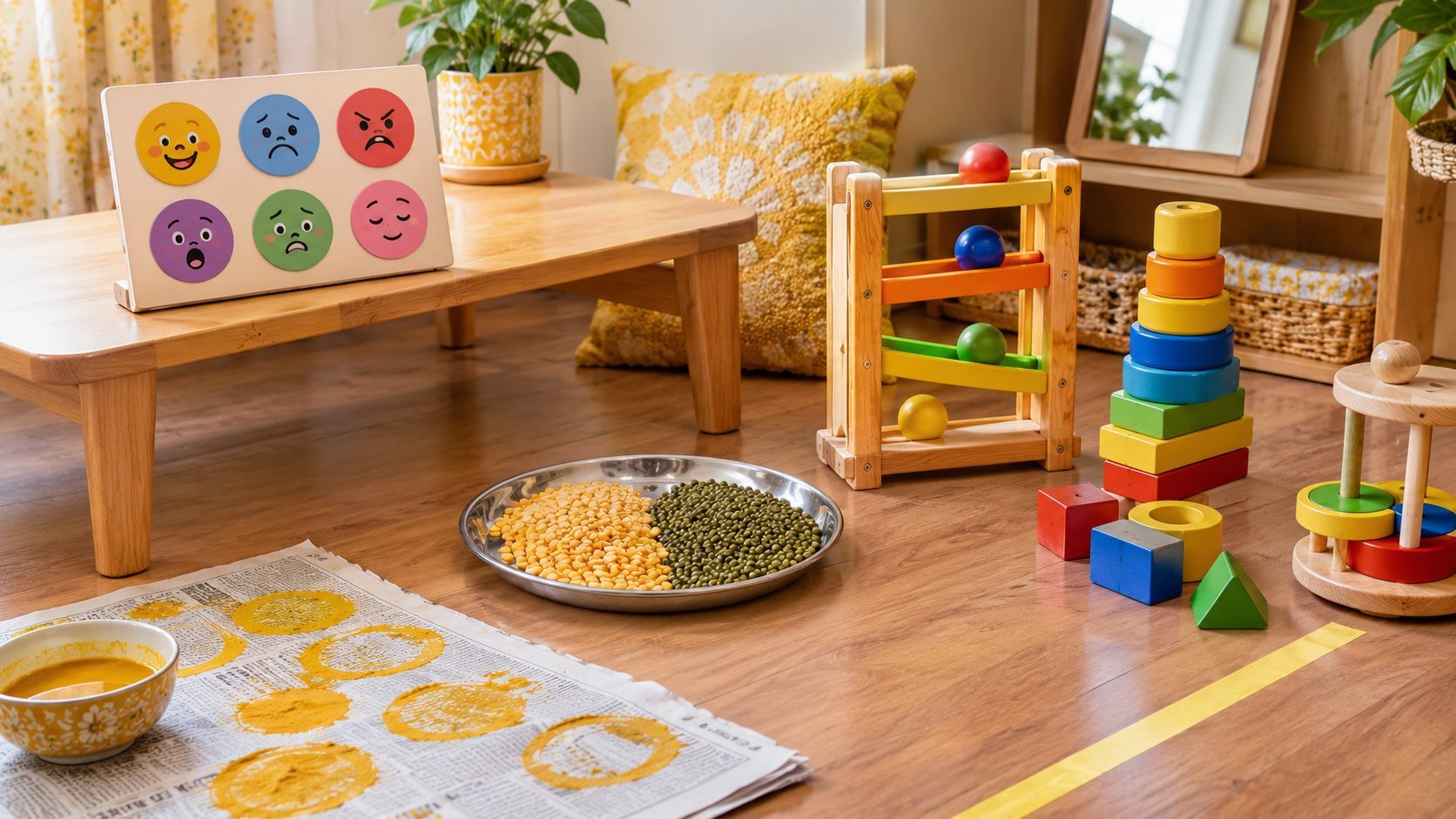
Turn-taking activities teach 2-3 year olds patience, waiting, and social awareness—all foundation skills for preschool. Try passing bowls in a circle, rolling a ball back-and-forth, stacking blocks one-by-one, stirring pretend food together, or a spoon-sharing game. All use household items; no purchases needed.
⚡ In a hurry? Our quick picks
By age 2, your child's brain is wiring up for social play in a new way. Until now, they watched others and played alongside them. Now they're ready to understand that play has a rhythm—my turn, then yours, then mine again. Turn-taking: taking turns or waiting for your opportunity to act, based on agreed rules. This is the invisible skill that makes preschool possible: sitting at circle time, waiting for snack, raising a hand, sharing a toy without a meltdown.
🏆 Quick comparison: our top picks
| Product | Award | Rating | Price | |
|---|---|---|---|---|
 Tupperware Wonderland Stacking Cups (Multicolor) |
🏆 Editor's Choice | ★ 4.4 2,103 reviews |
₹399 | Check price → |
 Funskool Giggles Musical Instrument Set (7 Pieces) |
💰 Best Value | ★ 4.1 654 reviews |
₹509 | Check price → |
 Playskool Pipeworks Building System Classic Playset |
👑 Premium Pick | ★ 4.2 847 reviews |
₹1,699 | Check price → |
 Djeco Tactile Puzzle Set (Animals, 4 Pieces) |
🪙 Budget Pick | ★ 4.3 456 reviews |
₹649 | Check price → |
🛒 Our Top Picks

Best-reviewed overall, 4.4★ across 2,103 ratings.
Tupperware Wonderland Stacking Cups (Multicolor)
- ✓ Why it fits: Perfect for stacking games where you and child alternate—each cup is a turn
- ✓ Nesting cups teach size awareness and fine motor skills
- ✓ BPA-free plastic, durable for repeated use and gentle throw
* We earn a small commission — at no extra cost to you.

Top rating for the price, 4.1★ at ₹509.
Funskool Giggles Musical Instrument Set (7 Pieces)
- ✓ Why it fits: Sharing instruments and taking turns (you play, then child plays) adds rhythm and novelty to turn-taking practice
- ✓ Includes tambourine, maracas, and drum—safe for ages 18 months+
- ✓ Loud enough to hold attention; keeps music simple enough for toddler rhythm
* We earn a small commission — at no extra cost to you.
Top of the range, for parents who want the best features.
Playskool Pipeworks Building System Classic Playset
- ✓ Why it fits: Stacking and building pieces encourage turn-taking (you add one, child adds one) and shared construction goals
- ✓ Large chunky pieces—no choking hazards for toddlers
- ✓ Colorful design holds attention through multiple rounds
* We earn a small commission — at no extra cost to you.
Lowest price that still clears our 3.8★ / 100-review bar.
Djeco Tactile Puzzle Set (Animals, 4 Pieces)
- ✓ Why it fits: Simple board game mechanic teaches turn-taking (one player moves, then the other) in a low-pressure setting
- ✓ Large wooden pieces with tactile textures—no small parts or choking hazard
- ✓ 4-piece design keeps attention span for this age
* We earn a small commission — at no extra cost to you.
Daily baby tips, exclusive Amazon deals & real parent advice — free forever.
The tricky part? A 2-year-old's impulse control is tiny. They don't lack kindness—their brain literally hasn't built the pathways yet to pause and think "someone else's turn now." That's why repetition at home, in safe, playful moments with you, works so much better than expecting it at a classroom or a birthday party. This guide walks through five tested at-home activities that build this skill quietly, without any formal teaching.
What's happening at this age
Between 24 and 36 months, your child moves from parallel play (playing next to you) to what child development specialists call associative play—playing with you, noticing you, responding to you. According to the National Curriculum Framework for Foundational Stage (NCF-FS 2022), this age band is when social-emotional learning shifts from simply recognizing emotions to beginning to regulate behavior based on social cues. Your child starts to notice cause-and-effect in social situations: if I pass the bowl, Mummy passes it back. If I wait, I get a turn.
This doesn't mean they suddenly share perfectly. What it means is their brain is now capable of understanding the pattern. Repetition builds the habit. The more times you play a turn-taking game together, the faster their impulse control wires up. By 3, most children can wait for a turn in a small group if the game is simple and the wait is short—usually under 30 seconds.
Try this at home
1. Passing Bowls in a Circle
You need: Two or three steel katoris (bowls) or plastic containers, you and your child sitting on the floor.
How: Sit facing your child with a bowl in your hands. Say "My turn—I pass it" and hand it to them. Wait, make eye contact, and say "Your turn—pass it back." Pass it back and forth 5–6 times. Once they get the rhythm, add a second bowl so you're passing at the same time. Keep it slow. Celebrate every successful handover with a smile and a "Yes, you passed it!"
What it builds: Understanding turn-taking rhythm, impulse delay (waiting for the bowl to come back), hand-eye coordination, and cause-and-effect (I pass, then it comes back).
Easier: Use one bowl and pass it very slowly. Harder: Use three bowls and rotate who starts.
2. Rolling a Ball Back-and-Forth
You need: One soft ball, small rubber ball, or even a rolled-up sock. Sit about 1 meter apart on the floor.
How: Roll the ball slowly to your child. When they catch it or touch it, say "Your turn—roll it back." Roll it back to them. Do this 8–10 times. Keep narrating: "Mummy rolls... now it's your turn... you roll." This is turn-taking with a visual object that travels between you—very clear cause-and-effect.
What it builds: Turn-taking awareness, gross motor control, tracking (watching the ball), and early understanding of waiting (they wait for you to roll, you wait for them to roll).
Easier: Use a bigger, softer object. Harder: Roll from farther away; introduce a simple rule like "roll it with the side of your hand only."
3. Stacking Blocks One-by-One
You need: Building blocks, wooden bricks, or even stacked chapati containers. Sit together at a low table or on the floor.
How: Place a block in the middle. Say "Mummy puts one block" and place it. Then say "Your turn—put one block." Alternate, building one shared stack together. Do this 8–10 times or until the stack falls (which it will, and that's fine—toddlers find this hilarious). Celebrate the falls and start again.
What it builds: Turn-taking sequence, fine motor control, shared goal-setting (we're building together), and delayed gratification (waiting for your turn to add the next block).
Easier: Stack just 4–5 blocks. Harder: Add a rule: "Only big blocks first, then small ones" to add anticipation and planning.
4. Pretend Food—Stirring and Sharing a Spoon
You need: A katori, a steel spoon or wooden spoon, water or dry dal, and a simple pot or cup.
How: Pretend you're cooking. Say "I'm stirring the daal. Now it's your turn to stir." Hand your child the spoon. Let them stir 3–4 times, then say "Mummy's turn now" and take it back gently. Go back and forth. Talk through it: "Stir, stir, stir. Now Mummy stirs. Good waiting." Once they're comfortable, pretend to taste it: "Mmm, yummy. You taste?" Offer an imaginary spoonful (or a real one with water).
What it builds: Turn-taking with objects, role-play and imagination, language development (cooking words: stir, taste, hot), and gentle negotiation ("Can I have a turn?").
Easier: Let them stir as long as they want before swapping. Harder: Set a timer (count to 10) for each turn to introduce the idea of time-based turns.
5. The Spoon-Sharing Game
You need: One teaspoon, a small cup of water, and two small bowls or cups (one for you, one for your child).
How: Say "I take a sip with the spoon" and take one pretend or real sip of water using the spoon. Then say "Your turn—you take a sip" and hand them the spoon. Take turns until the cup is empty. This is explicitly about sharing one object and waiting without it. Do this 6–8 times. The water doesn't matter—the turn-taking does.
What it builds: Sharing a single resource, impulse control (waiting for the spoon), and trust (knowing it will come back to you).
Easier: Use a cup with a straw so they're not fighting over the spoon shape. Harder: Introduce a rule: "Use your right hand" or "Take a sip, then pass."
What 'getting it' looks like
You'll notice your child is understanding turn-taking when they begin to anticipate their turn: they watch your face, they smile when you say "your turn," they sometimes hand you the object without being asked (a huge sign). By 3, many children will say "My turn now?" unprompted, or sit quietly for a few seconds waiting for you to pass the ball back. They won't be perfect—impulse still wins sometimes—but the pattern is there. The key sign is that they're no longer grabbing the object or crying when it's your turn; they're waiting, even if just for a few seconds.
When to move on, and when to ask
By age 3, most children can handle 3–4 turn-taking games reliably without meltdowns. If your child is still unable to wait for a turn by 36 months, or if they become very distressed during these activities, this is worth mentioning at your next pediatric visit. Most developmental delay in this area is not concerning and responds well to routine practice, but every child develops differently. Talk to your pediatrician if your child seems unable to understand turn-taking rules after many repetitions, or if turn-taking triggers extreme frustration.
If you're homeschooling
Slot one of these activities into your daily rhythm twice a week, ideally at the same time each day (after breakfast snack, before quiet time). Consistency builds habits faster than frequency. A 10-minute turn-taking game twice weekly will embed the skill more reliably than three games scattered randomly throughout the month. Pair it with picture books about sharing and waiting (many library books exist) to reinforce the idea in stories too.
What helps at home (optional)
Every activity above works perfectly with things you already have at home. Some parents find that a simple board game set designed for toddlers (with no small pieces), a stacking cup set (colorful plastic or wooden cups that nest and stack), or a musical instrument set (tambourine, maracas, drum) makes turn-taking more engaging because the novelty holds attention longer. None of these are necessary—your katoris and spoons work just as well—but they can add variety if your child tires of the same games.
What IAP and WHO Guidance Says
• Social-emotional development at 2-3 years: The Indian Academy of Pediatrics (IAP) recognizes turn-taking and waiting as key milestones in this age band, tied to prefrontal cortex development and impulse control.
• Play as learning: WHO guidelines emphasize that unstructured, playful interaction with a trusted caregiver is the primary vehicle for emotional and social learning in toddlers—far more effective than formal instruction.
This is general information, not medical advice.
📚 Reviewed against
This guide was checked against the sources below. It is general parenting guidance, not medical advice — for any concern about your child's development, talk to your paediatrician.
- National Curriculum Framework for Foundational Stage (NCF-FS 2022) — Defines social-emotional learning milestones for 2-3 year olds, including turn-taking and impulse regulation.
- Indian Academy of Pediatrics (IAP) – Developmental Milestones Guidelines — References turn-taking, social awareness, and play-based learning in the 24–36 month age band.
- WHO – Early Child Development: A Powerful Equalizer — Emphasizes play and caregiver interaction as primary learning modality for toddlers.
Last reviewed 30 Oct 2026
Frequently Asked Questions
What are some examples of imaginative play activities for 2-3 year olds?
What learning activities should I do with a 2 year old?
How can I entertain an active toddler at home?
When should my child be able to take turns in games?
Why is turn-taking important for preschool readiness?
What if my child refuses to wait for their turn?
Daily baby tips, exclusive Amazon deals & real parent advice — free forever.