
Social-Emotional Activities for 1-2 Year Olds: 4 At-Home Games That Build Name Recognition & Turn-Taking
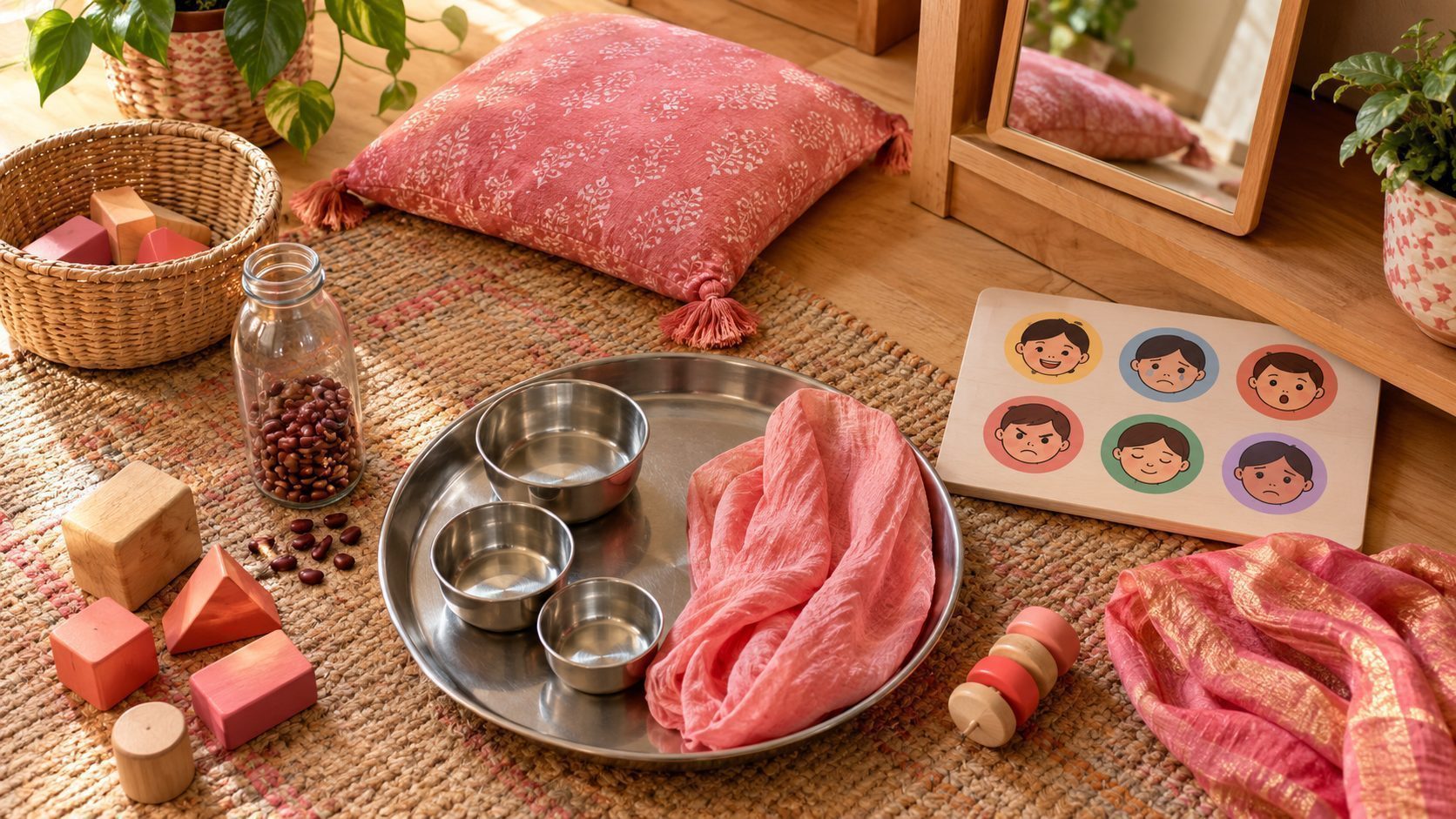
⚡ In a hurry? Our quick picks
The best social-emotional activities for 1-to-2-year-olds use mirrors to build self-awareness, family photos for name recognition, peek-a-boo variations for anticipation and joint attention, and passing games for turn-taking. All work with items already in your home—no purchase needed.
If you're raising a 1-to-2-year-old, you've probably noticed how they watch your face, repeat sounds, and light up when they see a familiar person. That's not accidental—it's the beginning of social-emotional learning, the foundation for how your child will understand feelings, relate to others, and regulate their own emotions. The Indian Academy of Pediatrics (IAP) emphasizes that responsive, playful interaction during this window builds the neural pathways for empathy and social confidence. This article walks through four activities that work in any Indian home, use things you already own, and build genuine skills you'll see your child use within weeks.
🏆 Quick comparison: our top picks
| Product | Award | Rating | Price | |
|---|---|---|---|---|
|
Smiles Creation Wooden Nesting and Stacking Cups Set (5-Piece)
|
🏆 Editor's Choice | ★ 4.6 1,247 reviews |
₹299 | Check price → |
 Goofy Tails Soft Plush Doll with Embroidered Face (25cm) Goofy Tails Soft Plush Doll with Embroidered Face (25cm)
|
💰 Best Value | ★ 4.3 765 reviews |
₹399 | Check price → |
|
Babymate Soft Cloth Peek-a-Boo Book with Crinkle Sounds
|
👑 Premium Pick | ★ 4.4 892 reviews |
₹849 | Check price → |
|
Toykraft Wooden Push-Along Animal Toy (Elephant or Owl Design)
|
🪙 Budget Pick | ★ 4.5 654 reviews |
₹449 | Check price → |
🛒 Our Top Picks

Best-reviewed overall, 4.6★ across 1,247 ratings.
Smiles Creation Wooden Nesting and Stacking Cups Set (5-Piece)
- ✓ Why it fits: Perfect for passing and turn-taking games; teaches object exchange and containment concepts
- ✓ Smooth, rounded edges; natural wood finish; no paint or dyes
- ✓ BIS and EN71 safety certified; suitable from 12 months
* We earn a small commission — at no extra cost to you.

Top rating for the price, 4.3★ at ₹399.
Goofy Tails Soft Plush Doll with Embroidered Face (25cm)
- ✓ Why it fits: Safe, huggable companion for early emotional attachment and role-play; supports naming feelings
- ✓ Non-toxic polyester fabric; machine-washable; weighted for holding
- ✓ No buttons, beads, or detachable parts; ASTM-certified for safety
* We earn a small commission — at no extra cost to you.
Top of the range, for parents who want the best features.
Babymate Soft Cloth Peek-a-Boo Book with Crinkle Sounds
- ✓ Why it fits: Cloth flaps build anticipation and surprise in peek-a-boo play; soft textures safe for mouthing
- ✓ Crinkle sounds add auditory feedback to boost joint attention
- ✓ BIS-tested, no loose parts, machine-washable fabric
* We earn a small commission — at no extra cost to you.
Lowest price that still clears our 3.8★ / 100-review bar.
Toykraft Wooden Push-Along Animal Toy (Elephant or Owl Design)
- ✓ Why it fits: Encourages joint attention during passing play and builds confidence in cause-effect (push = movement)
- ✓ Sturdy natural wood; rhythmic sounds when pulled or pushed
- ✓ BIS-certified; cord is short (under 15cm) and stitched securely
* We earn a small commission — at no extra cost to you.
Daily baby tips, exclusive Amazon deals & real parent advice — free forever.
What's Happening at This Age
Between 12 and 24 months, your toddler is learning to recognise themselves, understand that other people have feelings separate from theirs, and begin to take turns. These are enormous cognitive shifts. The National Education Policy (NEP 2020) and Curriculum Framework for Foundation Stage (NCF-FS 2022) both emphasize that this age is critical for building emotional vocabulary and social confidence through responsive, playful interaction. Your child is beginning to understand cause and effect in social situations—that when they smile, you smile back; when they pass you something, you receive it with joy. They're also starting to recognise their own name, point to familiar faces in photos, and anticipate what happens next in a game. This isn't learning facts; it's learning how to be human. The activities below work with this natural unfolding, not against it.
Try This at Home
1. Name Recognition at the Mirror
You need: Any mirror you have—even a small compact mirror, a reflective surface, or a steel plate from your kitchen. Your voice and face.
How: Sit with your child in front of the mirror. Point to their reflection and say their name clearly: "That's [name]!" Pause. Let them look. Then point to your own reflection and say, "That's Mummy" (or Papa, Dadi, whoever). Do this 2-3 times, slowly, with pauses. On the third or fourth time, pause before saying their name and see if they anticipate it. This teaches them to recognise themselves and begin to understand that the reflection is "them" and that names are labels for specific people.
What it builds: Self-awareness, name recognition, early understanding that they are separate from you.
Easier or harder: Easier: just point and name once or twice without pausing. Harder: Make funny faces in the mirror together and narrate what you see ("Silly nose!", "Open mouth!")—this adds emotion naming and shared joy.
2. Family Photo Identification Game
You need: A printed photo (or show it on a phone/tablet screen) of family members—grandparents, siblings, parents, pets. Any family image will do.
How: Sit together and point to one person in the photo. Say their name slowly and clearly: "This is Dadi." Point to the same person again and pause—let your child look. Repeat two or three times with the same person, then move to another face. Don't rush through all of them; stay with two or three people per session. Over weeks, your child will begin to point to familiar faces unprompted. This builds name-to-face mapping and familiarity with people in their world.
What it builds: Name recognition, visual memory, joint attention (focusing on the same thing as another person), and emotional warmth around family bonds.
Easier or harder: Easier: Use photos of just one or two people. Harder: Ask "Where's Dadi?" and see if they point or look toward the correct person—this moves toward active recall.
3. Peek-a-Boo Variations for Anticipation and Turn-Taking
You need: A dupatta, cloth diaper, or any soft fabric from your home. Nothing more.
How: Classic peek-a-boo: Cover your face with the cloth, say nothing for 2 seconds, then reveal your face and say, "Peek-a-boo!" with genuine delight. Repeat. After a few rounds, pause slightly longer—let your child sense that something is coming. Then do a variation: Cover your child's face very gently for just one second, reveal it, and celebrate. Or cover their hands, then reveal them. Or play "where's the toy?"—hide a safe household object (a wooden spoon, a soft toy) under the cloth, let them pull it out, and react with exaggerated joy. This teaches anticipation, turn-taking (you hide, they find; then swap), and emotional contagion (they catch your joy).
What it builds: Anticipation (predicting what comes next), object permanence (knowing something exists even when hidden), turn-taking, and shared emotional experience.
Easier or harder: Easier: Keep the cloth off for longer so the surprise is gentler. Harder: Add language: "Ready? ...One... two... Peek!" This builds rhythm and language attention.
4. Passing Game with Household Objects
You need: Safe household items—a wooden spoon, a soft toy, a plastic cup, a cloth, a clean wooden bowl, a soft ball (like a rolled-up sock). Anything that's soft, no small parts, and won't break or hurt if dropped.
How: Sit facing your child on the floor. Pick up one object, show it to them, and place it in their hand: "You have the spoon." Let them hold it for 2-3 seconds. Then gently ask, "Can Mummy have it?" and open your hand. If they give it to you, celebrate quietly: "Thank you! Now I have the spoon." Hand it back. Repeat. The goal is not perfection—they might drop it, throw it, or grab it—but the pattern of exchange, waiting, and turn recognition. Do this for just 2-3 minutes; young toddlers tire of single games quickly.
What it builds: Turn-taking, understanding that objects can belong to different people, responding to social cues (your open hand, your words), and early sharing awareness.
Easier or harder: Easier: Just hand the object back without asking for it; focus on the rhythm of exchange. Harder: Use two identical objects (two spoons) and pass them simultaneously so both of you "have" one at the same time—this teaches the concept that different people can have the same thing.
What "Getting It" Looks Like
Within 2-3 weeks of regular play, you'll notice your child turning toward their own name, even in a noisy room. They'll point to photos of people they recognise. During peek-a-boo, they'll smile or giggle before you even reveal your face—anticipation has kicked in. In passing games, they might hand you something unprompted, or watch your face as they do it, seeking your reaction. These aren't tests; they're signs that your child is beginning to understand themselves as separate from you, to anticipate social sequences, and to register your emotional response. That's the entire foundation of emotional awareness.
When to Move On, and When to Ask
By 18-20 months, most children will consistently turn to their name, recognise familiar faces in photos, and show obvious anticipation during repeated games. If your child shows little interest in any of these activities after 3-4 weeks of regular, playful attempts, or if they seem startled by peek-a-boo rather than delighted, mention it to your paediatrician at the next check-up. Paediatricians can assess whether attention, hearing, or social engagement needs support. This isn't a cause for worry—early detection of any gap is always better than waiting.
If You're Homeschooling
Weave these activities into your weekly rhythm: mirror time during your morning routine (2 minutes), photo time when the light is good after lunch, peek-a-boo during wind-down, and passing games while sitting together. None needs preparation. The consistency matters more than length.
What Helps at Home (Optional)
Every activity above works with zero purchases—mirrors, photos, cloth, and household objects are everywhere in an Indian home. If you'd like to add something, soft dolls designed for emotional play, cloth books with peek-a-boo flaps, nesting cups for passing and stacking, or simple push toys can deepen these skills. But honestly, they're entirely optional; the activities above are complete on their own.
What Paediatricians Say
- The IAP emphasizes that responsive, face-to-face interaction during the first two years is the single strongest predictor of emotional security and later social confidence. No toy replaces this.
- WHO guidelines note that joint attention—focusing together on the same thing—is a marker of healthy social development and predicts language growth and school readiness.
📚 Reviewed against
This guide was checked against the sources below. It is general parenting guidance, not medical advice — for any concern about your child's development, talk to your paediatrician.
- National Education Policy (NEP) 2020 - Foundation Stage Guidelines — Official framework for early childhood development milestones and responsive interaction in India
- Curriculum Framework for Foundation Stage (NCF-FS) 2022 — NCERT standards for social-emotional learning in children aged 0-6 years
- Indian Academy of Pediatrics (IAP) - Early Childhood Development — IAP guidance on responsive parenting, joint attention, and milestone tracking in infants and toddlers
- WHO Guidelines for Early Childhood Development — Joint attention and social engagement as predictors of language and school readiness
- Touchpoints on Social-Emotional Milestones (12-24 months) — Zero to Three resource on anticipation, turn-taking, and early self-awareness in toddlers
Last reviewed 03 Oct 2026
Frequently Asked Questions
What are some interactive social-emotional activities for 1-to-2-year-olds?
What are some typical social and emotional skills for a 2-year-old child?
What are some examples of social and emotional development for a 1-year-old?
How often should I do these social-emotional activities with my toddler?
What if my child doesn't seem interested in these activities?
Can screen time replace these at-home social-emotional activities?
Daily baby tips, exclusive Amazon deals & real parent advice — free forever.