
Teaching Body Parts to 1-Year-Old at Home: 4 Simple Mirror & Song Activities
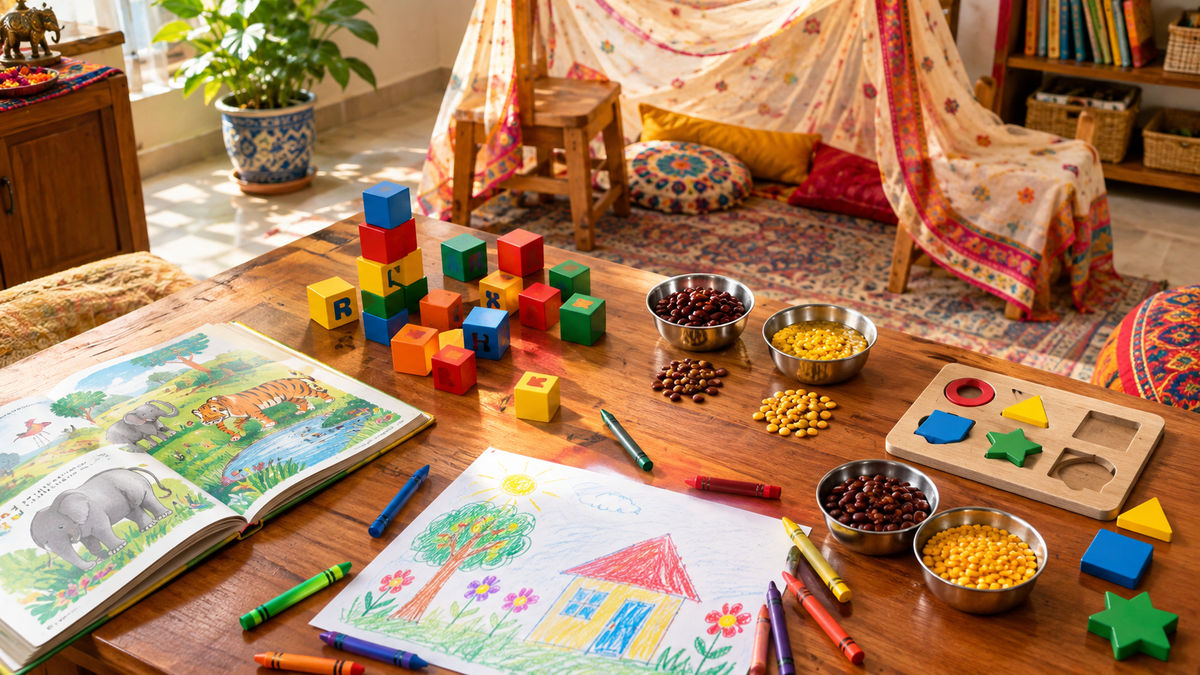
At 12–18 months, toddlers learn body parts through repeated naming and touch during everyday moments—bath time, mirror play, and songs. Point to a body part, say its name in Hindi or your regional language, and let your child touch it. Repeat the same activities daily for 2–3 weeks before moving to new body parts.
What's Happening at This Age
Between 12 and 18 months, your toddler is building receptive language—understanding words before saying them—and beginning to produce simple words like 'mama,' 'dada,' and 'no.' According to the National Curriculum Framework for Foundational Stage (NCF-FS 2022), toddlers at this stage learn body awareness and vocabulary through multisensory input: seeing, touching, and hearing the same word repeatedly in context. This is why naming body parts during bath time or diaper changes is far more effective than flashcards. Your toddler's brain is also developing gross and fine motor control—learning where their hands, feet, and face are in space—which makes touch-based learning ideal right now. Point + name + touch = the holy trinity for this age.
Daily baby tips, exclusive Amazon deals & real parent advice — free forever.
Try This at Home
Mirror Play: Name and Point
You need: A safe, low mirror (or even a reflective window pane your child can safely approach), nothing else.
How: Sit or stand with your toddler in front of the mirror. Point to their nose in the mirror and say 'naak' (or 'mundu' in Kannada, 'mookku' in Tamil—use your regional word). Touch your own nose, then gently touch theirs. Repeat the same body part 3–5 times in one sitting. The next day, do the same body part again before adding a new one.
What it builds: Visual recognition of their own body, link between the word and the body part, and early self-awareness.
Easier: Start with just the nose and mouth—big, obvious features. Harder: Once they're comfortable (after 1–2 weeks), add smaller parts like fingers, ears, and eyes in the same session.
Bath-Time Body Naming
You need: Water, your voice, and the routine you already have.
How: During bath, as you wash each part, name it aloud. 'Now we wash your haath' (hands). 'Let's clean your pair' (feet). 'Tummy time—pet' (belly). Let your toddler splash and touch the water on that body part while you repeat the word. The sensation of water + the word = strong memory anchor.
What it builds: Association of body-part names with sensation and action, comfort with being named and touched, routine-based learning.
Easier: Use just 2–3 body parts per bath at first. Harder: Add songs (see below) while you're washing, or ask simple questions like 'Where is haath?' and guide their hand to touch it.
Regional Songs with Hand Gestures
You need: Your voice and simple hand movements.
How: Use traditional nursery rhymes or action songs in your regional language. In North India, 'Aankhen Bandh Karo' (close your eyes) or 'Pakda Pakdi' involve body parts. In South India, Tamil 'Irukka Irukka' or Kannada traditional songs name body parts. Sing slowly, point to each body part as you name it, and guide your toddler's hand to touch their nose, ears, or belly as the song mentions it. Repeat the same 1–2 songs daily for a week before introducing a new one.
What it builds: Auditory memory, rhythm, cultural connection to language, motor coordination.
Easier: Use just your voice and one simple gesture (touching nose). Harder: Sing faster, add more body parts, or clap while singing.
Dressing & Dressing-Down Narration
You need: Clothes your toddler already wears—nothing extra.
How: When dressing or undressing, narrate what you're doing: 'Let's put on your kurta—over your tummy, now your haath goes in this sleeve.' 'Off comes the nappy—now we see your pair.' Point to each body part as you dress or undress them. This transforms a daily routine into a 10–15 second learning moment, repeated twice a day. The action + the word + the sensation = three-layer memory.
What it builds: Body awareness linked to clothing, routine-based vocabulary, comfort with adult naming of all body parts (including private areas—normalize this language early).
Easier: Name just one body part per dressing session. Harder: Ask 'Where is your haath?' as you hold up the sleeve, and wait for them to move their arm toward the opening.
What 'Getting It' Looks Like
By 15–18 months, you'll notice your toddler beginning to point to or touch their own body parts when you name them—not always, but increasingly. They might pat their own belly when you say 'pet,' or touch their nose unprompted after weeks of practice. They won't say the words yet (that's 18–24 months territory), but receptive understanding is the foundation. Some toddlers will start making attempts at the word—'tummy' might sound like 'tum-tum' or 'haath' like 'haa'—and that's huge progress. If your child seems to ignore the naming, that's normal; they're still processing. Keep repeating without pressure.
When to Move On, and When to Ask
Stick with the same 3–4 body parts (nose, hands, feet, belly) for 3–4 weeks before adding new ones. If your toddler shows no response after a month of daily repetition, and you're also noticing delays in understanding other everyday words or sounds, mention it to your paediatrician at the next checkup. This isn't a worry—many toddlers learn body-part vocabulary between 15 and 24 months—but it's worth flagging if language development seems slower across the board. Most typically developing toddlers need 20–30 repetitions of a word in context before it 'sticks,' so patience is key.
If You're Homeschooling
Integrate body-part naming into your weekly rhythm by assigning it to a specific routine: Monday–Friday mornings during mirror play, bath times 3 days a week, and singing on weekends. This builds consistency without adding 'school-like' structure. By treating it as part of life (not a lesson), your toddler absorbs the language naturally, just as they would in any other setting.
What Paediatricians Say
The Indian Academy of Pediatrics notes that receptive language (understanding) develops 2–3 months ahead of expressive language (speaking) in typical development. Naming body parts during daily care routines accelerates both, because the word is paired with real sensation and action—your toddler's brain learns faster this way than through pictures alone.
- Repetition in context (not flashcards) is how toddlers under 18 months build vocabulary.
- Regional/mother-tongue naming is just as effective—and more so for long-term retention—than English-only input.
📚 Reviewed against
This guide was checked against the sources below. It is general parenting guidance, not medical advice — for any concern about your child's development, talk to your paediatrician.
- National Curriculum Framework for Foundational Stage (NCF-FS 2022) — Multi-sensory learning and vocabulary acquisition in ages 12–24 months
- Indian Academy of Pediatrics (IAP) Developmental Milestones Guideline — Receptive vs. expressive language development; typical milestone timelines for body-part naming
- WHO Early Childhood Development: Talking with your baby — Language acquisition through daily routines and repetition in context
- ICMR Manual on Childcare and Nutrition — Sensorimotor learning and cognitive development in the second year of life
- Bright Futures/AAP—Language Development in the Second Year — Repetition requirements and multisensory pathways for word learning
Last reviewed 18 Sep 2026
Frequently Asked Questions
At what age should I start teaching body parts?
Should I teach body parts in English or Hindi/regional language?
My toddler doesn't respond when I name body parts. Should I be worried?
How many body parts should I teach at once?
Is mirror play safe for a 12–18-month-old?
Should I use toys or flashcards to teach body parts?
Daily baby tips, exclusive Amazon deals & real parent advice — free forever.