
Numeracy & logic
Counting katoris, sorting dal, measuring atta — number sense grows in the kitchen.
Maths does not start with worksheets — it starts in your kitchen. Counting katoris, sorting dal, sharing rotis equally and noticing big and small all build number sense, the deep feel for quantity that later powers arithmetic. Real, hands-on maths in daily life beats drilling almost every time.
What it looks like, age by age
Where to focus on numeracy & logic at each stage. Tap your child's age above for a fuller picture.
Not sums — quantity. Babies notice one versus many, in and out, more and gone. Counting fingers and toes aloud, stacking cups and hiding-and-finding games are the whole curriculum.
Nesting and stacking cups, and the words big, medium and small. Counting steps and fingers aloud plants the first seeds.
Sort by colour and size, and understand one versus lots. Count real things — spoons, stairs, biscuits — with meaning.
Count small groups accurately, compare more and less, and name shapes. Set-the-table maths and measuring while cooking make numbers real.
Add and subtract small numbers, handle simple money and time, and spot patterns — all through shopping games, cooking and everyday problems, not just sums on paper.
Fractions, money and measurement in real life: bills, recipes, a cricket scorecard. Estimating before calculating builds number sense.
Percentages, budgets and data: plan an outing, read a chart, spot when an answer looks wrong. Maths as a tool, not a subject.
Try this at home
Free, DIY-first activities using what you already have.
Sort the dals
Mix a little of two dals on a plate and sort them into separate katoris, counting aloud as you go.
Set-the-table maths
Ask how many people are eating, then how many plates and spoons are needed, and let your child count them out.
Katori nesting
Let your child stack and nest the katoris while you say big, medium, small.
Shopkeeper game
Set up a little shop, price the items, and practise adding prices and giving change.
In-depth guides
👶 0–12 months

Build Number Sense in Babies 0–12 Months: 4 Early Numeracy Activities Using Rhythm & Repetition
Babies learn numbers through rhythm and repetition, not flashcards. Four simple activities—clapping patterns,…
Early Math Activities for Babies 0-12 Months: Building Number Sense Through Rhythm and Pattern
4 no-buy activities using household items to build one-to-one correspondence and quantity awareness in babies…
🚼 1–2 years
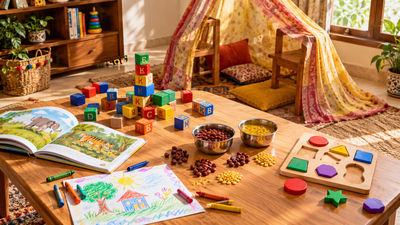
Shape Recognition Activities for 18-24 Month Olds: 5 No-Toy Home Activities
Teach circles, squares, and triangles using rotis, paratha, thepla, and household items. Five embodied learni…
Shape Activities for 18 Month Old at Home: 5 No-Buy Games Using Household Items
Five zero-cost shape activities using kitchen tools, clothes and household items to teach circles, squares an…
🎨 3–5 years

5 Kitchen Counting Activities for 3–5 Year Olds at Home
Teach counting with chapati, dal, and katoris—five household activities that build one-to-one correspondence …

Early Maths Activities for 3-5 Year Olds at Home: Counting with Rice, Grouping, and Number Recognition
Teach your 3–5-year-old foundational numeracy using rice, dal, chapatis, and chalk. Five hands-on activities …
When to check with someone
📚 Reviewed against
This guide was checked against the sources below. It is general parenting guidance, not medical advice — for any concern about your child's development, talk to your paediatrician.
- National Education Policy 2020, Ministry of Education — India's official framework: a play-based Foundational Stage for ages 3–8
- National Curriculum Framework for the Foundational Stage (NCF-FS) 2022, NCERT — Play-based learning outcomes and pedagogy for ages 0–8