
Shape Activities for 18 Month Old at Home: 5 No-Buy Games Using Household Items
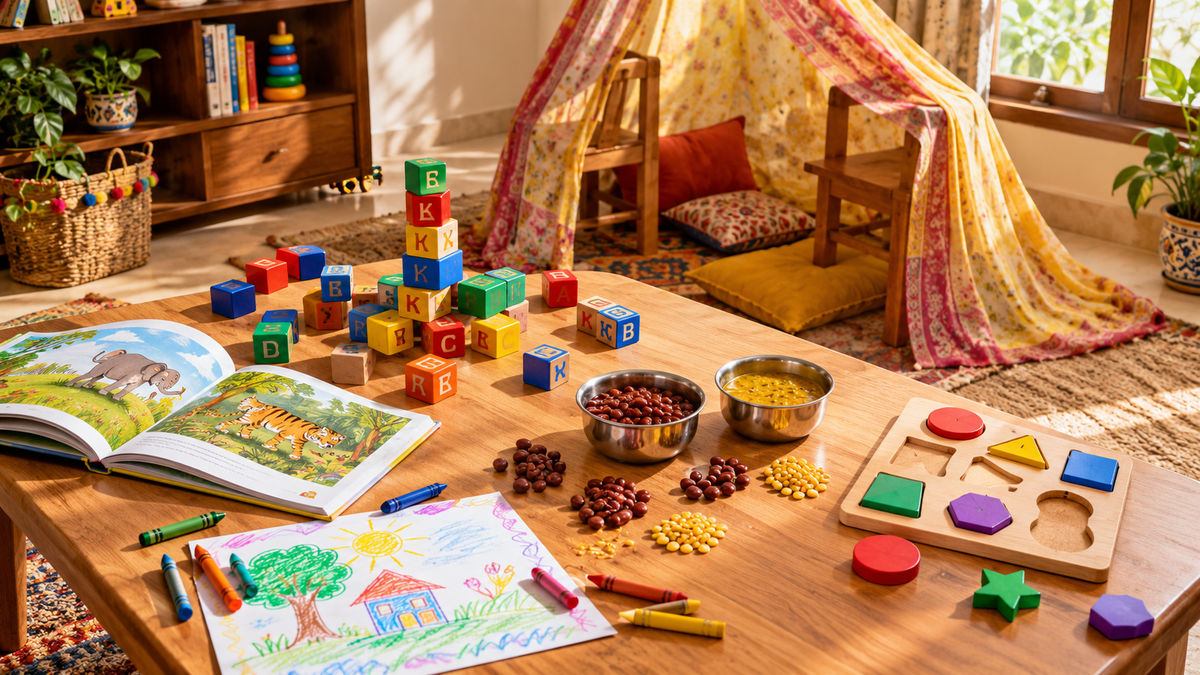
At 18 months, toddlers recognize circles and simple shapes through play. Use kitchen items (thalis, bowls), windows, hangers and dupatta folds to hunt and trace shapes. Five activities below need zero purchases and work with what's already at home.
⚡ In a hurry? Our quick picks


Between 18 and 24 months, your child is moving from exploring objects to noticing their shape—the outline and form rather than just the texture or taste. This is the age when a round plate becomes interesting not because it holds food, but because it *looks* like a circle. Shape recognition sits at the foundation of mathematical thinking and literacy (letters are shapes too), and the best part is that your home is already full of teaching tools.
🏆 Quick comparison: our top picks
| Product | Award | Rating | Price | |
|---|---|---|---|---|
 Hape Wooden Shape Peg Puzzle Hape Wooden Shape Peg Puzzle
|
🏆 Editor's Choice | ★ 4.6 1,876 reviews |
₹231 | Check price → |
|
Shumee Wooden Shape & Color Learning Puzzle
|
💰 Best Value | ★ 4.3 645 reviews |
₹231 | Check price → |
 Skillofun Wooden Shape Sorter Board with Blocks Skillofun Wooden Shape Sorter Board with Blocks
|
👑 Premium Pick | ★ 4.4 892 reviews |
₹1,055 | Check price → |
 Wahu Stacking and Nesting Rings with Base Wahu Stacking and Nesting Rings with Base
|
🪙 Budget Pick | ★ 4.5 1,203 reviews |
₹280 | Check price → |
🛒 Our Top Picks
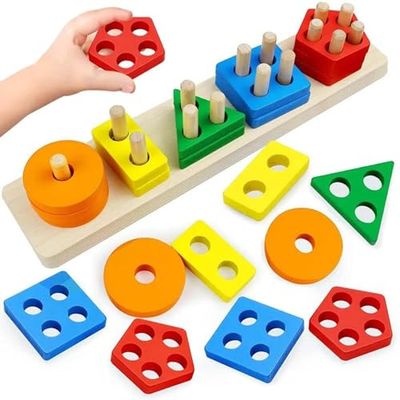

Best-reviewed overall, 4.6★ across 1,876 ratings.
Hape Wooden Shape Peg Puzzle
- ✓ Why it fits: Multi-shape puzzle board reinforces circles, squares, triangles, and stars—next step after household shape hunts
- ✓ Wooden pegs and frame, safety-tested
- ✓ Encourages independent shape matching and problem-solving
* We earn a small commission — at no extra cost to you.
Top rating for the price, 4.3★ at ₹231.
Shumee Wooden Shape & Color Learning Puzzle
- ✓ Why it fits: Combines shape sorting (circles, squares, triangles) with color matching for extended learning after shape hunts
- ✓ Wooden pegs and base, no detachable pieces
- ✓ EN71 certified for safety
* We earn a small commission — at no extra cost to you.
Top of the range, for parents who want the best features.
Skillofun Wooden Shape Sorter Board with Blocks
- ✓ Why it fits: Reinforces shape matching from household hunts with a purpose-made sorter—circles, squares, triangles in one board
- ✓ Wood-based, BIS-compliant, no small parts
- ✓ Simple push-fit design for 18+ months
* We earn a small commission — at no extra cost to you.

Lowest price that still clears our 3.8★ / 100-review bar.
Wahu Stacking and Nesting Rings with Base
- ✓ Why it fits: Stacking teaches circular shape recognition through repetitive stacking—each ring is a circle
- ✓ Plastic rings, sturdy base, no choking hazards
- ✓ ASTM-tested, BPA-free
* We earn a small commission — at no extra cost to you.
Daily baby tips, exclusive Amazon deals & real parent advice — free forever.
This guide uses only things in a typical Indian home: kitchen steel, dupatta, books, windows, hangers. No shape sorter needed (though we'll mention a few options at the end). The five activities below are sequenced to move from observation to hunting to active tracing—building confidence and sustained attention as you go.
What's happening at this age
At 18 months, your child's brain is wiring up visual categorization—the ability to spot that two things *look* similar even if they're different sizes or colours. According to the National Curriculum Framework for Foundational Stage 2022, shape recognition is a key milestone in the "Numeracy" domain for ages 18–24 months, sitting between basic counting and sorting by colour.
Right now, your child notices a circle (thali), another circle (wall clock), and slowly builds the mental model: "Ah, round things are... round." This is different from knowing the *word* "circle"—the shape itself is the learning. You'll see this in action when she picks up a lid and spins it, or traces a round outline with her finger. She's not being random; she's testing what the shape *does*.
The three core shapes to introduce now are circles, squares, and triangles. Don't worry about names yet—show the shapes, let her touch them, and narrate what you see. Labels come later.
Try this at home
Circle Hunt: Thali, Clock, Plate Walk
You need: Steel thali (or any round plate or bowl), a wall clock, a round lid—things already in your kitchen or on your walls. No special materials.
How: Point to the thali and trace the rim with your finger slowly. Say, "Round, round, round." Now walk around the house and find other round things—the wall clock, the pot lid, a bowl. Touch each one and repeat "Round." Let your child touch and trace too. Come back to the thali and ask, "Can you find the round thing?" Point if she's unsure.
What it builds: Visual matching (recognizing the same shape in different objects) and sustained attention. She's learning that "round-ness" is a feature that stays the same even when the object changes.
Easier: Just point and name ("Round") without the hunt. Harder: Hide three objects in a room (a thali, a round bowl, a square box) and ask her to find only the round ones.
Square Search: Books, Windows, Doors
You need: A picture book, a window, a door—all have flat, four-sided shapes. A dupatta or cloth laid flat also works.
How: Sit with a book and slowly run your finger along the edge: corner, corner, corner, corner. Say, "Square" or "Four corners." Now point to a window. "Look, four corners here too!" Walk to a door, a tile, a picture frame. Trace the corners together. Let her feel the corners (safely—no sharp edges).
What it builds: Understanding that shapes have consistent features (four corners for a square). Also starts connecting shapes to real objects in her world.
Easier: Stay with just one or two objects (the book, the window). Harder: Ask her to point to the four corners herself, or find a square in a cluttered shelf.
Triangle Discovery: Hangers, Folded Dupatta
You need: A wire or plastic coat hanger (safe, no sharp edges), a dupatta or large cloth you can fold into a triangle, or a corner of a blanket.
How: Show her the hanger. Trace the three points: "One, two, three corners." Say, "Triangle." Now fold a dupatta into a triangle shape and lay it on the floor. "Another triangle!" Let her explore the points with her hands. You can even make a small tent by draping the triangle over a cushion.
What it builds: Recognition of a third shape, and the idea that the same shape can be made different ways (hanger, cloth fold, tent).
Easier: Just show the hanger shape without folding cloth. Harder: Challenge her to fold a cloth into a triangle herself (with your hands guiding hers).
Sorting by Shape: Vessel Lids Discovery
You need: Three or four different lids from your kitchen—one round (dabbha lid), one square (container), one rectangular (box). A low shelf or a mat on the floor.
How: Place the lids in front of her, spaced out. Hold up the round lid and trace it. "This is round." Now pick it up and ask, "Can you find another round one?" She might pick a square one by mistake—that's normal. Just say, "Hmm, let's check... four corners. This is square." Return it and try again. Repeat with each lid. After a few rounds, she'll start sorting by shape, not by accident.
What it builds: Active sorting by shape category. This is the bridge between recognizing shapes and starting to categorize them—a key step in logical thinking.
Easier: Use just two lids (one round, one square) to start. Harder: Add a rectangular lid, or ask her to sort while you're cooking nearby (adds a real-world layer).
Flour Tray Tracing: Draw and Explore
You need: A shallow tray or a large plate, flour or fine sand (dal powder works too), your finger or a small stick.
How: Pour a thin layer of flour into the tray. Use your finger to draw a simple circle. Let her watch, then guide her finger to trace it. "Round, round, round." Smooth the flour flat and draw a triangle. Trace it together. Then a square. Let her draw—her lines won't be perfect, but she's engaging the motor memory of each shape while seeing it appear.
What it builds: Fine motor control, sensory engagement, and motor memory of shape-making. This combines visual and tactile learning.
Easier: Just let her play in the flour, drawing her own lines without you naming shapes. Harder: Draw a shape and ask her to trace it without your hand guiding hers.
What 'getting it' looks like
Around 20-22 months, you'll notice her pointing at a clock and then at a thali and looking at you as if to say, "Same thing." She might pick up a round cracker and a round plate and hold them close. She'll start spontaneously naming shapes (though "circle" might sound like "kir-kil")—and some will be wrong, which is exactly right. She's testing her hypothesis.
You'll also see her seeking out shapes: running to the window to show you corners, asking you to trace shapes with her. This shows she's not just passively recognizing but actively hunting—a sign the learning is real and sticky.
When to move on, and when to ask
By 24 months, most children can reliably identify circles and squares when pointed out, and can match a shape to another shape. If your child seems uninterested after five or six repeats over two weeks, or if she can't follow a simple point-and-match game by 24 months, mention it to your paediatrician. This is general information, not medical advice. Shape recognition is a gentle milestone, not an urgent one—but your doctor can check if anything else is slowing down her learning pace.
If you're homeschooling
If you're running a structured home rhythm, slot shape hunts into a weekly rhythm alongside sensory play and stories. Tuesday morning: circle hunt. Thursday: sorting vessel lids. Friday: flour tray. Five minutes per activity is enough; toddlers tire of repetition quickly, but brief, repeated sessions across weeks build the shape memory.
What helps at home (optional)
Every activity above works beautifully with household items. If you'd like to add something purpose-made, a simple shape sorter set, wooden shape puzzles, or stacking rings can speed up learning. These tools let her practice shape-matching without you needing to set up a hunt each time. They're optional—but popular with toddlers who like to repeat the same task many times.
What IAP and WHO Guidance Says
Cognitive development: The Indian Academy of Pediatrics aligns with WHO guidance that shapes recognition between 18–24 months is a normal part of mathematical and spatial reasoning. Play-based learning: WHO emphasizes that shape recognition develops best through play with real objects, not flashcards. Household items are as effective as purchased toys.
📚 Reviewed against
This guide was checked against the sources below. It is general parenting guidance, not medical advice — for any concern about your child's development, talk to your paediatrician.
- National Curriculum Framework for Foundational Stage 2022 (Ministry of Education, India) — Numeracy domain milestones for 18–24 months, including shape recognition as a foundational skill
- WHO Child Development: Play-Based Learning (World Health Organization) — Evidence that shape and object recognition develop through play with real-world items, not structured drills
- Indian Academy of Pediatrics – Developmental Milestones (IAP) — Cognitive milestones for toddlers, including visual categorization and shape matching at 18–24 months
Last reviewed 16 Oct 2026
Frequently Asked Questions
At what age do babies learn shapes?
Can a 2 year old do a shape sorter?
What activities support children's understanding of shape?
What educational activities would you engage with an 18 month old?
Do I need to buy a shape sorter to teach shapes?
Why does my 18 month old mix up shapes sometimes?
Daily baby tips, exclusive Amazon deals & real parent advice — free forever.