
5 Memory Games for 4-5 Year Olds: Build Focus at Home with Household Items
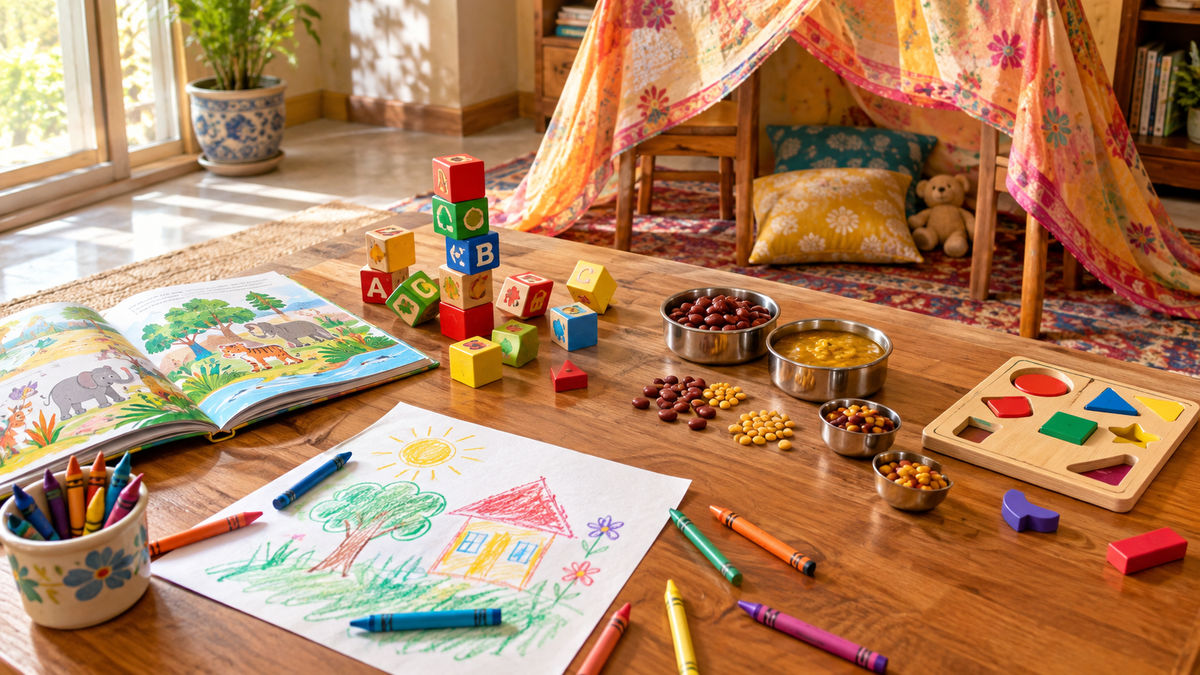
Memory activities for 4–5 year olds work best when they're play-based and use household items: a tray game where children recall missing objects, clapping sequences they repeat, storytelling with props, chaining memory games like 'I went to market', and hide-and-seek with toy recall. These build working memory—the ability to hold and manipulate information—which is essential for following multi-step school instructions. No apps or toys needed; start with 5–10 minute sessions, 3–4 times a week.
Daily baby tips, exclusive Amazon deals & real parent advice — free forever.
Around age 4 or 5, your child's brain is reorganising how it stores and retrieves information. Working memory—the ability to hold a thought, follow instructions with multiple steps, and remember why they walked into a room—is maturing rapidly. This is also the age when school readiness becomes a conversation, and memory skills sit at the centre of that readiness.
If your child struggles to remember a three-step instruction ("Go to your room, pick up the red toy, bring it to Mummy"), or loses track of a simple story, these aren't developmental delays—they're signals that working memory practice would help. The good news: working memory isn't fixed. It strengthens through play, just like a muscle, and you don't need to buy anything to start.
This guide walks you through five memory activities that work in Indian homes, use materials you already have (steel katories, cloth, kitchen items), and fit into a normal day without feeling like homework.
What's Happening at This Age
Between ages 4 and 5, working memory capacity roughly doubles. Your child can now hold about 2–3 pieces of information at once, compared to 1–2 at age 3. This is when they start to understand sequences, follow instructions with two or three steps, and retell short stories with some accuracy.
According to the National Education Policy (NEP) 2020 and the National Curriculum Framework for Foundational Stage (NCF-FS) 2022, memory and cognitive flexibility are identified as core foundations for school readiness, alongside language and social development. At this stage, memory games naturally strengthen the prefrontal cortex—the part of the brain responsible for planning, focus, and impulse control.
What you'll notice: your child can now remember where they put a toy yesterday, recall the plot of a familiar story, and copy a sequence of actions. But they'll still forget easily if there are distractions, and they'll need repetition to lock in new information. This is entirely normal and expected at 4–5 years.
Try This at Home
1. The Tray Game (The Memory Disappear)
You need: A steel tray or large plate, five household items (a steel spoon, a small katori, a lemon, a salt container, a cloth napkin or dupatta), and something to cover the tray (a blanket, dupatta, or board).
How: Arrange the five items on the tray in a line. Point to each one and name it: "Spoon, katori, lemon, salt, cloth." Let your child observe for 30 seconds. Then cover the tray completely and remove one item without showing your child which one. Uncover the tray and ask, "What's missing?" Start with five items; as they improve, move to six or seven.
What it builds: Visual memory, focus, and the ability to create a mental image of an arrangement and notice when it changes. This directly transfers to school tasks like remembering what was on a page or in a lesson.
Easier: Use only three items. Harder: Hide the tray for a few minutes before revealing it, or remove two items at once.
2. Clap-Stomp-Snap: Sequence Repeating
You need: Just your body—no materials.
How: Sit across from your child. Create a sequence of body sounds or movements: clap-clap-stomp. Perform it twice slowly, then ask your child to copy. Once they've mastered that, try a new one: snap-clap-stomp-clap. Gradually add more elements. You're building a rhythm together, and they're training their memory to hold and reproduce a sequence in the right order.
What it builds: Sequential memory (memory of order), auditory attention, and motor planning. This skill is foundational for reading and maths, where sequence matters.
Easier: Use just two sounds (clap-stomp). Harder: Introduce three sequences back-to-back and ask them to repeat all three.
3. Story with Props (The Dupatta Adventure)
You need: A dupatta or cloth, a wooden stick or spoon, a katori, and perhaps a soft toy if you have one.
How: Tell a very short, familiar story (like a simplified Panchatantra tale or something you make up: "A little girl [represented by the dupatta] went to the market with her stick. She found a bowl of fruit. A bird came and ate from the bowl.") Use the props as characters and move them around. Then ask your child to retell the story using the same props. They'll forget details and mix up the order—that's normal. The act of trying to remember and reconstruct the sequence strengthens memory pathways.
What it builds: Narrative memory (memory for stories), sequencing, and the ability to hold a multi-part event in mind. This is directly linked to literacy and comprehension later on.
Easier: Use a very familiar story (a nursery rhyme they know by heart). Harder: Tell a longer story with five events, or ask them to make up their own story with the props.
4. 'I Went to the Market' Chain Game
You need: Nothing—just voices.
How: Sit together. You start: "I went to the market and I bought a lemon." Your child repeats: "I went to the market and I bought a lemon." Then you add: "I went to the market and I bought a lemon and a cloth." Your child repeats the whole thing. Keep adding items (five or six is plenty for this age). Each round, the chain gets longer and they have to remember the full sequence. You'll see them count on their fingers, close their eyes to visualise, or mouth the words—all signs their memory is working hard.
What it builds: Auditory memory, the ability to hold increasing amounts of information, and verbal rehearsal strategies (the first step toward self-talk and learning to learn).
Easier: Stop at three items. Harder: Take turns adding items, so they have to remember what they added and what you added.
5. Hide-and-Seek with Toy Recall
You need: Three small toys (a wooden toy, a small doll, a block).
How: Show your child the three toys. Then, while they're not looking (or eyes closed), hide each toy in a different easy-to-find spot in one room: under a cushion, behind a chair, inside a box. Ask them to remember where each toy is and retrieve them one by one. Start with easy hiding spots; as memory improves, make them slightly trickier. The challenge is holding three spatial memories at once: "Where is the doll? Where is the block? Where is the wooden toy?"
What it builds: Spatial memory (memory for location and direction), which is foundational for maths concepts like position and early geometry.
Easier: Use just one toy and one hiding spot. Harder: Hide four toys, or after they find all three, ask them to retell where each one was.
What 'Getting It' Looks Like
Your child doesn't need to be perfect. Here's what shows memory is building: they notice when one item is missing from a tray; they can repeat a three-step sequence without you repeating it again; they add one or two details when retelling a familiar story; they hold the rule of a game (like hide-and-seek) in mind across multiple rounds. Some children will focus for five minutes, others for ten—that's normal variation. Progress shows up over weeks, not days.
When to Move On, and When to Ask
By age 5, most children can hold 3–4 pieces of information and repeat a sequence of five items. If your child consistently struggles to follow a two-step instruction ("Go get your shoes and come back"), or forgets rules of a game they played yesterday, or can't retell a familiar story with any sequence, it's worth mentioning to your paediatrician. Memory delay isn't common at this age, but some children benefit from slightly different teaching approaches. A chat with your child's school or Montessori trainer is also helpful.
If You're Homeschooling
Slot two of these activities into your week—perhaps the tray game on Monday and the chain game on Wednesday, each taking 8–10 minutes. Rotate through all five over a month. Memory work doesn't need structure; it needs repetition and play. Add storytelling during regular meal times, and you're building this skill without dedicating special time.
What Paediatricians Say
Working memory is trainable. The Indian Academy of Pediatrics (IAP) and international childhood development bodies emphasise that regular, play-based memory practice strengthens cognitive pathways. There's no "critical window"—children continue to improve memory skills through primary school and beyond.
- Memory games work best when they're repeatable (same game, fresh challenge each time) and lose their benefit as soon as they feel like a test.
- If a child is anxious or tired, memory performance drops—a sign of context, not capability.
📚 Reviewed against
This guide was checked against the sources below. It is general parenting guidance, not medical advice — for any concern about your child's development, talk to your paediatrician.
- National Education Policy (NEP) 2020 — India's foundational education framework, identifies memory and cognitive flexibility as core early learning outcomes.
- National Curriculum Framework for Foundational Stage (NCF-FS) 2022 — Developmental milestones and learning guidelines for children aged 3–6 in India; references working memory development.
- Indian Academy of Pediatrics (IAP) Child Development Guidelines — IAP position on cognitive development and memory in preschool children; supports play-based learning approaches.
- WHO Early Child Development Resources — Global standards on early cognitive development and memory maturation in ages 4–5.
- Montessori Method: Sensorial and Cognitive Development — Research on memory development through sensory and sequencing activities, widely used in Indian preschools.
Last reviewed 15 Sep 2026
🛒 If you want to buy (optional)
Everything above works with what you already have at home. If you'd rather buy, these are the few things parents keep reaching for. Entirely optional — nothing on this page needs a purchase.
Wooden Stacking Toys or Simple Building Blocks
Optional enhancement for the hide-and-seek recall game; helps with spatial memory visualisation.
At home instead: Use any three distinct small toys you already have (a plastic doll, a wooden spoon, a cloth).
Affiliate note: the Amazon links above may earn us a small commission, at no extra cost to you. It never changes what we recommend, and nothing on this page requires a purchase.
Frequently Asked Questions
What is the best age to start memory games?
How long should a memory activity session last?
Will memory games help with school readiness?
What if my child gets frustrated during a memory game?
Do I need to buy special memory game toys?
How do I know if my child's memory is developing normally?
Daily baby tips, exclusive Amazon deals & real parent advice — free forever.