
5 Discovery Boxes for 1-2 Year Olds: Curiosity Activities at Home
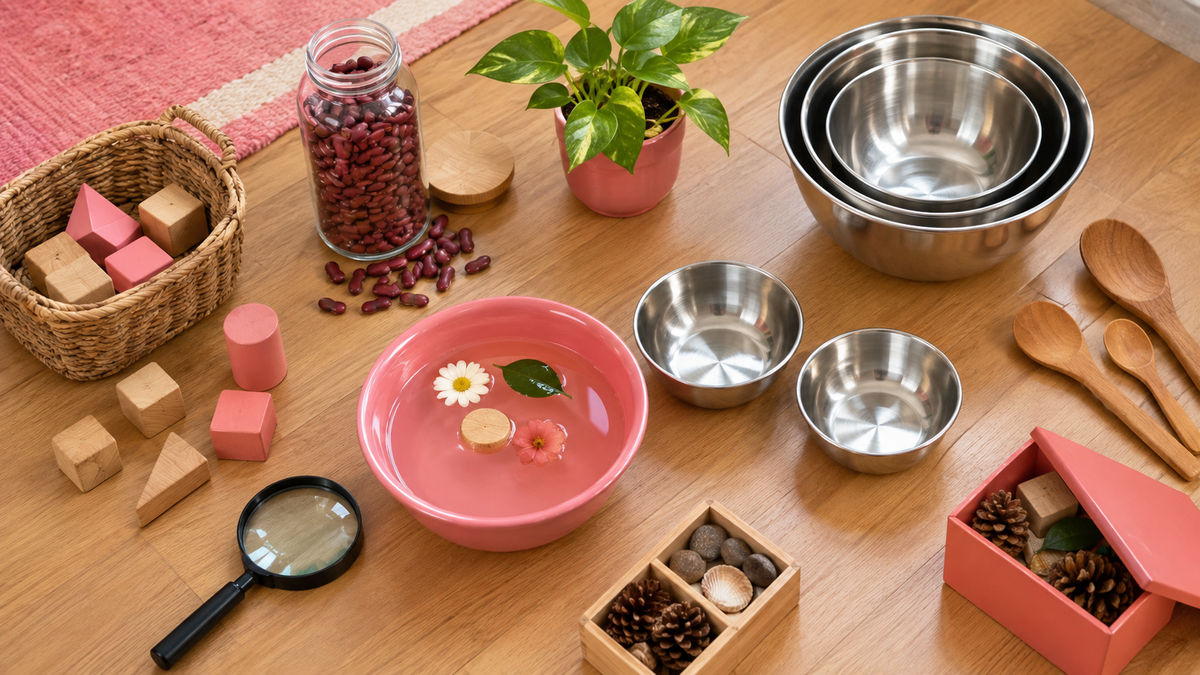
The best curiosity activities for 1-2 year olds are open-ended discovery boxes—baskets of textured fabrics, shallow bins of dry rice, nesting steel bowls, wooden spoons, and crinkly paper balls. These invite safe exploration through touch and sound, building sensory awareness and cause-effect understanding without instruction.
Between 12 and 24 months, your toddler isn't looking for the "right" way to play. They're driven by raw curiosity—picking up, dropping, shaking, squeezing—learning how the world responds to their hands. This phase is where open-ended play matters most: activities with no goal, no winning, no failure. Just materials and discovery. Most parents assume curiosity activities mean buying expensive toys. They don't. The richest learning happens with things already in your kitchen, cupboard, and laundry basket. This guide offers five discovery box setups that take 10 minutes to assemble and teach more than a shelf of branded products ever could.
Daily baby tips, exclusive Amazon deals & real parent advice — free forever.
What's Happening at This Age
At 12-24 months, your toddler is developing cause-and-effect reasoning: the growing ability to understand that their action produces a result. Drop a spoon—it makes a noise. Shake a basket of fabric—textures move. This isn't random play; it's active hypothesis testing. According to the National Curriculum Framework for Foundational Stage (NCF-FS 2022), sensory exploration and hands-on manipulation are core to cognitive development in this age band. The Indian Academy of Pediatrics emphasises that self-directed, unstructured play builds neural pathways for problem-solving and spatial reasoning far more effectively than structured lessons. Your child is also refining fine motor control—fingers and hands becoming steadier, stronger, more coordinated. Discovery boxes tap directly into this developmental window, offering repeated opportunities to grasp, release, transfer, and manipulate without pressure to "perform."
Try This at Home
Discovery Box 1: Textured Fabric Basket
You need: A shallow basket or cardboard box, plus 4-6 fabric scraps—old cotton dupatta, silk scarf corner, soft cotton dhoti, chunni, towel piece, muslin cloth. Anything soft and tactile from your cupboard.
How: Place all the fabric pieces loosely in the basket. Let your toddler pull them out one by one, feel them, rub them against their face and arms, bunch them, shake them. Don't guide or explain—just sit nearby and let them explore at their own pace.
What it builds: Sensory discrimination (soft, rough, smooth, stretchy), fine motor control (grasping and releasing), and confidence handling different textures.
Easier: Use just 2-3 fabrics so it feels less overwhelming. Harder: Add a lightweight silk scarf and watch them experiment with how it floats and drifts.
Discovery Box 2: Dry Rice Sensory Bin
You need: A wide, shallow steel or plastic tray (the kind you use for rotli dough works perfectly), 2-3 cups of dry rice or dal (moong dal is lightweight and easier to manage), a few wooden spoons, a small steel katori, and an empty container for scooping.
How: Pour the rice into the tray. Sit your child at a low table or on the floor in front of it. Hand them a spoon and a small katori. They'll scoop, pour, spill, dig, feel the grains slip between their fingers. This is messy and brilliant—exactly what sensory play should be.
What it builds: Fine motor precision (pincer grip, scooping), hand-eye coordination, sensory awareness of texture and sound, and the concept of containment ("stuff in, stuff out").
Easier: Use just the rice and let them feel it with their hands—skip the spoon at first. Harder: Add a second tray alongside so they practice transferring rice from one tray to another.
Discovery Box 3: Nesting Steel Bowls
You need: 4-5 stainless steel katoris or bowls of different sizes (the ones you have in your kitchen). Stack them inside each other before presenting them.
How: Place the stack in front of your toddler. They'll pull one bowl out, then another, watch them tumble apart, then attempt to stack them again (usually in the wrong order—that's fine). The clanging sound, the nesting puzzle, the cause-effect of stacking—all pure discovery.
What it builds: Size ordering and spatial reasoning, understanding of containment and fit, gross and fine motor control, and cause-effect through sound (hitting bowls together makes noise).
Easier: Use just 2-3 bowls so they're not overwhelmed. Harder: Introduce a wooden spoon—they'll use it to bang inside each bowl and discover different pitches.
Discovery Box 4: Wooden Spoons in Sizes
You need: 4-6 wooden spoons of different sizes—the large round spoon, a smaller flat spoon, a thin ladle, a cooking spoon, even a back-scratcher if you have one. Just variations in size and weight.
How: Put them in a basket or line them up on the floor. Your toddler will pick each one up, test its weight, bang it against other objects (walls, bowls, the floor—supervision required), and move between them discovering the weight and sound differences.
What it builds: Understanding of size, weight, and density; cause-effect learning through sound and movement; gross motor control and strength in hands and arms.
Easier: Offer just 2-3 spoons. Harder: Place a steel katori nearby and let them bang the spoon inside—exploring how the sound changes in an enclosed space.
Discovery Box 5: Crinkly Paper Balls
You need: Newspaper, old gift wrapping, kraft paper, or even old tissue paper. Crumple it into loose balls (don't compress too tightly—they should be light and easy to squeeze).
How: Fill a basket or box with these paper balls and watch your toddler grab them, crunch them, listen to the crinkle, throw them, and try to smooth them out again. The tactile and auditory feedback is addictive for this age.
What it builds: Hand strength, fine motor control through squeezing, auditory feedback and cause-effect (squeeze = crinkle sound), and the concept of soft versus solid objects.
Easier: Use just 3-4 balls so the activity feels contained. Harder: Hide small objects (a wooden spoon, a scarf) inside the paper balls and let them discover what's hidden inside as they open them.
What "Getting It" Looks Like
You'll know your toddler is genuinely exploring when they focus on one activity for 5-10 minutes without being told what to do. Watch for purposeful movement: picking up an item, testing it (shaking, banging, squeezing), noticing what happens, then repeating it. They might bang a bowl, pause, listen to it settle, then bang again. That pause is the "aha"—they've noticed cause-and-effect. Don't expect neat play. Spilled rice, scattered fabric, tumbled bowls—this is the output of genuine curiosity, not mess for mess's sake. The goal isn't completion; it's experimentation.
When to Move On, and When to Ask
Most toddlers in this age band can sustain interest in discovery play for 10-15 minutes before attention naturally shifts. That's normal—don't force longer sessions. Rotate the boxes every 3-4 days so novelty stays high. If your toddler shows persistent difficulty grasping objects, tires very quickly (under 3 minutes), or seems frustrated and distressed rather than curious, mention it at their next paediatrician check-in. Occasionally, motor or sensory delays appear around 18-20 months, and early support makes a real difference.
If You're Homeschooling
Build discovery boxes into your rhythm as "free exploration time"—30 minutes, 3-4 times a week. Rotate boxes so each gets attention weekly. These aren't separate from learning; they are learning. Take photos or quick notes of what captures their attention longest—it tells you what sensory pathway is strongest right now and guides what to offer next.
What Paediatricians Say
The Indian Academy of Pediatrics emphasises that unstructured, child-led sensory play is foundational to cognitive development in the 12-24 month period. Cause-and-effect exploration—dropping, shaking, listening—builds neural pathways for problem-solving that formal instruction cannot replicate.
- Open-ended play builds cause-effect reasoning faster than structured toys. Your toddler learns "my action changes the world" through repetition and discovery.
- Sensory variety (texture, sound, weight) activates multiple neural pathways simultaneously. A single rice bin teaches fine motor control, spatial reasoning, and auditory processing all at once.
A note on safety: All materials mentioned are household items your toddler likely encounters daily. Always supervise, ensure nothing small enough to swallow is introduced (rice is safe; small beads are not), and wash hands after play, especially with dry grains.
📚 Reviewed against
This guide was checked against the sources below. It is general parenting guidance, not medical advice — for any concern about your child's development, talk to your paediatrician.
- National Curriculum Framework for Foundational Stage (NCF-FS 2022) — Government of India framework emphasizing sensory exploration and hands-on manipulation in 0-3 age band.
- Indian Academy of Pediatrics: Child Development Guidelines — IAP guidelines on motor and cognitive milestones 12-24 months; role of unstructured play.
- WHO Early Childhood Development — World Health Organization standards for cognitive development and sensory exploration in toddlers.
- National Education Policy (NEP) 2020 — India's national curriculum policy emphasizing experiential, play-based learning in foundational years.
Last reviewed 20 Sep 2026
🛒 If you want to buy (optional)
Everything above works with what you already have at home. If you'd rather buy, these are the few things parents keep reaching for. Entirely optional — nothing on this page needs a purchase.
Stainless Steel Mixing Bowls Set (Optional: if upgrading from kitchen katoris)
Nesting bowls are safer and more durable than ceramic; steel creates richer sound for cause-effect learning.
At home instead: Use your existing kitchen katoris and bowls—they work just as well.
Wooden Spoon Set, Large & Small (Optional: if upgrading from kitchen spoons)
Untreated wooden spoons are gentler on toddler hands and create varied sounds when banged.
At home instead: Use spoons and ladles you already have in your kitchen drawer.
Shallow Stainless Steel Tray (Optional: for rice bin if you don't have a wide shallow bowl)
A proper rice sensory bin tray contains mess better and gives toddlers defined boundaries.
At home instead: Use a wide baking tray, roti plate, or the base of a large plastic food container.
Affiliate note: the Amazon links above may earn us a small commission, at no extra cost to you. It never changes what we recommend, and nothing on this page requires a purchase.
Frequently Asked Questions
What are some fun activities for a 1.5 year old?
How to keep a 1 year old busy at home indoors?
What is the 3-3-3 rule for toddlers?
What are some fun activities I can do with my 2-year-old at home?
At what age can babies play with rice sensory bins?
Do discovery boxes replace other forms of play?
Daily baby tips, exclusive Amazon deals & real parent advice — free forever.