
5 Activities to Build Curiosity in Babies 0–12 Months: Household Items Only
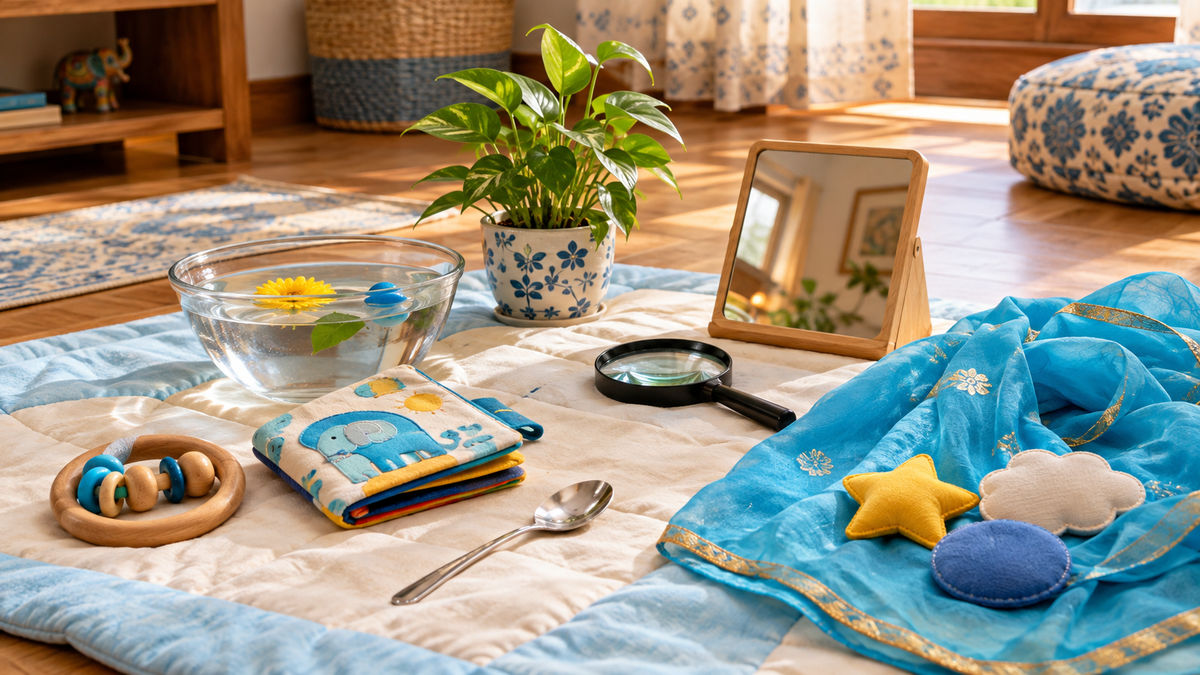
Babies aged 0–12 months build curiosity through repeated cause-and-effect games (drop something, it falls), object permanence (where did it go?), and exploration of textures. Peek-a-boo with cloth, hiding toys, and mirror play are the most effective activities, requiring only household items—dupatta, bowls, fabrics—and your responsive attention to their gaze and gestures.
Most parents worry they need special toys to help their baby's brain develop. The truth is quieter: babies learn by watching, reaching, dropping, and having someone—you—respond to that action. This is curiosity development in babies: the building of understanding that their actions cause things to happen, that hidden objects still exist, and that the world rewards exploration. In the first 12 months, your baby moves from reflexive behaviour to deliberate play. This article walks through five activities that build this foundation, using only what's in your home.
Daily baby tips, exclusive Amazon deals & real parent advice — free forever.
What's Happening at This Age
Between birth and 12 months, your baby's brain is making two huge leaps: object permanence (the understanding that things exist even when hidden) and cause-and-effect reasoning (the idea that their action caused something to happen). Newborns live in the moment—when you leave their sight, you've ceased to exist. By 8–9 months, they search for hidden toys. By 12 months, they deliberately drop objects to watch them fall and hear your response.
According to the National Education Policy 2020 (NEP 2020) and WHO developmental guidelines, this exploration phase is non-negotiable for later learning, language, and problem-solving. Babies who have rich opportunities to act on objects and see results develop stronger neural pathways for prediction and planning. Your job isn't to teach—it's to respond. When your baby reaches for your dupatta, pulls it, and you react with surprise or delight, their brain registers: my action matters. That feedback loop is learning.
Try This at Home
Peek-a-Boo with Dupatta (2–10 Months)
You need: One cotton dupatta or lightweight cloth (the kind you already wear). No special items—a bedsheet or large scarf works too.
How: Sit facing your baby. Cover your face slowly with the dupatta and say "Where's Mama?" Count to two, then pull it away with exaggerated surprise: "Peek-a-boo!" Repeat 4–5 times. Then hold the dupatta loosely in front of your baby's face, let them reach for it, and gently pull it away. Let them grab it back.
What it builds: Object permanence (you existed behind the cloth), cause-and-effect (their grab made you appear), and anticipation (they begin to predict the pattern).
Easier: Just cover your face briefly; don't make it a game yet. Harder: Hide a toy under the dupatta and let them search for it; vary where it's hidden.
Hiding Toys Under Cloth (4–12 Months)
You need: A lightweight cloth (dupatta, muslin, cotton saree) and toys your baby already grasps—a wooden spoon, a rubber toy, a fabric scrap.
How: Show your baby a toy they like. Hold it in view, then slowly cover it with the cloth while your baby watches. Say "Where's the toy? Can you find it?" Wait and watch—they may search, cry, or just stare. Gently uncover it: "Here it is!" Repeat 3–4 times, then let them reach under the cloth and pull it out.
What it builds: Object permanence (the toy still exists under the cloth), search persistence, and the idea that hidden things can be retrieved.
Easier: Cover only half the toy at first. Harder: Hide two toys under the cloth and see if they search for both; hide the toy while they're looking away (older babies only, 9+ months).
Drop-and-Fetch with Steel Bowls (6–12 Months)
You need: Two or three small steel katories (bowls), which most Indian homes have. Ensure there are no sharp edges; a cloth underneath muffles the sound if it's too loud for your baby.
How: Sit on the floor within arm's reach. Drop a bowl gently in front of your baby and say, "Drop!" Let them hear the sound. Pick it up immediately, show them, and drop it again. After a few drops, hand them a bowl and encourage them to drop it. When they do, respond with delight: "You dropped it! What a sound!" Repeat. Your baby will drop and watch your face for your reaction.
What it builds: Cause-and-effect (I dropped it, sound happened, Mama responded), intentional action (from accidental dropping to deliberate), and listening skills.
Easier: Sit very close and drop softly; respond quietly. Harder: Use bowls of different sizes or materials (plastic, wooden spoon) to create different sounds; see if your baby notices the difference.
Mirror Play (3–12 Months)
You need: A safe mirror. A small unbreakable mirror (acrylic or polycarbonate, available at any chemist for under Rs. 200, but household mirrors work if supervised) or even a shiny stainless-steel plate.
How: Hold your baby in front of the mirror. Point to the reflection and say, "That's you!" Make faces—tongue out, big smile—and wait for your baby to watch and copy. Younger babies (3–5 months) will just stare in fascination; older babies will reach toward the reflection and eventually understand it's themselves (around 9–10 months, though this develops over time). Let them touch the mirror surface and feel the coolness.
What it builds: Self-awareness, cause-and-effect (my smile in the mirror), and visual tracking skills.
Easier: Use a shiny plate; the reflection is less clear but equally engaging. Harder: Place toys in front of the mirror and see if your baby reaches for the toy or the reflection; this confusion is normal and healthy.
Texture Exploration with Fabrics (2–12 Months)
You need: Four or five pieces of different household fabrics: a cotton dupatta, a silk scarf (if you have one), a rough towel, a soft blanket, a muslin cloth. Nothing special—things you wear or use daily.
How: Sit with your baby and present one fabric at a time. Let them touch it, grab it, bring it to their mouth (ensure it's clean). Say what they're experiencing: "Soft towel," "Rough cloth," "Smooth silk." Change fabrics every 30 seconds. Watch their face—do they prefer one? Younger babies mouth everything; older babies (9+ months) will rub fabrics against their cheek deliberately, showing preference.
What it builds: Sensory discrimination, vocabulary (words tied to sensation), and fine motor control (grasping and releasing different textures).
Easier: Use just two very different textures (soft vs. rough). Harder: Hide a familiar toy in a fabric sack and let them search; or rub the fabric on their arm or cheek and wait for them to reach for it.
What 'Getting It' Looks Like
You'll see understanding when your baby's behaviour shifts from accident to intention. At 4–5 months, a drop is reflexive; by 8–9 months, your baby drops deliberately and watches your face. With peek-a-boo, early smiles are surprise; later smiles show anticipation—they know what's coming. With hidden toys, early staring becomes active searching under cloth by 7–8 months. With textures, mouthing is exploration; deliberate touch (stroking, grasping, pulling away) shows sensory preference. Listen for vocalizations too—cooing, laughing, or purposeful babbling are signs your baby is engaged and learning from the interaction.
When to Move On, and When to Ask
By 9–10 months, most babies search actively for hidden toys and anticipate peek-a-boo patterns. If your baby shows little interest in these activities by 10 months, or if they're not following your movements with their eyes, mention this at your next wellness check. Paediatricians track curiosity and exploration as early markers of healthy development. Talk to your paediatrician if your baby doesn't seem to notice when objects disappear, shows no preference for different textures, or doesn't respond to your facial expressions by 8 months.
If You're Homeschooling
Weave these activities into your weekly routine, not as "lessons" but as play. Monday: peek-a-boo with a dupatta while you have tea. Wednesday: hide-and-find with toys during floor time. Friday: drop-and-listen with bowls. Saturday: texture exploration while sitting together. The consistency builds patterns your baby's brain loves. No special time needed—just 5–10 minutes of your full, undivided attention.
What Paediatricians Say
The Indian Academy of Pediatrics (IAP) emphasizes that responsive play—where you react to your baby's actions—is as important as the activity itself. Babies learn not just from the object, but from seeing that their behaviour triggered a response from a trusted adult. Paediatricians also note that exploration and curiosity in the first year predict later problem-solving and language skills.
- Consistent, predictable responses teach your baby that the world is safe and responsive.
- Exploration (reaching, grasping, mouthing) is never "naughty"—it's how babies learn, and your job is to keep it safe, not stop it.
📚 Reviewed against
This guide was checked against the sources below. It is general parenting guidance, not medical advice — for any concern about your child's development, talk to your paediatrician.
- National Education Policy 2020 (NEP 2020) – Early Childhood Care and Education — Government of India policy on developmental milestones and responsive early-learning practices.
- WHO Child Development Milestones (0–12 months) — Object permanence, cause-and-effect, and exploration milestones by age band.
- Indian Academy of Pediatrics (IAP) – Developmental Screening and Guidance — Pediatric developmental tracking and parental guidance on responsive play and curiosity.
- National Curriculum Framework for Foundational Stage (NCF-FS) 2022 – India — Early childhood learning framework aligned with Indian developmental standards; emphasizes exploration and responsive adult interaction.
- Piaget, J. – Stages of Cognitive Development (Sensorimotor Stage) — Foundational research on object permanence, cause-and-effect, and exploration in infants 0–24 months; referenced in modern pediatric and early childhood guidance.
Last reviewed 19 Sep 2026
🛒 If you want to buy (optional)
Everything above works with what you already have at home. If you'd rather buy, these are the few things parents keep reaching for. Entirely optional — nothing on this page needs a purchase.
Unbreakable Acrylic Mirror
For mirror play activity; safer than glass mirrors and widely available. Household alternatives (shiny stainless-steel plate or reflective surface) work equally well.
At home instead: Shiny stainless-steel plate or any reflective metal surface from the kitchen
Affiliate note: the Amazon links above may earn us a small commission, at no extra cost to you. It never changes what we recommend, and nothing on this page requires a purchase.
Frequently Asked Questions
What are some activities for infants between 0 and 12 months old?
What is the 3–6–9 rule for babies?
What are signs of high IQ in babies?
How to improve 1-year-old baby brain development?
At what age does object permanence develop?
Do babies really learn from peek-a-boo, or is it just fun?
Daily baby tips, exclusive Amazon deals & real parent advice — free forever.