
Attention Span Activities for 5–8 Year Olds: 4 Games to Build Focus at Home
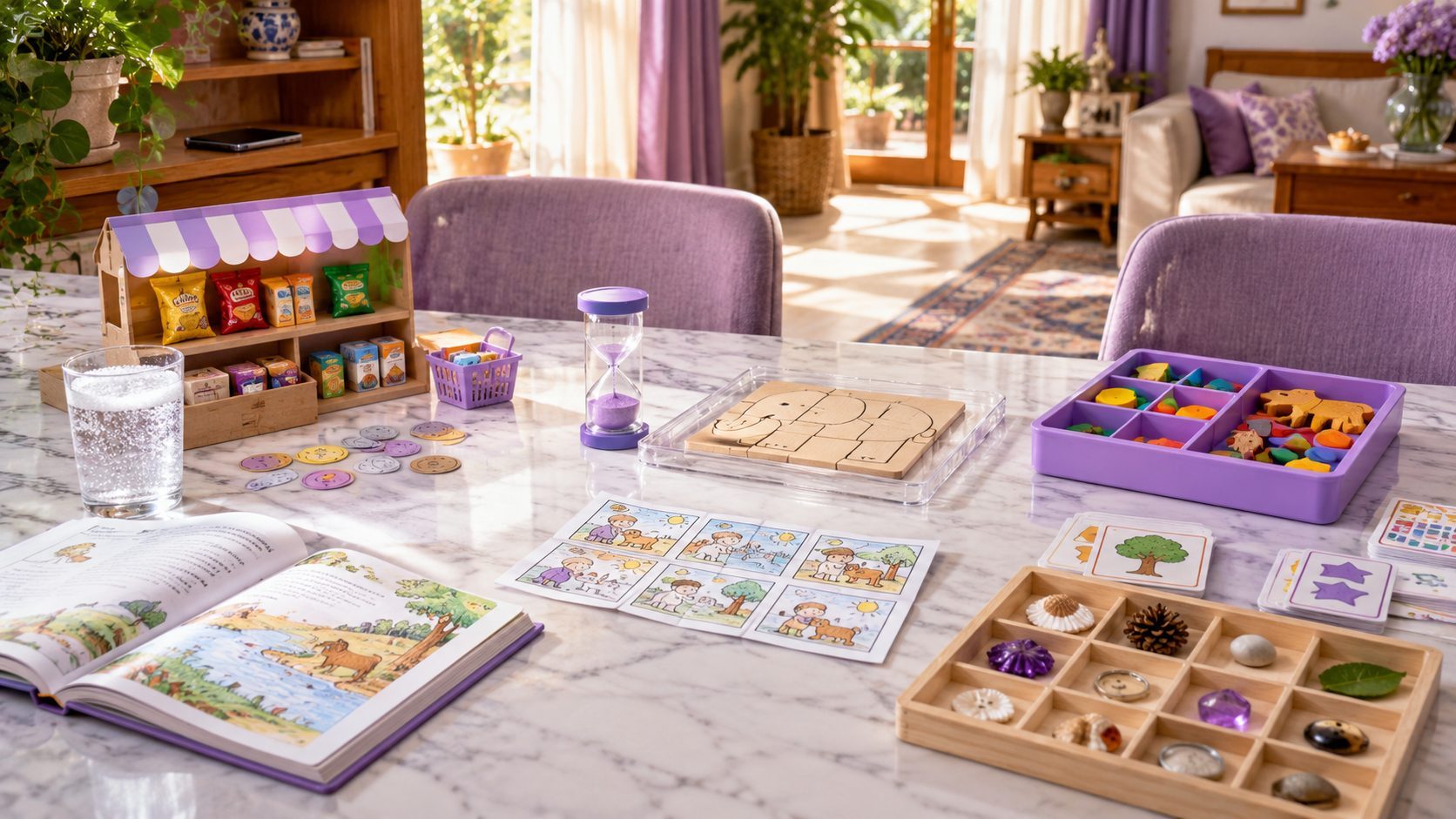
A 5-year-old can focus for about 5–10 minutes; by age 8, sustained attention grows to 12–15 minutes. Simon Says, I Went Shopping memory chains, freeze dance, and whisper telephone are household games that naturally extend attention span without requiring any purchases or screens.
⚡ In a hurry? Our quick picks
If your child drifts away after a few minutes of reading, drawing, or listening to instructions, you're not seeing a problem—you're seeing typical development. Attention span at this age isn't a fixed trait; it's a skill that grows through play. The games below work because they blend fun with focus: your child stays engaged because the game is genuinely interesting, not because you've announced it as "brain training." Every activity uses things already in your home.
🏆 Quick comparison: our top picks
| Product | Award | Rating | Price | |
|---|---|---|---|---|
 Goki Threading and Lacing Set (Wooden Beads) |
🏆 Editor's Choice | ★ 4.6 521 reviews |
₹379 | Check price → |
 Hape Listening Lotto Board Game |
💰 Best Value | ★ 4.5 289 reviews |
₹280 | Check price → |
 Toiing Attention Board Games – Logic & Focus Edition |
👑 Premium Pick | ★ 4.3 412 reviews |
₹599 | Check price → |
 Skillmatics Attention and Focus Card Games |
🪙 Budget Pick | ★ 4.4 623 reviews |
₹499 | Check price → |
🛒 Our Top Picks
Best-reviewed overall, 4.6★ across 521 ratings.
Goki Threading and Lacing Set (Wooden Beads)
- ✓ Why it fits: Fine-motor task requiring sustained visual focus and hand-eye coordination; builds 10+ minute concentration spans through quiet, structured play.
- ✓ Age range: 5–8 years
- ✓ Includes: 30+ wooden beads, woven strings, storage pouch
* We earn a small commission — at no extra cost to you.
Top rating for the price, 4.5★ at ₹280.
Hape Listening Lotto Board Game
- ✓ Why it fits: Audio-based matching game; child listens to sound cards and identifies matching pictures—identical to Whisper Telephone and Simon Says listening demands.
- ✓ Age range: 4–8 years
- ✓ Includes: Sound module, 24 image cards, no batteries
* We earn a small commission — at no extra cost to you.
Top of the range, for parents who want the best features.
Toiing Attention Board Games – Logic & Focus Edition
- ✓ Why it fits: Rule-based strategic play that requires sustained listening and decision-making—mirrors Simon Says and memory chains at home.
- ✓ Age range: 5–8 years
- ✓ Setup time: 3 minutes; play time: 15–20 minutes
* We earn a small commission — at no extra cost to you.
Lowest price that still clears our 3.8★ / 100-review bar.
Skillmatics Attention and Focus Card Games
- ✓ Why it fits: Memory sequencing and pattern matching tasks that extend focus from 5 to 10+ minutes through reward-based play.
- ✓ Age range: 5–8 years
- ✓ Includes: 30+ activity cards, no reading required, reusable
* We earn a small commission — at no extra cost to you.
Daily baby tips, exclusive Amazon deals & real parent advice — free forever.
What's Happening at This Age
Between ages 5 and 8, a child's brain is rewiring how it filters attention. The National Curriculum Framework for Foundational Stage (NCF-FS 2022) identifies sustained attention—the ability to stay with one task without distraction—as a core learning readiness skill. At 5, most children can hold focus for 5–8 minutes on something they choose; by 8, that can stretch to 12–15 minutes, especially if the activity has novelty, rhythm, or a clear reward (winning, finishing a puzzle, hearing the end of a story).
What looks like "short attention span" is often switching attention: your child can focus, but they're choosing to focus on everything else. A ringing bell, a sibling's voice, the way light falls on the wall—all of these compete with your instruction. Games that build attention work by making one thing more interesting than everything else in the room.
Try This at Home
Simon Says (Kitchen Edition)
You need: Your kitchen, your voice, and 5 minutes. That's all.
How: Stand in the kitchen and give one instruction at a time: "Simon says touch your nose." The child does it. Then: "Simon says hop three times." Child hops. Then, without saying "Simon says," you might say, "Clap your hands." If they clap, they're out; if they stop, they win the round. Play 3–4 rounds, 5–10 instructions per round. Start slow; speed up only after they're confident.
What it builds: Listening selectivity (filtering out the trick) and impulse control. The child has to hold two pieces of information in mind at once: the instruction and the rule (only do it if Simon says). That's sustained attention under a cognitive load.
Easier: Drop the trick part; just do "Simon says" versions for a month. Harder: Use longer instructions ("Simon says touch your nose, then your knee, then hop") or faster rounds.
I Went Shopping (Memory Chain)
You need: Sitting room floor or table. Your family (2–4 people). 10 minutes.
How: Sit in a circle. You start: "I went shopping and I bought an apple." Next person repeats it and adds one item: "I went shopping and I bought an apple and milk." Next person repeats both and adds one more: "...apple, milk, and a ball." Keep going until someone forgets. Then start a new round. Play 3–4 rounds.
What it builds: Working memory (holding a growing list) and sustained attention across turns. Your child has to listen to each person, retain the sequence, and prepare their addition. The list gets longer; the challenge grows naturally.
Easier: Start with just 2 people for the first week. Harder: Use categories ("I went to the market and bought vegetables: spinach, pumpkin..." or "I packed a picnic bag: roti, curd, mango...").
Freeze Dance
You need: A phone or radio. Your living room or courtyard. 10 minutes.
How: Play music loud enough to move to. Your child dances, spins, jumps. Without warning, you stop the music. When the music stops, your child freezes—absolutely still—for 3–5 seconds. Then music plays again. Repeat 8–10 times. Use songs with varied tempos so stopping times feel unpredictable.
What it builds: Divided attention (noticing when the music stops while moving) and impulse inhibition (choosing to freeze instead of keep dancing). This is particularly powerful because the child has to monitor an external signal while their body is doing something else.
Easier: Warn them: "When the music stops, you freeze." Harder: Add a rule: "When I clap, you can move again" (now they're monitoring two signals).
Whisper Telephone
You need: 3+ family members. One chair per person. 10 minutes.
How: Sit in a line. You whisper a sentence to the first person (make it 6–8 words, clear but not obvious): "The cat is sleeping on the green blanket." They whisper it to the next person, who whispers to the next. The last person says it aloud. It's usually hilariously wrong. Play 5–6 rounds with different sentences.
What it builds: Auditory attention (filtering speech from ambient noise, since you're whispering, not shouting) and short-term retention (holding the words just long enough to pass them on). For older children, this also builds awareness of how language changes.
Easier: Shorter sentences (4 words). Harder: Use sentences with repeated sounds ("Sally saw seven silver spoons") or rhyming patterns.
What 'Getting It' Looks Like
Over 2–3 weeks of playing these games, you'll notice: your child asks to play again (voluntary engagement); they remember rules from the last round without being told (sequence memory); they notice when you try to trick them in Simon Says (selective listening); they sit through a whole round without leaving the room. These are signs that attention is settling. You'll also notice them concentrating longer on other tasks—completing a puzzle, drawing a picture—because the brain is literally practising the skill of staying put.
When to Move On, and When to Ask
After 4–6 weeks of regular play (2–3 times a week), try adding one-step harder versions. If your child still struggles to hold a four-word sentence in Whisper Telephone, or forgets the rules of Simon Says after week three, that's within normal range; just keep playing. If, after two months, your child cannot sit through any five-minute activity they've chosen, leaves the room constantly, or seems distressed by focus demands, talk to your paediatrician. They may check for hearing, language, or developmental concerns—none of which this article can address.
If You're Homeschooling
Slot one game into your week as a 10-minute "transition" between tasks: Simon Says before reading practice, Freeze Dance before math. These games serve double duty: they wake the brain for focused work and give you data on which attention tools are working. If your child focuses better after Freeze Dance than after sitting quietly, you know movement + listening is their cognitive sweet spot.
What Helps at Home (Optional)
Everything above works without spending money. If you'd like one tool to make timing and rhythm clearer, or to extend these games into solo play, a few lightweight options can help. A simple sand timer or visual timer (so your child can literally see time passing during Freeze Dance), a memory matching set, or an audio-based listening game can deepen the skill. But none of these are necessary—household games are the foundation.
What IAP and WHO Guidance Says
Attention span milestones: The Indian Academy of Pediatrics aligns with WHO guidance that sustained attention grows progressively; by age 6, a child typically maintains focus on a chosen task for 8–10 minutes. Play as learning: WHO early-childhood guidance identifies pretend play and rule-based games as the primary tool for developing executive function skills, including attention. No screen time is needed; in fact, WHO recommends limiting screen time to improve attention span in this age group.
When to See a Doctor
Talk to your paediatrician if your child cannot sit through a meal without getting up, loses focus within 2–3 minutes on every activity including favourite ones, or has trouble understanding simple two-step instructions ("Get your shoes and come here") after age 6. This is general information, not medical advice. Your doctor can rule out hearing issues, language delays, or attention difficulties that need support.
📚 Reviewed against
This guide was checked against the sources below. It is general parenting guidance, not medical advice — for any concern about your child's development, talk to your paediatrician.
- National Curriculum Framework for Foundational Stage (NCF-FS 2022) — Defines sustained attention and listening skills as core learning readiness competencies for ages 5–8.
- WHO Early Childhood Development: Play and Learning — Establishes play-based games as evidence-based tools for executive function and attention development in early childhood.
- Indian Academy of Pediatrics (IAP) – Child Development Guidelines — Provides developmental milestones for attention span and focus across ages 5–8.
- WHO Guidelines on Screen Time for Children — Recommends limiting screens to support attention span growth; identifies play-based alternatives as primary intervention.
Last reviewed 25 Oct 2026
Frequently Asked Questions
How to improve attention in a 5-year-old?
Is short attention span ADHD?
What are some creative activities for a 5-year-old to build focus?
What are examples of divided attention tasks?
Why does my child lose focus after a few minutes?
Do attention span games work better with screens off?
Daily baby tips, exclusive Amazon deals & real parent advice — free forever.