
Why Your Baby Gets Bored With Toys Quickly: Attention Span by Age & 5 Fixes That Work
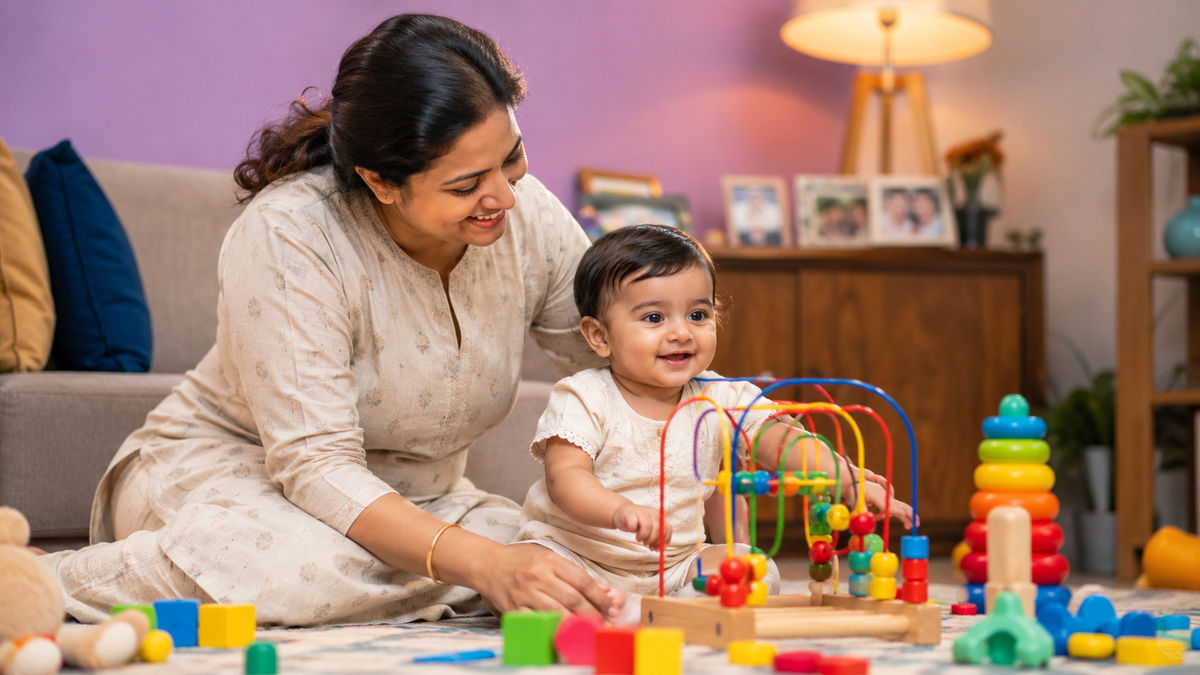
Losing interest in toys quickly is normal. A 3-month-old focuses for 30 seconds; a 6-month-old for 2 minutes; a 12-month-old for 5–8 minutes. The fix isn't buying more toys—it's rotating what you show, demonstrating how to play, and changing the play environment every few days.
Pratik had been a parent for six months when he started panicking. His daughter would grab a toy, mouth it for thirty seconds, then toss it aside and cry. He'd bought seven new toys that month alone. His wife, Ananya, finally asked: "Is this normal, or is something wrong with her?"
Daily baby tips, exclusive Amazon deals & real parent advice — free forever.
It's normal. And Pratik isn't alone—every parent believes their baby is the only one who cycles through toys like a bored CEO. The truth is simpler: your baby's attention span isn't broken. It's following a predictable, age-based rhythm. A newborn can focus on a face for barely thirty seconds. A 6-month-old might give you two minutes. A one-year-old, if you're lucky, will sit with a single toy for five to eight minutes before wandering off. Understanding what's typical for your baby's age, and why the brain works this way, changes everything about how you set up play—and stops the toy-buying panic.
What Is Normal Attention Span for Babies by Age?
Attention span isn't something babies are born with. It develops gradually, like rolling over or babbling. The younger the baby, the shorter the window. At three months, your baby's brain is still learning to hold focus on a single object. Thirty seconds of concentrated attention is actually an achievement. By six months, the window stretches to around two minutes—long enough for your baby to turn a rattle over in their hands, look at it from different angles, and then move on. At twelve months, most babies can sustain play on one toy for five to eight minutes, though this depends on how engaging the toy is and whether a parent is nearby.
These windows aren't failures. They reflect how the infant brain is wired. Babies are designed to sample their world quickly, not to bore deep into one thing. Each toy teaches something new—texture, sound, weight—and once that lesson lands, the brain is ready to move to the next input. This is why your one-year-old abandons a puzzle after a minute but will watch you demonstrate it for five minutes, then go back to trying it themselves.
Why Does Your Baby Lose Interest in Toys So Quickly?
There are two separate reasons this happens, and they feel the same but need different fixes. The first is novelty habituation: your baby's brain has learned what the toy does, and the dopamine hit from discovery fades. The second is under-challenge: the toy isn't complicated enough to hold their growing brain, or they haven't learned how to play with it yet.
You can usually tell the difference. If your baby picks up a toy, explores it for a minute, and drops it every single time, they've solved it—habituation. If your baby picks it up, gets frustrated, throws it, or ignores it entirely on day one, the toy might be the wrong fit for their age or skill level. A teething ring is perfect for a four-month-old but dead weight for a ten-month-old who wants to bang things together. An activity gym holds a six-week-old's attention; a nine-month-old needs something they can move, stack, or take apart.
The third reason—overstimulation—is less common but real. Too many bright toys, too many sounds happening at once, or too much parent chatter during play can overwhelm a baby's processing capacity. When this happens, babies shut down and look "bored" when they're actually tired.
Five Fixes That Actually Change the Problem
1. Rotate toys every three days. Store two-thirds of your baby's toys out of sight. Show one-third at a time. Swap them out every three days. When a toy reappears after a week away, your baby's brain sees it fresh—the novelty returns, focus returns. This single strategy makes parents feel like they've bought ten new toys when they've just reorganized what they own. Most parents report their babies play 40% longer with rotated toys than with the full collection visible at once.
2. Limit play sessions to one toy at a time. Don't scatter six toys on a mat and hope one captures attention. Put down one toy. Let your baby explore it fully for as long as they're interested—even if it's ninety seconds. When they move on, don't immediately introduce the next one. Sometimes babies need a thirty-second break between toys. A play session with one toy for three minutes beats six toys for twenty seconds each because focus builds incrementally.
3. Demonstrate first; then step back. Your baby learns how to play by watching you play. If you give them a stacking toy without showing how it stacks, they'll mouth it and abandon it. Sit down, stack three rings slowly while narrating—"Look, one ring, then another ring on top"—then hand it over. Your baby now has a puzzle to solve rather than an object to solve. The attention span stretches because there's a goal.
4. Change the play environment every few days. Same toy on the bedroom floor is boring. Same toy on a blanket by the window, with different light, is interesting. Sitting at a high chair with the toy on a tray feels different from playing on your lap. Babies' brains respond to context shifts. You don't need a new toy; you need a new frame around the old one.
5. Choose open-ended toys over single-function toys. A toy that does one thing—plays a song, lights up, spins—holds attention only as long as the novelty lasts, which for most babies is under a minute. A wooden spoon, a soft cloth, a plastic container, a set of stacking rings—these have no single "purpose," so your baby can use them differently each time. A six-month-old mouths it; a nine-month-old bangs it; a twelve-month-old stacks it. The same toy stays interesting across months because your baby's brain keeps finding new uses.
When Short Attention Span Might Be a Concern
If your baby is six months or older and cannot focus on a toy, a person's face, or a sound for more than fifteen seconds—even in optimal conditions—and this pattern has been consistent for weeks, it's worth mentioning to your pediatrician. Very short attention spans can occasionally signal sensory processing differences, hearing concerns, or other developmental questions that benefit from early assessment. But be clear on what you're describing: sustained inability to focus on anything, not just toys. Most babies who "get bored" with toys quickly are actually developing exactly as expected.
Overstimulation is worth checking too. If your baby plays calmly with one toy for three minutes but shuts down, cries, or gets hyperactive when multiple toys are visible, they may need a quieter play space. This is normal—some babies are simply more sensitive to sensory input—and it's fixed by reducing visual clutter, dimming lights slightly, and playing quieter music or no music during toy time.
The Toy-Buying Trap
Parents often interpret short attention span as a sign they need to buy more toys or different toys. Shops thrive on this. The truth is that most babies have enough toys already—they just can't see them all at once. A rotation system costs nothing and works better than a shopping spree. If you do add toys, pick them intentionally: does this toy match my baby's current age and skill? Is it something they can use in multiple ways? Can they play with it independently, or will I need to sit with them to make it work? One thoughtfully chosen toy beats ten impulse purchases.
What IAP and WHO Guidance Says
Play duration: The Indian Academy of Pediatrics emphasizes that play is a developmental tool, not an endurance test. Shorter, focused play sessions are developmentally appropriate and preferred over long stretches with multiple toys. Environment matters: WHO guidance on early childhood development highlights that changing the play context—location, lighting, available toys—supports sustained cognitive engagement and problem-solving skills in infants.
This is general information, not medical advice. If you're concerned about your baby's attention span or developmental progress, speak with your pediatrician.
📚 Sources
The guidance in this article draws on the sources below. It is general information, not medical advice: for any concern about your child's health, talk to your paediatrician.
- Indian Academy of Pediatrics: Early Childhood Development Guidelines — Supports expected developmental milestones and play behaviors by age
- WHO: Infant and Young Child Feeding Guidelines — Contextualizes early child development and sensory learning in developmental framework
Last updated 27 Oct 2026
Frequently Asked Questions
Is it normal for a 6-month-old to get bored with toys in 2 minutes?
How often should I rotate my baby's toys?
Does toy rotation actually work or is it just parent psychology?
What's the difference between bored and overstimulated?
Should I be worried if my 12-month-old won't focus on one toy for more than 5 minutes?
What types of toys hold a baby's attention longest?
Daily baby tips, exclusive Amazon deals & real parent advice — free forever.