
Screen Time Alternatives for 5-8 Year Olds: 5 Kitchen Science Activities That Build Real Curiosity
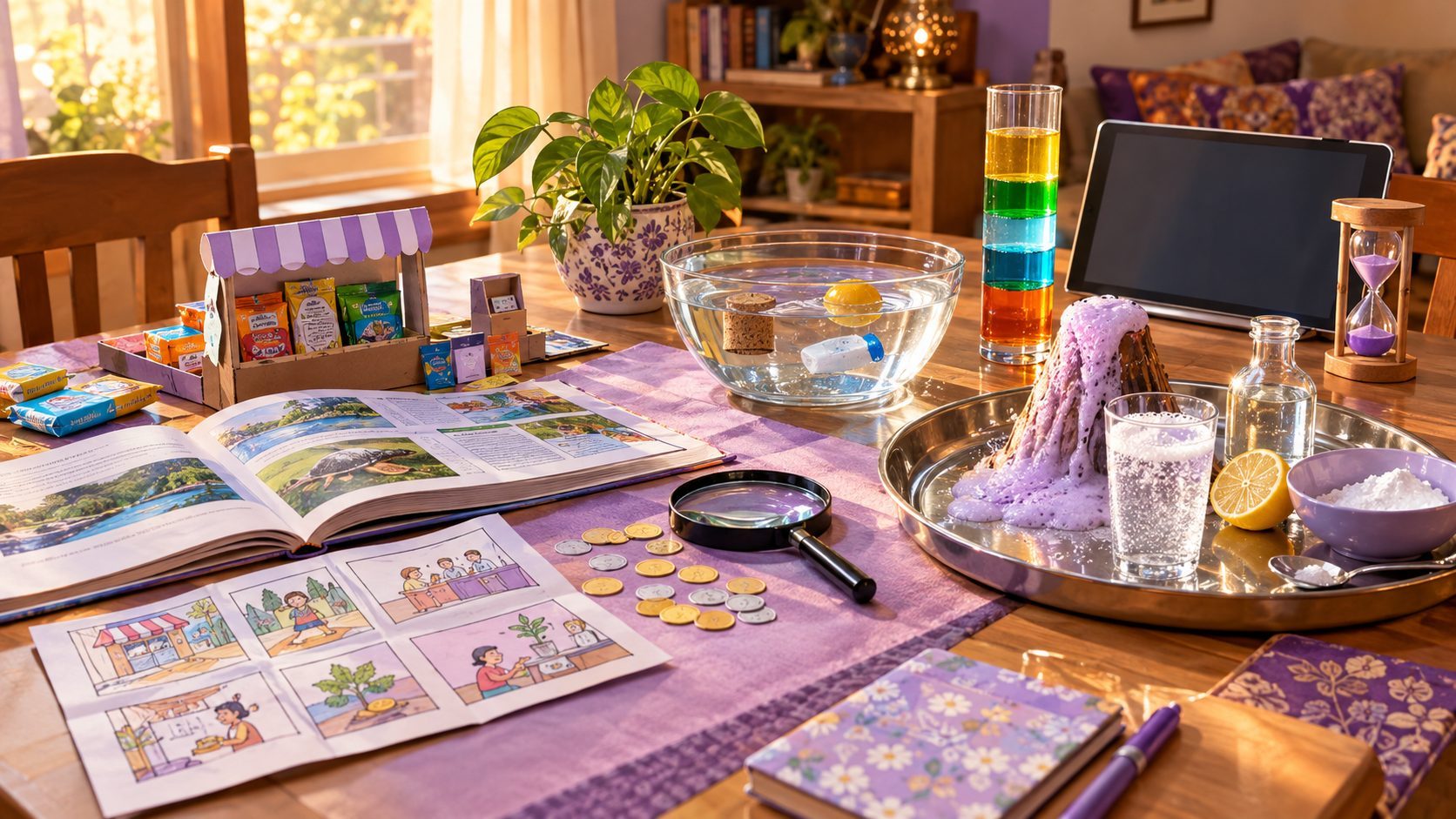
The best screen time alternatives for 5-8 year olds are hands-on science activities that teach observation and testing ideas. Five kitchen-based experiments—sink-or-float tests, ice-melt races, dissolving comparisons, baking-soda volcanoes, and shadow tracking—build real thinking skills using items you already have at home. IAP 2026 guidance recommends limiting recreational screen time to 1-2 hours daily for this age; structured hands-on learning fills that gap.
⚡ In a hurry? Our quick picks
What's Happening at This Age
🏆 Quick comparison: our top picks
| Product | Award | Rating | Price | |
|---|---|---|---|---|
 Usborne Science Experiment Activity Book for Ages 5-8 |
🏆 Editor's Choice | ★ 4.6 412 reviews |
₹499 | Check price → |
 Playshifu DIY Simple Circuit Kit with LED and Buzzer |
💰 Best Value | ★ 4.2 156 reviews |
₹249 | Check price → |
 National Geographic Junior Microscope with 40x-640x Magnification |
👑 Premium Pick | ★ 4.4 287 reviews |
₹5,834 | Check price → |
🛒 Our Top Picks
Best-reviewed overall, 4.6★ across 412 ratings.
Usborne Science Experiment Activity Book for Ages 5-8
- ✓ Why it fits: Gives your child a record of experiments they've done and sparks ideas for new ones—builds their own science journal habit
- ✓ Illustrated step-by-step instructions for 20+ experiments using household items
- ✓ Encourages prediction and observation note-taking; doubles as a keepsake
* We earn a small commission — at no extra cost to you.
Top rating for the price, 4.2★ at ₹249.
Playshifu DIY Simple Circuit Kit with LED and Buzzer
- ✓ Why it fits: Extends hypothesis-testing into cause-and-effect with electricity—if I touch this wire here, does the light turn on?
- ✓ Snap-together circuit components; no soldering or tools needed
- ✓ Includes battery, LED, buzzer, and wire connections; reusable for multiple builds
* We earn a small commission — at no extra cost to you.
Top of the range, for parents who want the best features.
National Geographic Junior Microscope with 40x-640x Magnification
- ✓ Why it fits: Magnifies details in salt crystals, sugar grains, and plant matter—deepens observation skills from the dissolving and nature experiments above
- ✓ 40x to 640x magnification lets kids see fine detail usually missed
- ✓ Comes with glass slides and cover slips; suitable for ages 6+
* We earn a small commission — at no extra cost to you.
Daily baby tips, exclusive Amazon deals & real parent advice — free forever.
Between 5 and 8 years, children's brains are wired to test ideas and notice patterns. This is the stage when a child moves from simply following instructions to asking "what if?" and wanting to see if their guess was right. According to the National Curriculum Framework for Foundational Stages (NCF-FS) 2022, this age group learns best through inquiry-based play: direct observation, making predictions, and testing them with their own hands. Screen time during these years can short-circuit this natural curiosity—the answers come too fast, and the child becomes a watcher rather than a thinker.
Kitchen science taps into exactly what this age needs: real materials, visible results, and the space to say "I think this will happen" and then find out if they're right. Every activity below builds on what a typical 5-8 year old can already do—follow a sequence, notice when something changes, and explain what they saw.
Try This at Home
Sink or Float with Kitchen Items
You need: A steel bowl or bucket of water, and items from your kitchen—steel spoon, wooden spatula, apple, lauki, tamarind (imli), salt jar, plastic container, cloth. Pick 8-10 items.
How: Ask your child to predict whether each item will sink or float before dropping it in. Write their guesses on a piece of paper (or use a simple chart). Drop each item and check. Talk about why they think something floated or sank—was it heavy, light, hard, soft? Does size matter? Did their prediction match?
What it builds: Observation, prediction-testing, reasoning about material properties.
Easier: Use only 5 very different items (apple vs stone, cloth vs spoon). Harder: Test sealed containers with different amounts of water inside; challenge them to explain why some floated and others sank.
Ice-Melt Race
You need: Three ice trays (or containers), freeze water overnight, table salt, regular sugar, and a spoon. Make ice cubes ahead of time.
How: Place three ice cubes on a plate or tray. Sprinkle salt on the first, sugar on the second, and leave the third plain. Check every 2-3 minutes and ask: which is melting fastest? Why do you think that is? You can time them with a simple watch or phone timer.
What it builds: Observation of change, hypothesis-testing, understanding that materials affect how things work.
Easier: Just observe which melts fastest without adding salt or sugar. Harder: Try warm water, cold water, and room-temperature water on the same materials; predict what happens and test it.
Salt vs Sugar: Dissolving Speed
You need: Two clear glasses, warm water (not hot), a spoon, salt, and sugar. Label or remember which is which.
How: Pour warm water into both glasses. Add a teaspoon of salt to one, a teaspoon of sugar to the other, at the same time. Stir both at the same speed. Which disappears first? What do they notice about the crystals before and after? Does the water look different?
What it builds: Observation of dissolving, understanding that different materials behave differently, timing and comparison skills.
Easier: Use hot water (adult handles this) to see faster results. Harder: Add a third glass with salt in cold water; predict which glass's salt will disappear first and why.
Lemon and Baking Soda Volcano
You need: A lemon, a small spoon, baking soda, a plate or tray, and food colouring (optional—turmeric or tomato juice works too).
How: Cut a lemon in half. Scoop out a small hollow at the top. Place it on a plate. Let your child add a pinch of turmeric or food colouring to the hollow, then add a teaspoon of baking soda. Ask them to predict what will happen. Pour a little lemon juice into the hollow and watch the reaction. Talk about the fizzing—what made it bubble? Why did the colour come out?
What it builds: Cause-and-effect thinking, observation of chemical reaction, excitement about discovery.
Easier: Just use baking soda and vinegar in a cup (adult pours the vinegar). Harder: Try the same volcano with different liquids (orange juice, milk, water) and predict which will fizz most.
Shadow Length Tracking
You need: A sunny outdoor space (or sunny windowsill indoors), a stick or pencil, paper, a marker, and a clock or your phone for time notes.
How: Stand the stick upright in the ground or tape it to a sunny window ledge. Mark where the shadow falls on the ground with chalk or paper. Check and mark the shadow's position every hour or every 30 minutes over a morning or afternoon. Talk about what they notice: Is the shadow moving? Getting shorter or longer? Why do they think it's changing?
What it builds: Observation over time, pattern recognition, understanding how the sun moves, patience with slow changes.
Easier: Just check the shadow length morning, midday, and afternoon (three observations). Harder: Measure the shadow length with a ruler; plot the measurements on graph paper and look for a pattern.
What "Getting It" Looks Like
You'll know your child is thinking like a scientist when they start asking "what if?" before you even suggest an experiment. They'll notice small changes—the ice is slippery now, the sugar looks different—and want to explain why. They may want to test the same idea twice or try a variation on their own. They'll get frustrated when a prediction doesn't match the result, but then want to do it again to figure out why. They may start noticing patterns: "The shadow moves every time!" or "Salt melts ice faster than nothing." These aren't big achievements, but they show a mind actively testing reality rather than passively receiving it.
When to Move On, and When to Ask
If your child can make a simple prediction, test it, and notice the result, they're ready for slightly more complex experiments—comparing three things instead of two, or testing over a longer time. If they're not interested yet, that's normal; keep offering low-pressure invitations. If you notice they struggle to focus on any activity for more than a few minutes, or if they seem fearful of getting predictions "wrong," talk to your paediatrician to rule out attention or anxiety concerns. Most children at this age are ready for this kind of play—it's actually what their brains crave when screens aren't filling the space.
If You're Homeschooling
These activities slot naturally into a weekly rhythm. Pick one each week and let it take 15-20 minutes. Rotate them so your child isn't bored. Sink-or-float can become a sorting and classification lesson; shadow tracking becomes basic astronomy; dissolving leads naturally into fractions and measurement. Pair each experiment with a simple drawing or observation notebook—your child sketches what they saw and writes one sentence about it (or you scribe). This builds both scientific thinking and literacy.
What Helps at Home (Optional)
Every activity above works with things you already have. But a few additions can make observation easier and more rewarding. A simple magnifying glass lets them see fine details they'd miss (salt crystals before and after dissolving, or the texture of materials before they go in water). A junior microscope or magnification set opens up a new layer of curiosity. An activity book with illustrated science experiments designed for this age can spark ideas and give them a record of what they've tried. None of these are necessary—the kitchen and outdoors have everything a 5-8 year old needs to learn—but they can deepen the play if your child is already hooked.
What IAP and WHO Guidance Says
The Indian Academy of Pediatrics (IAP) 2026 guidelines recommend limiting recreational screen time to 1-2 hours per day for children 5-8 years. Hands-on, unstructured play—especially exploration with real materials—supports the cognitive development that screens interrupt. WHO guidance similarly emphasises that this age needs active play and direct problem-solving to develop attention and reasoning skills.
📚 Reviewed against
This guide was checked against the sources below. It is general parenting guidance, not medical advice — for any concern about your child's development, talk to your paediatrician.
- National Curriculum Framework for Foundational Stages (NCF-FS) 2022 — Supports inquiry-based play and observation-led learning in ages 5-8
- Indian Academy of Pediatrics (IAP) Screen Time Guidelines 2026 — Recommends 1-2 hours daily recreational screen limit for 5-8 year olds
- WHO Guidelines on Physical Activity and Sedentary Behaviour for Children Aged 5-17 Years — Emphasises importance of active play and hands-on learning over passive screen use
Last reviewed 02 Nov 2026
Frequently Asked Questions
How much screen time is okay for a 5-8 year old according to IAP?
Do these experiments need special materials or supplies?
How long do these activities usually take?
What if my child isn't interested in science activities?
Can these activities work outdoors?
Should I correct my child if their prediction is wrong?
Daily baby tips, exclusive Amazon deals & real parent advice — free forever.