Storytelling Activities for 1 Year Old at Home: 5 Ideas Using Household Items
Storytelling for 1-year-olds means rhythm, repetition and simple narratives tied to things they see daily. Try lullabies with hand actions, stories told with kitchen items, photo-album narration, sound-effect play and naming what happens during routine caregiving. All work with what's already in your home.
⚡ In a hurry? Our quick picks

At 12 to 24 months, your child's brain is wired to absorb language through rhythm, repetition and emotion—not through screens or even perfect words. When you tell a story, sing a lullaby or narrate your morning routine in a sing-song voice, you're doing something far more powerful than entertainment. You're building the neural pathways for listening, memory, vocabulary and the confidence to eventually tell their own stories. This guide gives you five storytelling activities that work in any Indian home, right now, with nothing to buy.
🏆 Quick comparison: our top picks
| Product | Award | Price | |
|---|---|---|---|
 Toysme Finger Puppets Set (Pack of 10) - Animals |
👑 Premium Pick | ₹369 | Check price → |
 Pratham Books 'Early Learning Board Book Series' - Set of 5 |
🪙 Budget Pick | ₹167 | Check price → |
 Mira Enterprises Soft Cloth Baby Book Set (Pack of 4) |
See on Amazon | Check price → | |
 Moonlight Slumber Hand Puppet - Soft Plush (Multi-character set) |
See on Amazon | Check price → |
🛒 Our Top Picks

The highest-priced option in this guide.
Toysme Finger Puppets Set (Pack of 10) - Animals
- ✓ Why it fits: Small puppets introduce characters to daily storytelling and sound-effect narratives, helping toddlers connect voice to character
- ✓ Soft felt construction safe for 12+ months (no button eyes or detachable parts)
- ✓ Fits small hands; encourages reaching and grasping during story play
* We earn a small commission — at no extra cost to you.
The lowest-priced option in this guide.
Pratham Books 'Early Learning Board Book Series' - Set of 5
- ✓ Why it fits: Sturdy board books with simple, culturally relevant images for India-based daily routine narration and photo-style storytelling
- ✓ Thick cardboard pages withstand mouthing and repeated page-turning
- ✓ Minimal text, large images align with 12-24 month receptive language levels
* We earn a small commission — at no extra cost to you.
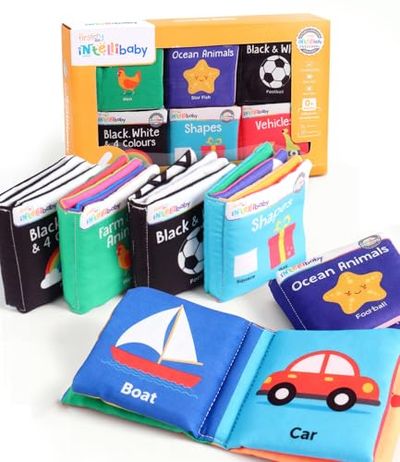
Mira Enterprises Soft Cloth Baby Book Set (Pack of 4)
- ✓ Why it fits: Cloth books with simple, repetitive images and textures support photo-narrative storytelling and tactile exploration during story time
- ✓ Machine washable, durable fabric safe for mouthing
- ✓ Soft crinkle sounds built into pages add multi-sensory dimension to narration
* We earn a small commission — at no extra cost to you.

Moonlight Slumber Hand Puppet - Soft Plush (Multi-character set)
- ✓ Why it fits: Hand puppets allow you to embody characters during sound-effect and lullaby stories, adding visual movement and voice variation
- ✓ Lightweight plush safe for supervised play; no small parts or cords
- ✓ Fits your hand comfortably for extended storytelling sessions
* We earn a small commission — at no extra cost to you.
Daily baby tips, exclusive Amazon deals & real parent advice — free forever.
What's happening at this age
Between 12 and 24 months, your child is in what early-childhood educators call the "receptive language explosion"—they understand far more than they can say. According to the National Curriculum Framework for Foundational Stage (NCF-FS 2022), this is the ideal window for building listening skills, phonological awareness (the ability to hear and play with sounds) and narrative understanding. They don't need complex plots; they need repetition, rhythm, familiar voices and emotional connection. When you tell a story, sing with actions or narrate their own day back to them, you're creating anchor points for memory and meaning-making. The rhythm of language—even in Hinglish or your mother tongue—is what matters most.
Try this at home
Lullaby and rhyme with hand actions
You need: Your voice, your hands, your lap. No materials.
How: Sing a familiar lullaby or nursery rhyme in your mother tongue—a Marathi, Bengali, Tamil, Punjabi, Hindi or Telugu lullaby works beautifully. As you sing, guide your child's hands (or your own, for them to watch) to tap your knees, clap, or trace circles in the air. For example, while singing "Ramdhan Ramdhan," clap on each beat. Repeat the same song 3–4 times over a week so the pattern becomes familiar. Watch how your child's body starts to anticipate the rhythm.
What it builds: Phonological awareness, rhythm recognition, body coordination and emotional bonding through your voice and touch.
Easier / harder: Easier: just sing, no actions—watch them sway or babble along. Harder: introduce two hand actions (clap, then tap chest) and see if they copy after a few repetitions.
Story with spoons and katoris
You need: Two steel spoons, two katoris (steel bowls), a dupatta or cloth.
How: Sit on the floor with your child. Drape the cloth over the katoris to create a "house" or "cave." Tap the spoons gently on the katoris to make sounds. Tell a simple, repetitive story: "Choti chidiya ghar mein chupa hai. *Tap tap tap.* Bahar nikla. *Tap tap tap.* Phir se chupa." (Little bird is hiding in the house. It came out. It hid again.) The tapping becomes the heartbeat of the story. Repeat the same narrative 2–3 times, so the pattern and sounds anchor the story in their memory.
What it builds: Listening for patterns, understanding cause-and-effect (sound follows action), vocabulary tied to objects they can touch.
Easier / harder: Easier: just tap the katori without a narrative; let them tap too. Harder: use the spoon to "feed" the cloth-covered katori and add dialogue: "Katori ko khana khila rahe hain." (We are feeding the bowl.)
Photo-album story narration
You need: A simple photo album or printed photos—your family, your home, your child at different ages.
How: Sit together and flip through the photos slowly. Narrate what you see in a warm, descriptive voice: "Dekho, tu tera mumma ke saath hai. Mumma khush hai. Tu bhi khush hai." (Look, there you are with your mother. Mother is happy. You are happy too.) Use the same words and tone for the same photos each time. Children this age love the predictability. Point to faces and name them: "Nani, Papa, Dadi." Pause and see if they look, point or babble in response.
What it builds: Memory, face recognition, vocabulary for family members, understanding that images represent real people and moments.
Easier / harder: Easier: just show photos and name people. Harder: ask questions: "Yeh kaun hai?" (Who is this?) and wait for their response (even if it's a sound).
Sound-effect story play
You need: Your voice and body. Optional: a wooden spoon, a plate, a bell or anything that makes a safe, non-startling sound.
How: Tell a story with sound effects. For example: "Choo-choo train aa rahi hai." (Here comes the train—make a chugging sound with your mouth: "Choo-choo-choo.") "Ruk gai!" (It stopped—silence). "Phir chali!" (It went again—more sounds.) Repeat this pattern 3–4 times. If you have a wooden spoon, tap it on the floor for the train sounds. The repetition, the sounds and the pauses create suspense and anticipation. Children this age light up when they can predict what comes next.
What it builds: Sound discrimination, anticipation and prediction, vocabulary linked to actions and emotions.
Easier / harder: Easier: make one sound (a "moo" for a cow) repeatedly. Harder: add two sound effects and see if they point or vocalize when they hear each one.
Daily routine narration
You need: Your voice and your regular day.
How: As you move through your morning or evening routine, narrate it like a gentle, ongoing story. "Ab naha lete hain. Pehle haath. Phir muh. Ab tummy." (Now let's bathe. First hands. Then face. Now tummy.) Use the same words, the same order, the same rhythm every day. When you dress them: "Pehle bazu. Ab baki badu." (First arm. Now other arm.) This isn't sing-song performance; it's warm, conversational storytelling woven into real life. Children thrive on predictability, and when the words match the actions, language sticks.
What it builds: Language tied to real actions and objects, predictability and comfort, vocabulary for body parts and daily routines.
Easier / harder: Easier: narrate in single words: "Paani... Hath... Sukha." (Water... Hand... Dry.) Harder: add questions: "Paani thandi hai na? Thandi-thandi!" (The water is cold, isn't it? So cold!)
What "getting it" looks like
Around 18–24 months, you'll notice your child turning toward your voice, watching your mouth as you speak, and babbling or vocalizing along with songs. They might point at photos when you name them, or repeat a sound (like the train's "choo-choo") after hearing it several times. Some children will try to clap along to a rhyme, or sway when they hear a familiar lullaby. These aren't perfect imitations—they're signs that the story, the rhythm and the words are landing in their brain. If your child is quieter and seems to prefer watching over joining in, that's also normal; every child processes language at their own pace.
When to move on, and when to ask
By 24 months, most children start using 20–50 words and show interest in simple picture books or pointing games. If your 20-month-old shows no response to your voice, doesn't turn toward sounds or hasn't started babbling or vocalizing, it's worth mentioning to your paediatrician. Hearing concerns are easier to address early. If language development feels slower than you expected, a speech-language pathologist can offer guidance. This is general information, not medical advice—trust your instinct and ask if something feels off.
If you're homeschooling
Weave one storytelling activity into your daily rhythm—perhaps a lullaby after lunch, a photo-album moment on a rainy afternoon, or routine narration during bath time. The goal isn't a formal "lesson"; it's consistency and warmth. Five minutes of your focused voice and attention is more powerful than any structured program at this age.
What helps at home (optional)
Every activity above works with absolutely nothing new—just your voice, your hands and things you already have. That said, a few items can make storytelling a bit richer: a cloth book your child can touch and chew (soft, washable, durable), a set of finger puppets or felt characters to introduce during stories, or a sturdy board book with bright, simple images and minimal text. None of these are necessary, but they can add a tactile dimension to the stories you're already telling.
What IAP and WHO Guidance Says
• Language development: The Indian Academy of Pediatrics (IAP) emphasizes that responsive, conversational language from caregivers during the first three years is foundational for vocabulary and literacy. Narration, song and repetition are key tools.
• Early literacy: WHO's early-childhood development guidelines highlight that children learn language best through interaction, rhythm and emotionally warm exchanges—not screens or formal instruction. Home language (mother tongue) is as effective as any other for building these skills.
📚 Reviewed against
This guide was checked against the sources below. It is general parenting guidance, not medical advice — for any concern about your child's development, talk to your paediatrician.
- National Curriculum Framework for Foundational Stage (NCF-FS) 2022 — Guides early language and listening development for children 0–6 years, emphasizing mother-tongue narratives and rhythm.
- WHO Early Childhood Development Fact Sheets — Supports language learning through responsive caregiving, repetition and emotional connection in the home language.
- Indian Academy of Pediatrics (IAP) - Child Development Guidelines — Documents key language milestones and the importance of conversational, narrative interaction for language growth in infants and toddlers.
Last reviewed 26 Nov 2026
Frequently Asked Questions
How can I teach my kids storytelling skills at this age?
How do I entertain my 1 year old at home with stories?
Is story time good for toddlers?
What should I tell a 1 year old in a story?
How long should storytelling sessions be for a 1 year old?
What if my 1 year old doesn't seem interested in stories?
Daily baby tips, exclusive Amazon deals & real parent advice — free forever.