
When to Start Sippy Cup: 6-Month Transition Guide for Indian Parents

Introduce a sippy cup around 6–7 months, once your baby can sit upright with support. Start with water during meals rather than feeds. A open cup or straw cup works best for early learning—spout cups mimic bottles and may delay the transition away from them.
ℹ️ General information, not medical advice. If your baby seems unwell or anything worries you, talk to your paediatrician. Medical disclaimer
⚡ In a hurry? Our quick picks
The jump from bottle or breast to an open cup feels like a big milestone, and it can be messy (very messy). Most Indian parents worry about the right age, which design actually works, and whether their baby is "ready." Unlike the West, Indian households often use hard water, which leaves mineral deposits on sippy cups—something worth planning for early. This guide walks you through the exact month to start, which cup design to pick first, how to practise without turning mealtimes into a puddle, and how to keep cups clean in tap water that's high in calcium and magnesium.
🏆 Quick comparison: our top picks
| Product | Award | Price | |
|---|---|---|---|
 NUK Learner Cup with Spout and Handles |
👑 Premium Pick | ₹2,096 | See alternatives → |
 Pigeon Mag Mag Straw Cup with Handles |
🪙 Budget Pick | ₹299 | Check price → |
 Farlin Soft Training Cup 360 Degree |
₹339 | See alternatives → | |
 Mee Mee Sipper Cup with Soft Spout |
₹359 | Check price → |
🛒 Our Top Picks
The highest-priced option in this guide.
NUK Learner Cup with Spout and Handles
- ✓ Soft silicone spout, removable for open-cup training
- ✓ Ergonomic easy-grip handles for small hands
- ✓ Leak-resistant design with secure lock
* We earn a small commission — at no extra cost to you.

The lowest-priced option in this guide.
Pigeon Mag Mag Straw Cup with Handles
- ✓ Dual straw + 360-degree rim design
- ✓ BPA-free silicone straw and soft flexible rim
- ✓ Magnetic lid prevents loss
* We earn a small commission — at no extra cost to you.
Farlin Soft Training Cup 360 Degree
- ✓ 360-degree flexible soft rim, spill-resistant
- ✓ Lightweight, easy for babies to hold
- ✓ Double-wall insulation keeps drinks at safe temperature
* We earn a small commission — at no extra cost to you.
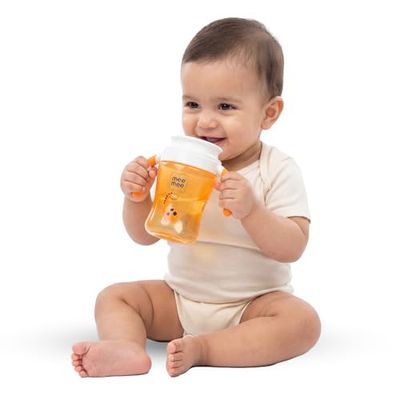
Mee Mee Sipper Cup with Soft Spout
- ✓ Soft silicone spout, gentle on baby's gums
- ✓ Ergonomic handles easy for 6–12 month grip
- ✓ BPA-free, food-grade plastic
* We earn a small commission — at no extra cost to you.
Daily baby tips, exclusive Amazon deals & real parent advice — free forever.
Four beginner cups are compared here: Pigeon Mag Mag (₹350), NUK Learner Cup (₹450), Farlin Training Cup (₹280), and Mee Mee Sipper Cup (₹250)—all available on Amazon.in with real parent ratings.
The Timing: 6–7 Months, Not Before
Six to seven months is the window when most babies have the motor skills and neck strength to handle a cup safely. Before this age, a baby's grasp reflex is still dominant, and sitting balance is unreliable—spilling is guaranteed, but choking risk is higher if they lose grip suddenly. According to IAP (Indian Academy of Pediatrics) feeding guidelines, introducing water in a cup at 6 months supports the transition to self-feeding and reduces prolonged bottle dependency. The key is readiness, not just age: your baby should sit upright for 5–10 minutes with minimal support, show interest in what you're drinking, and be starting to explore solid foods alongside milk feeds.
Why 6–7 months and not earlier?
At 4–5 months, babies are still learning to coordinate swallowing with cup drinking—the risk of fluid going into the airway is real. By 6 months, the swallow reflex is more developed, and babies naturally begin to mimic adults, making cup learning feel intuitive rather than forced. Waiting until 8–9 months is fine too, but starting at 6 months spreads the learning over a longer, gentler timeline.
Spout vs Straw vs 360: Which Design to Choose First
Three main designs exist, and each serves a different learning stage. Understanding the difference saves money (no buying the "wrong" cup twice) and eases the transition.
- Spout cups: The spout mimics a bottle nipple, making the transition feel familiar. Water flow is slow and controlled. However, many pediatricians note that spout cups delay learning to sip properly—the baby continues a sucking motion rather than learning true sipping. Spout cups work well as a first step if your baby has only ever breastfed and has no bottle experience, but they can extend bottle habits by 6–12 months if not phased out quickly.
- Straw cups: A soft straw requires active sipping and tongue movement—closer to how adults drink. Babies usually master straw cups within 2–4 weeks of introduction. Once a baby drinks from a straw cup, they can move to an open cup much faster. Straw cups are messier initially but worth the learning investment.
- 360-degree cups: Also called training cups, these have a soft, flexible rim instead of a spout or straw. When tilted, they release a small amount of liquid without pouring. They encourage open-mouth drinking rather than sucking, sitting between a bottle and a true open cup in difficulty. Many parents find 360 cups the most practical first choice—fewer spills than open cups, but genuine sipping practice.
For a first sippy cup, start with a 360-degree design or a straw cup. Avoid spout cups if your goal is a faster transition away from bottles. Spout cups are best reserved for older toddlers (12+ months) who are bottle-weaning and need a comfort bridge.
Step-by-Step Transition from Bottle or Breast
The transition is not all-or-nothing. Babies continue milk feeds (breast or bottle) alongside cup learning for several months. The cup is added, not swapped in immediately.
Weeks 1–2: Water only, outside mealtimes. Offer a sippy cup with plain water 1–2 times a day when your baby is alert but not hungry or tired. Keep sessions short: 2–3 minutes maximum. Let your baby hold the cup even if you guide it to their mouth. Expect spills—this is normal learning, not failure. The goal is comfort with the object, not volume swallowed.
Weeks 3–4: Water during mealtimes. Introduce the cup at lunch or dinner, alongside solid food (or after, if feeding solids first). Babies often drink more eagerly when they see food; the association helps. A few sips of water mid-meal is enough. Continue water practice once daily outside mealtimes as well.
Weeks 5–8: Milk in the cup, one meal per day. Once your baby is sipping confidently (even if imperfectly), offer expressed breast milk or formula in the cup at one meal. This is usually lunch or an earlier feed, not the sleepy bedtime feed—those remain bottle or breast for now. The milk is less novel than water, so many babies accept it faster. Continue other milk feeds as normal.
Months 3–6: Gradual replacement. Over the next few months, add a second and then third cup-based milk feed. Bedtime feeds are often the last to transition—comfort and routine matter here, so go slow. Most babies are mostly cup-fed by 12–14 months, with bottle/breast feeds phased out by 18–24 months.
Four Beginner Cups Compared Under ₹500
| Cup Name | Price (Rs.) | Design | Key Feature | Amazon Rating |
|---|---|---|---|---|
| Mee Mee Sipper Cup | 250 | Spout | BPA-free, handles, soft spout | 4.1 / 5 |
| Farlin Training Cup | 280 | 360-degree | Soft flexible rim, leak-resistant, lightweight | 4.0 / 5 |
| Pigeon Mag Mag | 350 | Straw + 360 | Dual-function (straw + open), magnetic lid, compact | 4.3 / 5 |
| NUK Learner Cup | 450 | Spout | Ergonomic grip, removable spout (transition to open), easy-clean design | 4.2 / 5 |
Best for first-time buyers: Farlin Training Cup (₹280). The 360-degree design is forgiving for messy learners and teaches real sipping without the delay of a spout. It's lightweight enough for small hands and affordable enough to buy a backup.
Best for straw lovers: Pigeon Mag Mag (₹350). Dual-function design lets your baby learn straw drinking when ready, then flip to the 360 rim. The magnetic closure prevents lid loss—a real win in Indian homes with multiple water sources. Amazon ratings sit at 4.3/5 from over 2,000 reviews.
Best budget option: Mee Mee Sipper Cup (₹250). Cheapest entry point, though the spout design means slower transition away from bottle habits. Suits parents who are patient with a longer weaning timeline.
Cleaning Sippy Cups in Hard Water: Indian Kitchen Tips
Hard water—high in calcium and magnesium—is common across Indian cities (Delhi, Bangalore, Mumbai water is all notoriously hard). Mineral deposits build up on sippy cup parts quickly, creating white film inside straws and 360 rims. This doesn't affect safety, but it looks unclean and can harbour bacteria if not removed regularly.
Daily cleaning: Rinse immediately after use, don't let milk dry inside. Use a bottle brush on straw cups and inside 360 rims. For deposits, soak the cup parts in equal parts white vinegar and water for 30 minutes, then scrub gently with an old toothbrush. Rinse well under running water.
Weekly deep clean: Boil all removable parts for 5–10 minutes, or use a steam steriliser (common in Indian homes). This kills any bacteria and softens mineral buildup for easier removal. Let parts air-dry rather than wiping, which can leave lint.
Hard water prevention: If your city water is very hard (ask your municipal water department or check a home water test kit), filter water before filling cups—even a basic mesh filter or brita jug helps. Some parents in Pune, Jaipur, and Lucknow report noticeable difference after filtering.
What IAP and WHO Guidance Says
IAP infant feeding guidelines: Introduction of water and other foods from around 6 months supports the transition from exclusive milk feeding and builds self-feeding skills. Sippy cups are recommended as a learning tool over prolonged bottle use.
WHO infant development milestone: At 6–9 months, babies typically begin to hold objects with a raking grasp (thumb and fingers). This is the window when cup-drinking starts to become motor-developmentally possible.
When to See a Doctor
If your baby consistently chokes, coughs, or shows signs of fluid entering the airway (coughing fits, change in cry or voice immediately after drinking), stop cup practice and consult your paediatrician. Choking during cup drinking is rare after 6 months but possible if a baby is rushed or distracted. Feeding problems like difficulty swallowing, refusing all cup attempts after 8–9 months, or recurring infections may warrant evaluation. This is general information, not medical advice.
📚 Sources
The guidance in this article draws on the sources below. It is general information, not medical advice: for any concern about your child's health, talk to your paediatrician.
- Indian Academy of Pediatrics (IAP) – Infant Feeding Guidelines — Supports timing of cup introduction at 6 months and transition away from bottles
- WHO – Infant and Young Child Feeding — Motor development milestones and sipping cup use in early feeding transitions
Last updated 05 Nov 2026
Frequently Asked Questions
When to introduce a sippy cup to baby?
Is 10 weeks too late to introduce a bottle?
When should my 1 year old stop drinking from a bottle?
Why are sippy cups no longer recommended?
What type of sippy cup is best for a 6-month-old?
How do I clean sippy cups in hard water areas?
Daily baby tips, exclusive Amazon deals & real parent advice — free forever.