
Phonics vs Whole Language: Why Indian Schools Use Both for Grade 1–2 Readers
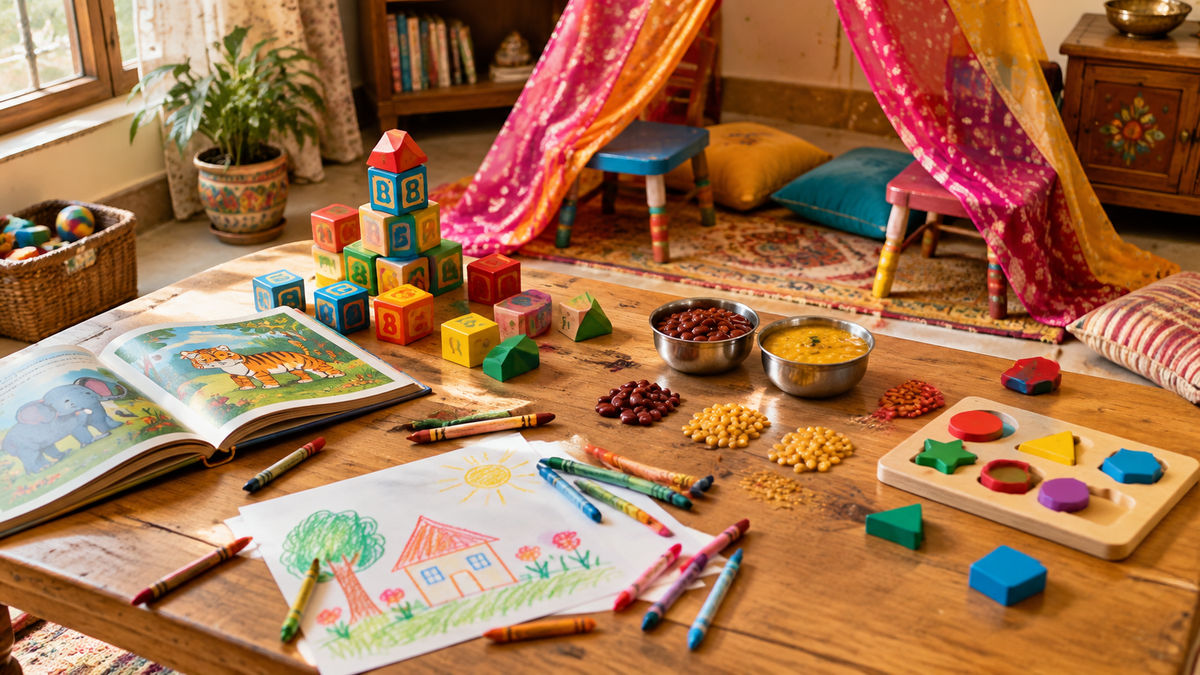
Phonics teaches children to sound out letters and blend them into words; whole language teaches them to recognize whole words by sight and context. Indian schools use both methods because English alphabet letters differ from Devanagari and Tamil phonetic structures — phonics alone struggles with irregular words like "was," while whole language helps children read fluently but may mask weak decoding skills. At home, combining chalk-on-floor letter games with story retelling works better than either approach alone.
Daily baby tips, exclusive Amazon deals & real parent advice — free forever.
If your Grade 1 or 2 child's teacher mentions phonics during parent conversations, or you've noticed your child guessing at words instead of sounding them out, you're already thinking about reading methods. That's the parent dilemma right here: Should I drill letter sounds? Should I show whole words? Or both? And does it even matter with Devanagari or Tamil at school?
The short answer is yes, it matters — and yes, both. But not equally, and not at the same time. Indian schools mix these approaches because English arrived in Indian education with its own irregular rules, yet children already have phonetic script literacy from regional languages. Understanding which method does what at home saves you from drilling the wrong thing.
What's Happening at This Age
Between ages 6 and 8, your child's brain is rewiring for written language. According to India's National Curriculum Framework for Foundation Stage (NCF-FS 2022), Grade 1–2 reading is not about memorizing; it's about building two parallel skills: decoding (sounding out) and automaticity (recognizing familiar words instantly). The shift from oral to written language happens fastest when children see print as sounds first, then internalize common patterns.
In Devanagari and Tamil, this transition is cleaner: almost every letter has one consistent sound, and there are far fewer irregular words than in English. But because many Indian schools teach English as a second language from Grade 1, children meet a script where "c" sounds like "k" in "cat" but "s" in "city" — phonics alone creates confusion. Whole language steps in to say: "just remember this word as a shape." Paediatricians and speech-language pathologists in India (IAP advisory, 2023) note that bilingual children actually develop stronger phonemic awareness when both approaches are explicitly taught, because comparing sound rules across scripts strengthens the underlying skill.
Try This at Home
Activity 1: Chalk Letters on the Floor
You need: A stick of chalk and a small clear floor space — no purchase needed.
How: Write a single letter (A, B, M) in large chalk. Point to it and make the sound ("ahhh," "buh," "mmm"). Ask your child to walk on it, say the sound, then say a word that starts with it. Erase and pick a new letter. Do 2–3 letters per session, 5 minutes.
What it builds: Letter-sound association, the foundation of phonics. The physical movement anchors the sound in memory better than flashcards.
Easier: Stick to vowels (A, E, I, O, U) first. Harder: Say two words that start with the letter; ask which one matches a picture you describe.
Activity 2: Newspaper Headline Hunt
You need: Any newspaper, scissors, a notebook or cardboard — materials most homes have.
How: Cut out 3–4 short, repeated words from headlines (words like "the," "and," "for," "his," "can"). Glue them onto cardboard. Show each one and say it aloud. Next day, shuffle the cards and ask your child to find the one you name. This is whole language learning: the word becomes a familiar visual.
What it builds: Sight-word fluency. Children who recognize 30–40 common words by sight read simple sentences without sounding out every word, which feels like "real reading" and builds confidence.
Easier: Use words with repeated letters ("see," "book") so the shape is memorable. Harder: Mix in phonetically regular words ("cat," "run") and irregular ones ("said," "was") to show which ones need sounding out.
Activity 3: Story Retelling with Props
You need: A picture book (library book is free) and 2–3 toy items or drawn pictures — no cost.
How: Read a short story aloud. Stop and ask your child to retell it using toy items or drawings. The child uses words and context, not yet decoding, but the brain builds the link between meaning and print. As she retells, point to the words in the book: "See, it says 'the cat ran.' That's where it tells us what happened."
What it builds: Comprehension and context clues (whole language strength). Retelling also builds vocabulary and confidence that reading is about meaning, not just letter sounds.
Easier: Retell using only actions — no words. Harder: Ask her to find specific words in the text after retelling ("Can you point to where it says 'cat'?").
Activity 4: Sound Blend Games
You need: Your voice and simple three-letter words written on scraps of paper — no purchase.
How: Write "cat," "run," "sit" on scraps. Point to each. Say the sounds separately ("c — a — t") then blend them fast ("cat!"). Ask your child to blend a word you sound out: "m — a — t" (wait for "mat"). This is phonics at work.
What it builds: Blending fluency. Children who can blend sounds into words can decode unfamiliar words, a skill that prevents them from relying only on guessing.
Easier: Use only two sounds ("ma," "to"). Harder: Use words with consonant clusters ("flag," "step").
Activity 5: Regional Script Comparison
You need: A Devanagari or Tamil alphabet chart (draw it, or print from a free source) and the English alphabet side by side.
How: Point to a Devanagari letter (say, "का") and its sound ("kaa"). Then show English "c" and explain: "In English, this sometimes says 'k' and sometimes says 's'. In Hindi, it's always this sound." This meta-awareness helps children understand why phonics is easier in regional languages.
What it builds: Metalinguistic awareness — understanding how languages work differently. Bilingual children who see this pattern often become stronger decoders because they stop expecting English to be regular and instead use context.
Easier: Just match letters to one sound each. Harder: Ask her to write a word in Devanagari and English and notice which script needs fewer "rules."
What "Getting It" Looks Like
By end of Grade 1, a child who's developing well can blend simple three-letter words ("cat," "sun," "sit") in 2–3 seconds without sounding out aloud. She recognizes 20–30 common sight words instantly ("the," "and," "was"). When she encounters a new word, she tries sounding it out first, or uses a picture as a clue. She's not reading fluently yet — that comes Grade 2–3 — but she's no longer just guessing.
Red flag: If she's still reversing letters ("b" and "d") often after age 7, or can blend sounds but can't remember any sight words, or guesses randomly without trying to sound out, tell her teacher. These aren't failures; they're signals to adjust the method mix.
When to Move On, and When to Ask
Move on from chalk letters once she's blending three-letter words fluently. Move from simple sight words to longer ones. By mid-Grade 2, shift toward reading short sentences aloud (not memorized, actually decoding). If she's still struggling to hear sounds in words, or if she reverses letters after age 7.5, or if she avoids reading, request a learning assessment from your school. Indian schools have dyslexia screening; most are free. A speech-language pathologist can confirm if it's a processing issue or just a learning pace difference. Talk to your paediatrician if you're unsure whether to pursue assessment — they can refer you to a specialist.
If You're Homeschooling
Phonics and whole language fit a homeschool week like this: Monday–Wednesday, 5-minute phonics (chalk, sound blending, letter-sound cards). Thursday–Friday, 10-minute whole language (stories, retelling, sight-word games). This rhythm lets you see which approach clicks for your child without overwhelming her. Most homeschooling parents report that the first 10 weeks are chaotic; by week 12, children often bloom when they realize they can decode.
What Paediatricians Say
Speech-language pathologists and paediatricians in India increasingly recommend a blended approach for English literacy in bilingual children. Key points: Phonics builds decoding independence; whole language builds reading fluency and comprehension. Neither works alone. A child who only learns phonics often sounds robotic and loses meaning; a child who only learns whole language often can't decode new words and hits a ceiling around Grade 2. IAP guidelines (2023) emphasize that parents' role is encouragement and consistency, not drilling — children who are talked to, read to, and allowed to play with language develop literacy faster than those drilled with flashcards.
- Phonics is not "the correct way" and whole language is not "outdated" — both are skills the brain needs for fluent reading.
- Letter reversals are normal until age 6.5; persistence after 7.5 warrants a dyslexia screening, not panic.
📚 Reviewed against
This guide was checked against the sources below. It is general parenting guidance, not medical advice — for any concern about your child's development, talk to your paediatrician.
- National Curriculum Framework for Foundation Stage (NCF-FS 2022), NCERT — Indian government framework for early literacy and language development in Grade 1–2
- Indian Academy of Pediatrics (IAP) Reading & Language Development Guidelines (2023) — IAP advisory on bilingual literacy and dyslexia screening in Indian children
- WHO: Early Childhood Development and Learning, South-East Asia Region — WHO framework on language development milestones for children ages 5–8
- Bürgermeister et al. 2020: Phonemic Awareness in Bilingual Children, Journal of Learning Disabilities — Research on phonemic awareness transfer across scripts in bilingual literacy
- Dehaene, S. 2009: Reading in the Brain — The New Science of How We Read (Harper) — Cognitive neuroscience foundation for phonics-whole language debate and brain imaging evidence
Last reviewed 11 Sep 2026
Frequently Asked Questions
Which is more effective for Indian children — phonics or whole language?
Why is phonics easier to teach in Devanagari or Tamil than in English?
What are red flags for dyslexia, and when should I ask for assessment?
Should I drill my child with phonics flashcards at home?
How many sight words should my Grade 1 child know by the end of the year?
Can a child be bilingual in Devanagari and English and still learn to read well?
Daily baby tips, exclusive Amazon deals & real parent advice — free forever.