
Craft Activities for 2–3 Year Olds at Home: 5 DIY Ideas Using Household Items
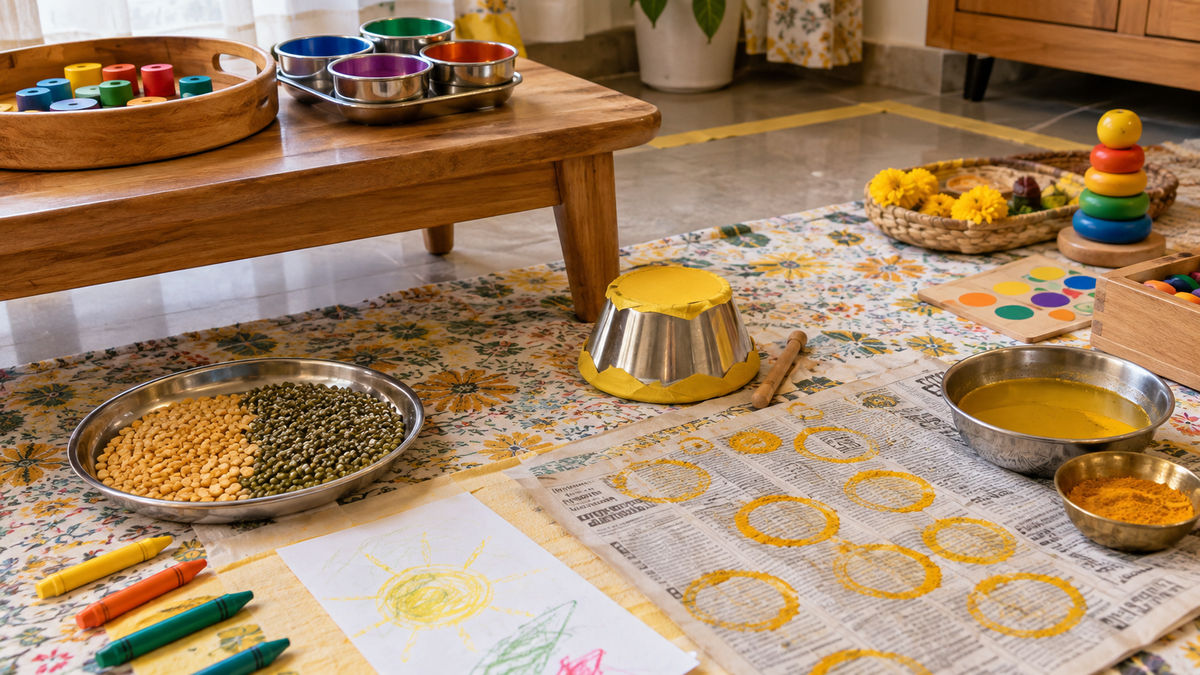
Five simple craft activities for 2–3 year olds—torn newspaper collage, homemade play dough, finger painting with turmeric water, sticker play, and pressed leaves—all use household items and build fine motor control, hand–eye coordination and creative thinking without safety risks or mess headaches.
⚡ In a hurry? Our quick picks
Around two to three years, your toddler's hands are getting stronger, their fingers more precise, and their brain hungry for things to touch, squeeze, tear and explore. This is craft activities for 2–3 year olds at home—the perfect window to offer process-driven creativity. The goal isn't a finished picture for the fridge; it's the doing itself. Ripping paper, squishing dough, dabbing paint, peeling stickers and arranging leaves teaches toddlers how their hands work, builds patience, and gives their brain something genuinely absorbing to do on a rainy afternoon.
🏆 Quick comparison: our top picks
| Product | Award | Price | |
|---|---|---|---|
 Shuttle Art Washable Finger Paint Set for Kids |
👑 Premium Pick | ₹4,457 | Check price → |
 Generic Blunt Safety Scissors for Toddlers |
🪙 Budget Pick | ₹155 | Check price → |
 Crayola Jumbo Crayons (16-count pack) |
₹419 | Check price → | |
 Giggles Play Dough with Moulding Tools (500g tub) |
See on Amazon | Check price → |
🛒 Our Top Picks
The highest-priced option in this guide.
Shuttle Art Washable Finger Paint Set for Kids
- ✓ Why it fits: Water-based finger paint supports sensory play and hand–eye coordination without toxic fumes or staining
- ✓ 6 vibrant colours, non-toxic and easily washable
- ✓ Safe for skin contact and accidental ingestion in small amounts
* We earn a small commission — at no extra cost to you.
The lowest-priced option in this guide.
Generic Blunt Safety Scissors for Toddlers
- ✓ Why it fits: Blunt-edge scissors allow older toddlers (nearing 3 years) to practise cutting paper strips safely under supervision, extending fine motor challenge
- ✓ No sharp edges, designed for small hands
- ✓ Plastic or metal construction, BIS or EN71 certified
* We earn a small commission — at no extra cost to you.
Crayola Jumbo Crayons (16-count pack)
- ✓ Why it fits: Thicker, easier-to-grip crayons for toddlers developing pincer grasp and fine motor control
- ✓ Non-toxic, AP certified
- ✓ Washable and long-lasting
* We earn a small commission — at no extra cost to you.
Giggles Play Dough with Moulding Tools (500g tub)
- ✓ Why it fits: Pre-made, non-toxic play dough saves prep time while building finger strength and sensory engagement
- ✓ Soft, pliable texture suitable for 2+ years
- ✓ BIS certified, wheat flour-based
* We earn a small commission — at no extra cost to you.
Daily baby tips, exclusive Amazon deals & real parent advice — free forever.
Every activity below uses things a typical Indian home already has—no craft shop trip, no buying special kits, and no small parts that cause silent panic. You'll also find tips to keep the mess manageable and know when your child is ready to move on to something harder.
What's happening at this age
Between 24 and 36 months, your child's fine motor skills are developing rapidly. The National Curriculum Framework for Foundational Stage (NCF-FS) 2022 and India's National Education Policy 2020 emphasize that this period is critical for sensory exploration and hand development. Around two years, toddlers can hold a crayon with a whole hand; by three, many can hold it with thumb and fingers. Their pincer grasp—thumb and index finger working together—is still developing but improving fast. This is also the age of repetition; your toddler will do the same thing over and over, which is not boredom—it's how the brain wires up control and memory. Craft play also builds confidence, focus and the ability to sit with one task for 10–15 minutes without adult direction.
Try this at home
1. Torn Newspaper Collage
You need: Old newspaper or magazines, a large sheet of paper or cardboard, a paste made from flour and water (or store-bought glue stick), and a shallow tray to catch bits.
How: Let your toddler rip newspaper or magazine pages into rough pieces—they don't need to be neat. Brush or glue-stick the paper pieces, or offer pre-glued strips. Let them stick pieces onto the cardboard base. Encourage them to cover the whole sheet, layer pieces, or stick them in clusters. The mess stays on the tray and can be wiped up easily.
What it builds: Bilateral coordination (both hands working together), hand strength, understanding cause and effect (tear paper → it separates), and the confidence that mistakes don't matter.
Easier / Harder: Easier—pre-rip the paper into small pieces; they just glue. Harder—add painted or coloured paper, or ask them to sort pieces by colour before sticking.
2. Play Dough from Flour and Salt
You need: Plain flour or atta (2 cups), salt (1 cup), water (add slowly until dough forms), and optionally a few drops of food colouring or turmeric for colour.
How: Mix flour and salt in a bowl. Add water a little at a time, stirring with your fingers until it forms a soft, pliable dough. If it's sticky, add a bit more flour; if crumbly, add water. Let your toddler squish, roll, poke and shape it. Encourage them to make balls, snakes, flat cakes. Keep a damp cloth nearby to wipe hands. Store in a sealed container for up to 3 days.
What it builds: Hand and finger strength, hand–eye coordination, sensory awareness, and abstract thinking (imagining that a ball of dough is a cake or a snake).
Easier / Harder: Easier—just squish and explore. Harder—hide small toys (like a bead or button, never beads alone) in the dough and let them fish it out; shape snakes and coils together.
3. Finger Painting with Turmeric Water
You need: Plain white paper or cardboard, a shallow dish or old plate, water mixed with a pinch of turmeric (or beetroot juice for red, spinach juice for green), and an old shirt or apron for your toddler.
How: Pour the coloured water into a shallow dish. Let your toddler dip their fingers, palms and hands into it and press or drag them across the paper. They can tap their fingers to make dots, swipe to make lines, or press their whole palm down. No brushes—hands only. Let it dry; the patterns will stay soft and stained, which toddlers love.
What it builds: Fine motor control, colour and texture awareness, and self-expression without pressure to draw anything recognizable.
Easier / Harder: Easier—use just one colour. Harder—offer two colours and watch them discover what happens when they mix them (yellow turmeric + red beetroot juice = orange).
4. Sticker Play and Peeling Practice
You need: Large, low-tack stickers (avoid tiny stickers or tiny sticky dots), a sheet of paper, and a tray to catch pieces.
How: Offer your toddler a sheet of paper and a pile of stickers. Let them peel the backing (this is the main work—it builds hand strength and coordination), and stick them anywhere on the paper. Stickers can go in rows, clusters, or random spots. No rules. When they're done, you can peel them off and do it again, or let the paper become a sticker mosaic.
What it builds: Pincer grasp, hand–eye coordination, persistence (peeling can be fiddly for a two-year-old), and the joy of repetition.
Easier / Harder: Easier—use large stickers with easy-peel backing. Harder—add other items to stick (scraps of paper, leaves, cotton) and let them make a mixed-media sheet.
5. Pressed Leaves and Flower Petals
You need: Leaves, petals or grass collected from outside, old newspaper or paper towels, a heavy book or stack of books, and a large sheet of paper for arranging.
How: Go for a short walk and collect leaves, petals, grasses—whatever is safe and available. Back home, let your toddler press them under a book for 20–30 minutes to flatten them. Meanwhile, draw or paint a background on a sheet of paper. Then let them arrange the dried leaves and petals on the paper, sticking them down with glue or glue stick. They can make patterns, a garden, or just a scattered arrangement.
What it builds: Sensory awareness, fine motor precision, patience (waiting for pressing to finish), and an understanding that natural objects can become art.
Easier / Harder: Easier—skip the pressing; just glue fresh leaves and petals straight away (they'll dry on the paper). Harder—add other items like twigs, seeds or paper scraps, or challenge them to make a specific pattern.
What 'getting it' looks like
You'll know your toddler is engaging meaningfully with these crafts when they sit without being prompted for at least 10–15 minutes, focus on what their hands are doing (tearing, squishing, sticking), and repeat the same action over and over—not because they're bored, but because the repetition feels good. They may not follow your demonstration exactly, and that's fine; they're learning how things work, not trying to copy you. Around three years, many toddlers start to intentionally create something (a 'snake' from dough, a 'pattern' with stickers) and want to show you, which is a big leap in self-awareness and pride in doing.
When to move on, and when to ask
If your toddler masters ripping and sticking and seems hungry for more challenge, try adding tools—blunt-edge scissors for cutting paper strips, or a spatula for scooping and pressing dough. If they lose interest in an activity after 2–3 minutes consistently, it may be too hard or too easy; adjust the materials or offer a different craft. If your toddler shows extreme distress at mess, refuses to touch materials, or avoids hand play altogether at three years, chat with your paediatrician—it may be sensory sensitivity or developmental variation worth exploring. This is general information, not medical advice.
If you're homeschooling
Fit one craft activity into your weekly rhythm on a fixed day—say, Wednesday morning craft time. Keep materials in a low shelf so your toddler can help choose. Rotate the five activities weekly so there's novelty without overwhelm. Photography a finished piece and date it; you'll be amazed at the progress from two to three years. Tie crafts loosely to seasons or themes (pressed leaves in autumn, flower petals in spring) so the activity feels connected to the world outside your home.
What helps at home (optional)
Every activity above works with things you already have. That said, a few items make the process smoother and more inviting: a set of jumbo crayons (thicker than regular crayons, easier to grip), a small container of washable finger paints (if you want colour beyond turmeric and juice), blunt safety scissors (for older toddlers nearing three who want to cut), or a tub of store-bought play dough (saves the flour-mixing step on busy days). None are necessary—homemade paste, water-coloured paper, and household scraps are just as good for learning. The choice is yours.
What IAP and WHO Guidance Says
• Fine motor milestones: IAP guidelines note that by 24 months, toddlers should be able to scribble intentionally and by 36 months, hold a crayon with thumb and fingers; craft play directly supports this development.
• Safe play materials: WHO emphasizes that toddler play materials should be non-toxic, free of small parts, and supervise-friendly—all five activities above meet these criteria with household items.
📚 Reviewed against
This guide was checked against the sources below. It is general parenting guidance, not medical advice — for any concern about your child's development, talk to your paediatrician.
- National Curriculum Framework for Foundational Stage (NCF-FS) 2022 — Guides sensory exploration and fine motor development for 2–3 year olds
- National Education Policy 2020 — Emphasizes play-based learning and creative development in early childhood
- Indian Academy of Pediatrics (IAP) - Developmental Milestones — Fine motor milestones for 24–36 month age group
- WHO Fact Sheets on Child Development — Safety and developmental readiness for play materials and activities
Last reviewed 24 Nov 2026
Frequently Asked Questions
What are some fun and easy crafts for kids aged 2–3?
What fun things can you do with a 2 year old?
What can I make for my 2 year old to keep them busy?
How do I do crafts with a 2 or 3 year old without a mess?
How long should a 2–3 year old do crafts?
Are homemade play dough and finger paint safe for toddlers?
Daily baby tips, exclusive Amazon deals & real parent advice — free forever.