
School Readiness Activities for 3-5 Year Olds: 5 Home Games That Build Sitting, Listening & Sharing

School readiness isn't about letters or numbers — it's about sitting still for 20 minutes, following a two-step instruction, taking turns, and handling buttons or zips. Five household activities teach these skills: storytelling circles, kitchen helper tasks, family board games, self-dressing practice, and item labelling walks. Every activity uses things you already have at home.
⚡ In a hurry? Our quick picks

Around age three, your child shifts from free play to structured time. School isn't about academics at this stage — it's about rhythms, listening to an adult who isn't mum or dad, waiting your turn, and managing your own body (buttoning a shirt, pouring water without spilling). These are the real school readiness activities that matter. And honestly, they're less about buying a special kit and more about noticing what your child does naturally, then building on it in a focused way.
🏆 Quick comparison: our top picks
| Product | Award | Price | |
|---|---|---|---|
 Wooden Button and Zip Practice Board – Fine Motor Skills |
👑 Premium Pick | ₹1,440 | See alternatives → |
 Melissa & Doug Peg Puzzle and Stacking Game Set |
🪙 Budget Pick | ₹231 | See alternatives → |
 Skillmatics My First Games Board Game Set |
₹266 | Check price → | |
 Simple Story Time Picture Book Bundle (Indian Folk Tales) |
₹253 | Check price → |
🛒 Our Top Picks
The highest-priced option in this guide.
Wooden Button and Zip Practice Board – Fine Motor Skills
- ✓ Why it fits: Isolated practice for buttoning, zipping and lacing without damaging clothes
- ✓ Includes 4 panels: large buttons, velcro strips, zips and shoelace practice
- ✓ Safe for 3+ with no small parts; made from plywood with non-toxic finish
* We earn a small commission — at no extra cost to you.
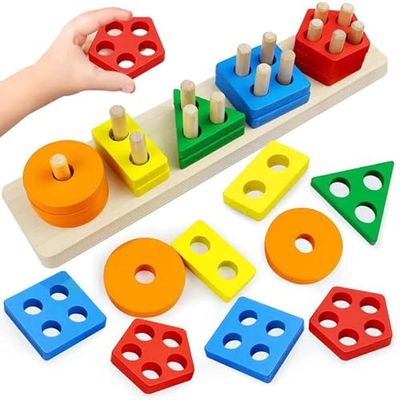

The lowest-priced option in this guide.
Melissa & Doug Peg Puzzle and Stacking Game Set
- ✓ Why it fits: Builds fine motor control and sitting focus for quiet practice; supports sustained attention
- ✓ Includes chunky wooden pegs and colourful stacking rings in age-safe designs
- ✓ BIS and EN71 safety certified; suitable for ages 3-5
* We earn a small commission — at no extra cost to you.

Skillmatics My First Games Board Game Set
- ✓ Why it fits: Teaches turn-taking and following simple game rules; designed for ages 3-5
- ✓ Includes 4 games in one box with large, chunky pieces
- ✓ No reading required; played with dice and colour matching
* We earn a small commission — at no extra cost to you.
Simple Story Time Picture Book Bundle (Indian Folk Tales)
- ✓ Why it fits: Repetitive, picture-led stories designed for circle-time practice; builds listening for 10-15 minutes
- ✓ Set of 3 short board books with simple narratives, thick pages, durable binding
- ✓ Large, colourful illustrations hold attention; minimal text
* We earn a small commission — at no extra cost to you.
Daily baby tips, exclusive Amazon deals & real parent advice — free forever.
What's Happening at This Age
Between 3 and 5 years, children move from play-based learning to the ability to sit, listen and follow routine. According to the National Curriculum Framework for Foundational Stage (NCF-FS) 2022, which guides Indian early childhood classrooms, this age band is critical for developing self-regulation: the ability to manage attention, wait, and follow an adult's lead without constant redirection. Their attention span grows from 5–10 minutes at age 3 to 15–20 minutes by age 5. Fine motor skills sharpen — they begin to button, zip, and pour with less spillage. Social skills develop too: sharing becomes possible (not easy, but possible), and turn-taking stops feeling like a punishment.
This isn't about flashcards or worksheets. It's about rhythm and predictability. School is different from home: there's a group, one adult leading, and rules that apply to everyone. If your child has practised this at home — sitting together during a story, helping in the kitchen while you give clear instructions, playing a simple board game where turns matter — the transition feels less jarring.
Try This at Home
Activity 1: Storytelling Circle (Sitting and Listening)
You need: A small carpet or cushion, a picture book or a simple story you tell from memory, a small timer (optional but helpful — 10–15 minutes to start).
How: Sit on the floor with your child and one other family member (a sibling, grandparent, or another child). Decide on a 10–15 minute window — same time each day if you can. Read or tell a story, and make it a rule: everyone sits until the story ends. When your child wiggles, gently say, "The story continues when we're sitting together," then carry on. No screens, no interruptions. Let your child sit on your lap if needed, but stay seated.
What it builds: Sustained attention, listening to an adult in a group, understanding that routines have a start and end, comfort with sitting still.
Easier: Start with 5 minutes and a very short, repetitive story (like a nursery rhyme repeated). Harder: Read a longer chapter from a book, or invite two other children and ask each to sit in a specific spot (not always on a lap).
Activity 2: Kitchen Helper Tasks (Following Two-Step Instructions)
You need: A simple kitchen job (mixing dal before cooking, pouring water into a vessel, sorting lentils into a bowl), a step stool if needed, a small cloth for cleanup.
How: Give one clear two-step instruction: "First, pour the dal into this katori. Then, stir it with this spoon." Repeat the instruction once, then let your child do it. If they get stuck, repeat the instruction; don't show them. When done, praise the attempt, not perfection. Repeat the same task for three days in a row, then swap to a new one.
What it builds: Following multi-step directions, sequencing (first this, then that), fine motor control (pouring, stirring), confidence in a task-based role.
Easier: Give one-step tasks: "Pour the water," or "Stir the dal." Harder: Add a third step, or ask, "What should we do next?" and let your child remember.
Activity 3: Family Board Game (Turn-Taking and Sharing)
You need: A simple game with minimal rules — a dice and a moving piece (homemade with a bottle cap and a drawn spiral on paper), or a shop-bought game designed for this age (Snakes & Ladders, Ludo with 2–3 players, or simple card games like snap).
How: Play 2–3 short rounds once a week. Set a clear rule: "You roll, move your piece, then pass the dice." If your child refuses to pass, pause the game and say, "Games need turns. When you're ready to take a turn, we play again." Stay calm — this is the whole point. After 5–10 minutes, even if unfinished, stop. Celebrate the turns that worked.
What it builds: Understanding that not everything is about them, waiting without constant distraction, managing mild frustration, understanding rules.
Easier: Play with just you and your child (no sibling to compete with). Harder: Add a second sibling or invite a friend; play for longer rounds.
Activity 4: Self-Dressing and Self-Care (Independence Skills)
You need: Clothes with buttons or zips, a shirt or cardigan (not a onesie), a dupatta or fabric rectangle to practise tucking, shoes with velcro or laces.
How: Each morning, before getting dressed, let your child attempt buttons or zips, even if you have to finish it. Give one instruction at a time: "Push the button through the hole." If they're frustrated, guide their hand but let them feel the action. Practise one skill per week (buttons one week, zips the next). Celebrate the try, not just the success.
What it builds: Fine motor precision, independence, patience with repetition, body awareness.
Easier: Start with oversized buttons on a practice board or a doll's clothes. Harder: Introduce shoelace tying or buckling a belt.
Activity 5: Household Item Labelling Walk (Name Recognition and Vocabulary)
You need: A marker and small paper pieces, tape or blu-tack, common household items (door, window, table, chair, lamp, tap, shelf).
How: Write the name of each item on a label (use simple block letters). Stick labels around your home with your child. Walk around and read each label aloud together: "This is the door," and point to it. Leave the labels up for a week, then ask, "Show me the door," without pointing. This builds the link between the written word and the object.
What it builds: Name recognition, sight vocabulary, confidence with text, spatial awareness.
Easier: Label just three items (door, table, lamp). Harder: Ask your child to draw a picture of the item next to the label, or find items that rhyme with the label.
What 'Getting It' Looks Like
You'll notice your child sitting quietly through a 15-minute story without needing to leave. They'll follow a two-step instruction the first or second time you say it. In a game, they'll pass the dice without being told repeatedly. When you say, "Button your shirt," they'll attempt it without a tantrum, even if they need help. They'll point to a labelled item when asked. These aren't perfections — buttons may be in the wrong holes, the story might bore them sometimes, and they'll still fidget. But the capacity to try, sit, listen and wait becomes visible.
When to Move On, and When to Ask
By age 4.5 to 5, most children can sit for 15–20 minutes, follow two-step directions reliably, and manage turn-taking with only occasional reminders. If your child is consistently unable to do these — if they cannot sit for five minutes even with your support, or if they have no interest in games or tasks — it's worth mentioning to your paediatrician. This is general information, not medical advice. Most delays in this area are developmental, but early chats with your doctor help rule out hearing or attention concerns that might need support before school starts.
If You're Homeschooling
These activities form the backbone of a weekly homeschool rhythm: storytelling circle on Monday, kitchen helpers on Tuesday–Thursday, one board game session on Friday, and self-care practice daily. Label items as new vocabulary units. This rhythm mimics a school day's structure without academic pressure and builds the habits your child will need later.
What Helps at Home (Optional)
Every activity above works entirely with household items — no purchases needed. That said, a few things can make practise easier: a set of large wooden blocks or stacking cups (for fine motor warm-up), a simple board game designed for this age (with clear, big pieces), or a practice board with buttons, zips and laces (saves your clothing from constant practice wear). None of these are necessary, but if you like adding a small tool, they do streamline the skill-building.
What IAP and WHO Guidance Says
• The Indian Academy of Pediatrics recognises that school readiness includes self-regulation and social skills, not just academic knowledge.
• WHO's guidelines on early childhood development emphasise that structured, predictable routines at home directly support a child's ability to transition to group settings.
School readiness happens quietly at home, through repetition and rhythm. Five simple activities — storytelling, kitchen tasks, games, dressing practice, and labelling — give your child the real skills they need: sitting still, listening, waiting, and managing themselves. The good news? You've likely already started doing most of this. Now you're just being intentional about it.
📚 Reviewed against
This guide was checked against the sources below. It is general parenting guidance, not medical advice — for any concern about your child's development, talk to your paediatrician.
- National Curriculum Framework for Foundational Stage 2022 (NCF-FS) — Guidance on school readiness, self-regulation and learning milestones for 3-5 year olds in Indian classrooms
- Indian Academy of Pediatrics (IAP) – Child Development Guidelines — Developmental milestones and transition readiness for preschool age children
- WHO Early Child Development: Milestones and Warning Signs — Age-wise developmental expectations and guidelines for attention, fine motor and social skills
- NCERT – Learning Outcomes (Foundational Stage) — Expected learning outcomes for self-care, listening and following instructions in ages 3-5
Last reviewed 06 Nov 2026
Frequently Asked Questions
How long should a 3-year-old be able to sit and listen?
What's the difference between school readiness and academic readiness?
My child refuses to take turns in games. Is this normal at age 3?
Should I teach my child to button or zip before school starts?
Can I do these activities if my child goes to preschool?
What if my child shows no interest in sitting still or following instructions?
Daily baby tips, exclusive Amazon deals & real parent advice — free forever.