
School Readiness Activities for 3-5 Year Olds: 5 Home Activities Before Nursery
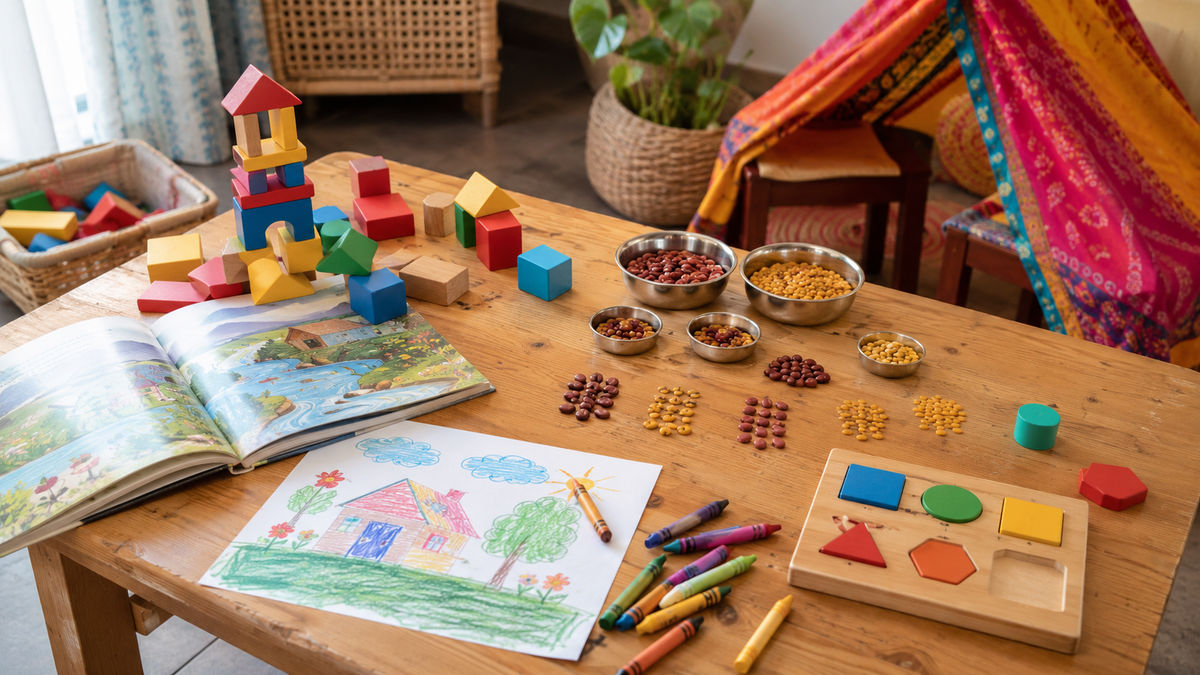
School readiness for 3–5 year olds means following simple instructions, using the toilet independently, sitting still for 5–10 minutes, sharing with others, and recognizing their own belongings. Five home activities—morning-routine charts, snack-time turn-taking, book-sitting practice, name recognition, and backpack packing—build these skills without any purchases.
⚡ In a hurry? Our quick picks

Around age 3, children start thinking about routines and rules in ways they didn't before. By 5, they're ready to sit through a full nursery day. But readiness isn't about knowing letters or numbers—most nurseries teach that. What they need is the ability to listen, wait their turn, manage their body in a group, and feel confident about their things. This is exactly what you can build at home in the months before school starts.
🏆 Quick comparison: our top picks
| Product | Award | Price | |
|---|---|---|---|
 Melissa & Doug Self-Correcting Letter Puzzle Set with Storage Box |
👑 Premium Pick | ₹3,336 | See alternatives → |
|
Kookee Analog Teaching Time Learning Clock with Movable Hands (20 cm Diameter)
|
🪙 Budget Pick | ₹329 | Check price → |
 Doodle Pads - Thick Black Sticky Notes (100 Notes per Pack) Assorted Colours |
See on Amazon | Check price → | |
 Personalized Name Stamp Set for Kids (6 Stamps + Ink Pad, Self-Inking) |
See on Amazon | Check price → |
🛒 Our Top Picks

The highest-priced option in this guide.
Melissa & Doug Self-Correcting Letter Puzzle Set with Storage Box
- ✓ Why it fits: Builds name recognition and letter awareness through puzzle manipulation
- ✓ 26 wooden letter tiles with shapes that match only their correct spots
- ✓ Self-correcting design encourages independent practice without frustration
* We earn a small commission — at no extra cost to you.
The lowest-priced option in this guide.
Kookee Analog Teaching Time Learning Clock with Movable Hands (20 cm Diameter)
- ✓ Why it fits: Essential for routine-chart activities and timer games—teaches sequencing and time awareness
- ✓ Large, easy-to-read face with movable hour and minute hands
- ✓ Bright colours help children recognize patterns; numbers 1–12 clearly marked
* We earn a small commission — at no extra cost to you.
Doodle Pads - Thick Black Sticky Notes (100 Notes per Pack) Assorted Colours
- ✓ Why it fits: Perfect for name-labeling activity—label belongings, create routine charts, and sticky-note sorting games
- ✓ 100 bright, repositionable notes per pack
- ✓ Strong enough to stay put through a preschool day but easy to peel without damaging surfaces
* We earn a small commission — at no extra cost to you.
Personalized Name Stamp Set for Kids (6 Stamps + Ink Pad, Self-Inking)
- ✓ Why it fits: Supports name-recognition and belonging-identification activities—child stamps their name on belongings
- ✓ 6 interchangeable name stamps (numbers, icons, and text options)
- ✓ Self-inking pad lasts 500+ stamps; washable, kid-safe ink
* We earn a small commission — at no extra cost to you.
Daily baby tips, exclusive Amazon deals & real parent advice — free forever.
What's happening at this age
Three to five year olds are becoming aware of routines and social expectations. According to the National Curriculum Framework for Foundation Stage (NCF-FS 2022), this age group develops what's called executive function: the ability to follow multi-step instructions, manage impulses, and shift between activities. They're also becoming more independent—they want to do things themselves, even if it takes longer. Socially, they're beginning to understand that other children have needs too, though sharing and turn-taking still feel hard.
At this age, your child is learning through routines and repetition. The same morning pattern, the same snack ritual, the same goodbye—these aren't boring, they're deeply reassuring. A child who knows what comes next feels in control, even when the world is new and big.
Try this at home
Morning Routine Chart (3–5 minutes daily)
You need: A sheet of white paper or cardboard, coloured markers or crayons, a toy clock or drawn clock face (with movable hands if you can manage it).
How: Draw or stick pictures of your child's morning in sequence—waking up, brushing teeth, eating breakfast, getting dressed. Number or time each step. Every morning, point to the next picture together. "After breakfast, what comes next? Yes, getting dressed." By age 4–5, your child may start pointing and telling you the order without prompting.
What it builds: Following a sequence, anticipating what's next, and confidence that routines are predictable. In nursery, there's a routine for morning circle, snack, and home time—a child who's comfortable with sequences settles faster.
Easier: Use only 3 big steps. Harder: Draw or make a photo chart without the clock; have your child guess what time it is on the toy clock before you move to the next step.
Snack-Time Turn-Taking with Siblings (5–10 minutes, when you have siblings or play with dolls)
You need: A plate or small bowl, a few raisins or small pieces of dal, two spoons (or doll + your child).
How: Sit together and say, "Doll's turn—she takes one raisin. Now your turn—you take one." Repeat 5–6 times. On your turn, exaggerate the wait: "Now I'm waiting. You're eating. I'm waiting. My turn now!" This makes waiting feel like a game, not a punishment.
What it builds: Understanding that waiting is okay, that others get a turn, and that the turn comes back to you. In nursery, this shows up as waiting for the teacher's attention and standing in line.
Easier: Use just you and your child; serve snacks one at a time so waiting is very short. Harder: Play with two siblings or dolls at the same time ("Whose turn? Let's see...").
Book-Sitting Practice with a Timer (5–10 minutes)
You need: A picture book your child likes, a kitchen timer or your phone timer set to 5 minutes, a comfortable place to sit together.
How: Start the timer and say, "Today we're going to sit together until the timer rings." Read a story, point to pictures, let your child turn pages. When the timer goes off, celebrate: "You sat the whole time!" Repeat every few days; gradually extend to 7, then 10 minutes. The point is not reading comprehension—it's staying still.
What it builds: The ability to sit for group time or circle time in nursery, and the confidence that sitting still for short periods is manageable.
Easier: Start with 3 minutes and use a very familiar book. Harder: Have your child hold the book and turn pages themselves; increase to 10 minutes.
Name Recognition with Sticky Notes (10 minutes, 2–3 times a week)
You need: Sticky notes, a marker, your child's name written large and clear on each note, 5–6 household items (a spoon, a cup, a toy, a shoe).
How: Stick a note with your child's name on their cup. Say, "This is yours—it says your name." Repeat with other objects. After a few days, ask, "Which one is yours?" and point to the sticky notes. By 4–5, many children can start recognizing the shape of their own name.
What it builds: Name recognition and the sense that their belongings are theirs—crucial for nursery, where 20 similar lunch boxes sit in a row and your child needs to know which is theirs.
Easier: Use just one item (their cup) for a week. Harder: Write the name without showing it first; have them guess whose it is.
Backpack Packing Role-Play (5–10 minutes, 1–2 times a week)
You need: A small backpack or bag, 4–5 toy items or household objects (a toy car, a book, a spoon, a cup, a small cloth), a "school" space in your home (could be a chair, a cushion, anywhere).
How: Say, "Let's get ready for school. What do we need in our bag?" Let your child pick items and place them inside. Then act out arrival: take off the backpack, unpack together. Reverse roles: you become the child, and your child "helps" you unpack. This simple pretend play familiarizes them with the rhythm of arrival and departure.
What it builds: Independence in managing belongings, comfort with the idea of leaving home and coming back, and the routine of a school day.
Easier: Use just 2–3 items and do it once. Harder: Add more objects or introduce a simple "rule" ("We always pack the book first").
What 'getting it' looks like
Your child is ready for school when they can follow a two- or three-step instruction without reminders ("Put on your shoes and get your bag"), use the toilet during the day without accidents most of the time, sit through a 10-minute activity without constantly getting up, offer a toy to another child without being asked, and start to recognize their own name or the first letter of it. They may still struggle with any one of these things—that's normal—but there should be clear signs of trying.
When to move on, and when to ask
By age 5, most children can do all five of these things. If your child is older than 5 and isn't managing two-step instructions, toileting during the day, or sitting for 10 minutes, it's worth a conversation with your paediatrician. Some children need more time; some benefit from a few sessions with a child psychologist. This is general information, not medical advice.
If you're homeschooling
If your child isn't attending nursery, these skills still matter for kindergarten and beyond. Weave them into your weekly rhythm: a routine chart at breakfast, turn-taking games during snack, 10-minute book time every afternoon, and pretend-play about the "outside world" once a week. The goal is the same—building the nervous system's ability to follow, wait, sit, and manage transitions.
What helps at home (optional)
Every activity above works with things you already have. A paper chart, a timer, sticky notes, and a book are enough. If you'd like tools that make the routine feel more official and fun, a printed daily calendar, a name-stamp set, and a simple visual timer can help some children stay more engaged—though they're never necessary.
What IAP and WHO Guidance Says
• The Indian Academy of Pediatrics emphasizes that school readiness is about self-regulation and social skills, not academics. • WHO guidelines on early childhood development highlight that predictable routines build emotional security and help children manage transitions—the foundation for learning at any age.
📚 Reviewed against
This guide was checked against the sources below. It is general parenting guidance, not medical advice — for any concern about your child's development, talk to your paediatrician.
- National Curriculum Framework for Foundation Stage (NCF-FS 2022) — Defines developmental milestones and learning goals for ages 3–6, including executive function and social-emotional readiness
- Indian Academy of Pediatrics (IAP) – Child Development Guidelines — IAP guidance on preschool readiness, emphasizing social and emotional skills over academics
- WHO Early Childhood Development Guidelines — WHO framework on how routines, predictability, and emotional security support development in ages 3–5
Last reviewed 04 Nov 2026
Frequently Asked Questions
What activities do 5 year olds do?
Is it normal for a 3 year old to go to preschool?
What does my 4 year old need to know before pre-K?
How long should a 3 year old sit still?
How do I teach my child to recognize their name?
What should be in a child's preschool backpack?
Daily baby tips, exclusive Amazon deals & real parent advice — free forever.