
Riddles for 4 Year Olds in Hindi and English: 5 Home Activities to Build Vocabulary and Sound Play
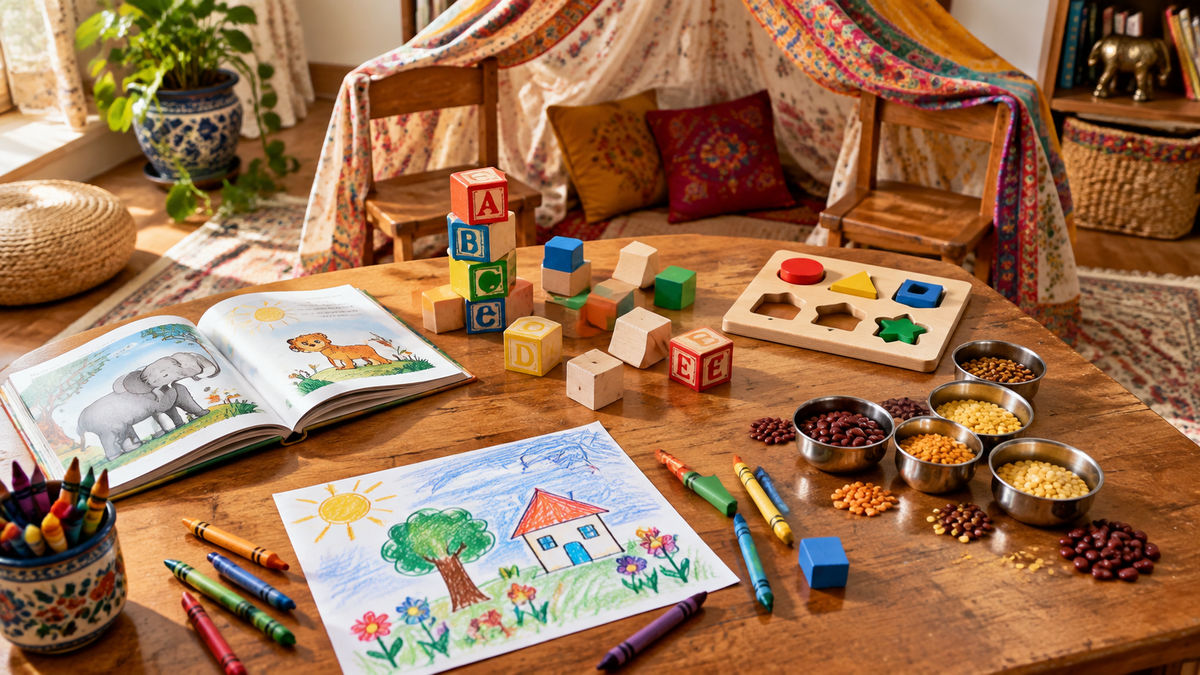
Five household riddles and sound games—kitchen-object riddles in Hindi, tongue twisters at mealtime, rhyme-and-clap games, mystery-bag guessing with everyday objects, and making up riddles for grandparents—build phonological awareness and vocabulary without buying anything. Start with simple Hindi riddles (Meri mummy kya hai? Chammach / spoon), repeat often, and let your child lead the guessing.
⚡ In a hurry? Our quick picks
Riddles for 4 year olds in Hindi and English are one of the most playful ways to sharpen listening, grow vocabulary, and build the sound-pattern awareness children need for reading and writing later. At this age, your child is ready to hear the rhythm in language, spot rhymes, and start thinking about how words fit together. This isn't about being "clever" or "getting it right"—it's about playing with sound in a way that feels like a secret code between you and them.
🏆 Quick comparison: our top picks
| Product | Award | Price | |
|---|---|---|---|
 Sound Play and Phonics Picture Book (Indian Home Context) |
👑 Premium Pick | ₹999 | Check price → |
 Rhyme Time Picture Book Series (Hindi and English) |
🪙 Budget Pick | ₹137 | Check price → |
 Riddle and Guess Card Deck for Kids (Hindi-English Bilingual) |
₹420 | Check price → | |
 Picture Flashcard Set – Common Household Objects (Bilingual Hindi-English Labels) |
₹599 | Check price → |
🛒 Our Top Picks
The highest-priced option in this guide.
Sound Play and Phonics Picture Book (Indian Home Context)
- ✓ Why it fits: Uses tongue twisters, rhymes, and alliteration in Hindi and English set in Indian home scenes (kitchen, daal, chammach), making the sound patterns in this guide even more familiar
- ✓ Ages 4–6, interactive flap-and-reveal format encourages repetition
- ✓ Printed on FSC-certified paper, non-toxic inks
* We earn a small commission — at no extra cost to you.
The lowest-priced option in this guide.
Rhyme Time Picture Book Series (Hindi and English)
- ✓ Why it fits: Pairs simple rhyming words with colorful pictures, reinforcing the rhyme-awareness skill this guide builds
- ✓ Ages 3–6, board-book format safe for 4-year-olds to handle
- ✓ BIS-compliant child-safe ink and binding
* We earn a small commission — at no extra cost to you.
Riddle and Guess Card Deck for Kids (Hindi-English Bilingual)
- ✓ Why it fits: Gives you 50+ ready-made riddles in Hindi and English with picture clues, extending the mystery-bag and riddle-making activities beyond household objects
- ✓ Durable cardstock, picture side helps non-readers guess independently
- ✓ EN71-certified non-toxic materials
* We earn a small commission — at no extra cost to you.
Picture Flashcard Set – Common Household Objects (Bilingual Hindi-English Labels)
- ✓ Why it fits: Shows images of kitchen and home objects your child already knows, letting you create riddles together and name clues accurately in both languages
- ✓ 30–50 cards, card size safe for 4-year-old hands (not choking hazard)
- ✓ Laminated, washable cards; BIS baby-safe labeling
* We earn a small commission — at no extra cost to you.
Daily baby tips, exclusive Amazon deals & real parent advice — free forever.
What's happening at this age
Four-year-olds are in the middle of a language explosion. Phonological awareness: the ability to hear and play with the sounds in words, separate from their meaning. The National Curriculum Framework for Foundational Stage (NCF-FS 2022) emphasizes that this skill—hearing rhymes, spotting syllables, noticing first sounds—is a foundation for early literacy. At this stage, your child can hear the rhyme in "chanda–kanda" or "cup–pup," and they're starting to notice that some words sound alike. They're also picking up between 50 and 150 words a month, so vocabulary games with sound play stick harder than simple naming games. Hindi-language play is especially powerful in an Indian home because it strengthens mother-tongue fluency while building these sound skills.
Try this at home
Activity 1: Kitchen-Object Riddles in Hindi
You need: Common kitchen items—steel katori, chammach (spoon), chalni (sieve), glass, plate, atta (flour), daal (lentil), salt pot.
How: Start with one item. Hold it and say a simple riddle in Hindi, then ask your child to guess. Example: "Meri mummy kya hai? Dhoon, dhoon mein khana khilata hoon. Main kya hoon?" (What am I? In the kitchen, I feed food. What am I? Answer: chammach / spoon). Repeat the same riddle 2–3 times over a week before moving to a new one. Let your child repeat the riddle back to you, even if the words aren't perfect.
What it builds: Listening for key words ("kitchen," "feed"), sound repetition, and vocabulary anchored to things they touch every day. This builds semantic awareness—the connection between a word's sound and its meaning.
Easier: Use very simple Hindi hints: "Yeh hot hai." (This is hot.) / "Yeh cold hai." (This is cold.)
Harder: Ask your child to give you the riddle in Hindi or Hinglish after you've done it once. Let them make one up for you.
Activity 2: Tongue Twisters at Mealtime
You need: Nothing—just your mouth and a chair at the table.
How: Pick one Hindi or English tongue twister and say it slowly, then faster, then giggle when you mess up. Repeat the same one for three meals, then switch. Example: "Pappu picked a peck of pickled peppers" (English, emphasizes the "p" sound) or "Mithi malai, malai mithi" (Sweet cream, cream is sweet—emphasizes the "m" sound). Let your child copy you. Don't correct mispronunciations; just smile and do it again.
What it builds: Phonemic awareness—the ability to hear and isolate individual sounds (phonemes). Tongue twisters force your child's mouth to slow down and notice the difference between similar sounds like "p," "b," and "m."
Easier: Use two-word rhyming patterns: "Doodh-doodh," "Khana-khana," "Cup-cup."
Harder: Ask your child to pick the first sound in the tongue twister: "Pappu picks... what sound? Puh? Puh? Puh?"
Activity 3: Rhyme-and-Clap Games
You need: Your hands and a word.
How: Say a word aloud, clap once, then say a word that rhymes, clap again. Example: You say "Ball" (clap), your child says "Call" (clap). Then you say "Mera" (clap), your child says "Sera" (clap). Keep a steady rhythm—it's like a game of sound catch. Start with familiar words: "Raat–baat," "Chai–jai," "Run–fun." After a few weeks, switch roles—your child leads, you follow and clap.
What it builds: Rhyme awareness, rhythm, and turn-taking. The clapping gives tactile and auditory feedback, so your child feels the rhyme pattern in their body, not just their ears.
Easier: Use very simple, identical-sounding rhyme pairs from everyday words: "Maa–baa," "Paa–taa."
Harder: Add a movement (hop, spin, jump) instead of clapping. Or ask, "What else rhymes with that?" and collect three rhymes in a row.
Activity 4: Mystery Bag Guessing with Household Objects
You need: A cloth bag or old pillow cover, 3–5 household objects (steel katori, wooden spoon, glass cup, dal packet, cloth dupatta).
How: Put one object in the bag. Give your child riddles or clues: "This is cold and round. You eat from me. What am I?" (katori). Let your child reach in without looking and guess by touch first, then pull it out. As they improve, give faster clues: "I am silver. I mix. I am a...?" (chammach). After several rounds, let your child be the guesser while you hide and describe.
What it builds: Descriptive vocabulary, listening for details, and syllable awareness (when you break words into parts: "cha-mmach," "ka-to-ri"). The touch element strengthens the word-to-object link.
Easier: Let your child see the object first, then describe it back to you in one word.
Harder: Give two clues in a row: "I am round and hot. I hold dal. What am I?"
Activity 5: Make-Your-Own Riddle for Grandparents
You need: A familiar person (grandparent, sibling) and an object your child knows well.
How: Over a few days, help your child make up a simple riddle about something they love—their blanket, their toy cup, their doll, their dinner plate. Write it down (or record your child's voice if they're shy). Then, during a video call or visit, have your child ask the grandparent the riddle. Example: "Mera blanket blue hai. Mera blanket soft hai. Main kya hoon?" (My blanket is blue. My blanket is soft. What am I?). Celebrate when grandparent guesses.
What it builds: Expressive language, confidence, and the ability to put descriptive words in order. Your child learns that words have power—they can stump someone, make someone smile, and start a conversation.
Easier: Let your child point to the object while giving clues. You say the clues aloud, they just nod.
Harder: Ask your child to give two or three clues in a row without showing the object: "Can you guess? Hint 1: I am cold. Hint 2: I am round. Hint 3: I am blue."
What "getting it" looks like
Around this age, you'll notice your child starting to spot rhymes without you pointing them out ("Mummy, 'boat' and 'coat' sound the same!"). They'll begin to repeat parts of riddles back to you, play with tongue twisters even when you're not asking, and ask you to repeat the same game multiple times. They might start making up nonsense words that follow the rhyme pattern they've heard ("Can–dan–fan–ban"). These are all signs that they're internalizing the sound patterns. Some children will giggle or clap when they hear a rhyme; others will simply repeat it. Neither means more understanding—they're just different ways of showing they heard it.
When to move on, and when to ask
Most 4-year-olds enjoy riddles and sound games for 5–10 minutes at a time. If your child loses interest, that's normal—stop, play again tomorrow. If after a month of daily play they show no interest in repeating words, spotting rhymes, or trying tongue twisters, or if they don't seem to hear you when you give a riddle, mention it to your paediatrician. This is general information, not medical advice. A formal language-hearing check can rule out delays and give you confidence in what comes next.
If you're homeschooling
Fit these games into your existing rhythm: a tongue twister at breakfast, a rhyme-and-clap during outdoor time, a kitchen riddle while cooking lunch, and the mystery-bag game once a week. If you're following a formal early-learning curriculum, these sound games slot naturally before formal letter-sound instruction because they build the foundation phonological awareness requires.
What helps at home (optional)
All five activities above work beautifully with nothing but your voice and household objects. That said, some families find it helpful to have a set of rhyming picture books or a deck of riddle cards with simple images to spark ideas when you're fresh out of inspiration. A basic picture flashcard set can also help—your child points to the image while you say the riddle, strengthening the word-to-picture link. None of these are necessary, and your child learns just as much from your words, your timing, and your laugh.
What IAP and WHO Guidance Says
Phonological awareness by age 4–5: The Indian Academy of Pediatrics (IAP) recognizes phonological awareness as a key early-literacy skill. WHO's work on early childhood development emphasizes that playful, language-rich environments build literacy foundations. Both bodies note that games and riddles in a child's home language (Hindi, in this case) are as effective as formal instruction because the familiarity and joy make the learning stick.
People Also Ask: Common questions parents have
Covered in the FAQ section below.
📚 Reviewed against
This guide was checked against the sources below. It is general parenting guidance, not medical advice — for any concern about your child's development, talk to your paediatrician.
- National Curriculum Framework for Foundational Stage (NCF-FS 2022) — Guides phonological awareness and language play for ages 3–6 in Indian schools; supports the emphasis on sound play and Hindi language
- Indian Academy of Pediatrics (IAP) - Early Childhood Development Guidelines — Establishes age-appropriate language and literacy milestones for 4-year-olds; supports the connection between sound play and literacy readiness
- WHO Caring for Child Development Handbook — Emphasizes play-based learning and home language use in early development; underpins the household-activity approach
- UNESCO Early Childhood Care and Education (ECCE) Framework — Supports multilingual learning and phonological awareness in home and community settings
Last reviewed 27 Nov 2026
Frequently Asked Questions
What are 5 good riddles for 4-year-olds?
What do we say riddle in Hindi?
What's a good riddle for a 4-year-old?
Can you give me some Hindi riddles with answers in English?
How do I know if my child is ready for riddles and sound games?
Should I correct my child if they get the riddle wrong?
Daily baby tips, exclusive Amazon deals & real parent advice — free forever.