
Self-Regulation Activities for 3–5 Year Olds: Build a Calm-Down Corner at Home
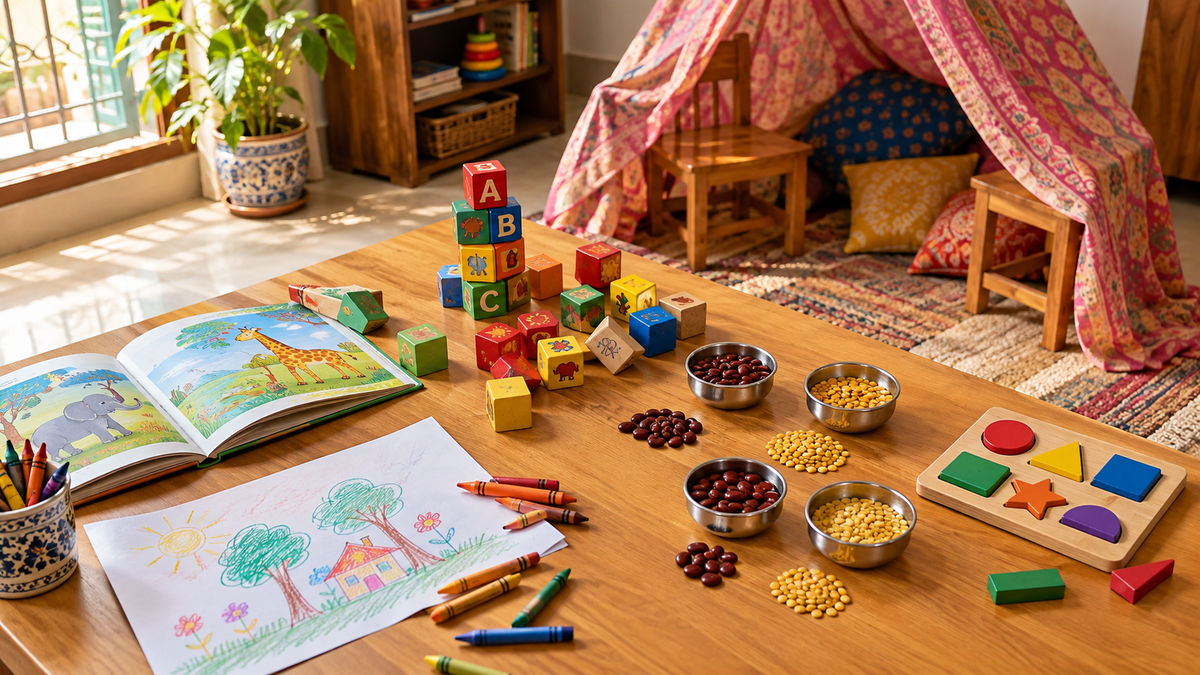
Self-regulation activities for 3–5 year olds build emotional awareness and calm-down skills through breathing exercises, emotion games, and sensory play. A calm-down corner with soft cushions, a breathing bottle (water and glitter), and soft cloth helps children soothe themselves when upset—skills that emerge naturally as the prefrontal cortex develops between ages 3 and 5.
⚡ In a hurry? Our quick picks


If your 4-year-old still melts down over a missing toy, or your 3-year-old screams when you say "no"—that's completely normal. The part of the brain that manages emotions and impulse control is still under construction. But here's the good news: you can help it along with simple, everyday activities that teach self-regulation at home.
🏆 Quick comparison: our top picks
| Product | Award | Rating | Price | |
|---|---|---|---|---|
|
Shumee Sensory Fidget Toys Set for Kids (Stress Relief Pop It, Spinners, Bubble Poppers)
|
🏆 Editor's Choice | ★ 4.4 1,124 reviews |
₹280 | Check price → |
|
Smartcraft Feelings & Emotions Poster Chart for Kids (Laminated, 45x60cm)
|
💰 Best Value | ★ 4.5 267 reviews |
₹149 | Check price → |
 Wembley Colours Sensory Bottles Set of 2 (Glitter, Water, Beads – Pre-Made, Sealed) Wembley Colours Sensory Bottles Set of 2 (Glitter, Water, Beads – Pre-Made, Sealed)
|
👑 Premium Pick | ★ 4.3 556 reviews |
₹249 | Check price → |
|
Toiing My Feelings Emotion Cards Flash Cards for Kids (English, Ages 3+)
|
🪙 Budget Pick | ★ 4.6 382 reviews |
₹249 | Check price → |
🛒 Our Top Picks

Best-reviewed overall, 4.4★ across 1,124 ratings.
Shumee Sensory Fidget Toys Set for Kids (Stress Relief Pop It, Spinners, Bubble Poppers)
- ✓ Why it fits: Gives hands something to do during calm-down time, supporting the texture-touch and sensory awareness activities
- ✓ 5–6 pieces including pop-its, spinners, and bubble poppers in bright colours
- ✓ BIS-certified for safety; non-toxic silicone and plastic
* We earn a small commission — at no extra cost to you.
Top rating for the price, 4.5★ at ₹149.
Smartcraft Feelings & Emotions Poster Chart for Kids (Laminated, 45x60cm)
- ✓ Why it fits: Hangs in the calm-down corner as a visual reference for emotion vocabulary, supporting the charades and emotion-naming activities
- ✓ Laminated, wipeable, vibrant illustrations of 12–15 emotions with relatable child scenarios
- ✓ Hindi and English text for bilingual learning
* We earn a small commission — at no extra cost to you.

Top of the range, for parents who want the best features.
Wembley Colours Sensory Bottles Set of 2 (Glitter, Water, Beads – Pre-Made, Sealed)
- ✓ Why it fits: Ready-made breathing bottles eliminate prep time and provide an immediate visual calming tool for the breathing-bottle activity
- ✓ 2 clear bottles (500 ml each) pre-filled with glitter, water, beads, and non-toxic colour (no leaking)
- ✓ BIS and ASTM-certified safe plastic; sealed and tamper-proof for ages 3+
* We earn a small commission — at no extra cost to you.
Lowest price that still clears our 3.8★ / 100-review bar.
Toiing My Feelings Emotion Cards Flash Cards for Kids (English, Ages 3+)
- ✓ Why it fits: Teaches emotion vocabulary and recognition, a core skill for naming feelings during the charades activity and throughout daily routines
- ✓ 24 large laminated cards with emotions and facial expressions
- ✓ Durable thick cardboard, safe for ages 3+ with no small parts
* We earn a small commission — at no extra cost to you.
Daily baby tips, exclusive Amazon deals & real parent advice — free forever.
What's Happening at This Age
Between ages 3 and 5, your child's prefrontal cortex—the brain region responsible for decision-making, impulse control, and emotion management—is developing rapidly but is nowhere near mature. According to the National Education Policy (NEP) 2020, preschool years (3–6 years) are critical for building social-emotional competencies that last a lifetime. This means tantrums aren't a sign of failure; they're a sign of normal brain development. Your child feels big emotions but doesn't yet have the neural wiring to manage them independently. Self-regulation skills—the ability to pause, breathe, and choose a calm response—are learned through practice and repetition, especially when a trusted adult models them first.
Try This at Home
Activity 1: Turtle Breathing (The Slow-Down Anchor)
You need: Just your child's body and your voice; optionally, a small stuffed toy turtle or a rolled-up dupatta to represent a shell.
How: Sit together on the floor. Ask your child to curl up like a turtle hiding in its shell—knees tucked, head down. Say: "Now breathe in very slowly through your nose as the turtle comes out of its shell." Pause. "Hold it." Pause. "Now breathe out slowly as the turtle goes back in." Repeat 3–5 times, speaking in a calm, slow voice. You do it together.
What it builds: Awareness of breathing as a tool to calm the nervous system; the ability to pause before reacting.
Easier/Harder: Easier: just count "1, 2, 3" instead of describing the turtle. Harder: add a colour game—"Breathe in the blue sky, breathe out the red fire."
Activity 2: Emotion Charades with Family (Name It to Tame It)
You need: Just faces and bodies; optionally, print or draw simple emotion faces (happy, sad, angry, scared) on paper and put them in a bowl.
How: Draw an emotion card or pick one together. Act it out silently—big sad face, angry stomp, scared huddle. Your child guesses. Then swap: you guess while your child acts. After each one, ask: "When do YOU feel angry/sad/scared?" Listen and name it back: "You feel angry when I won't give you more juice." That's the magic—naming the emotion.
What it builds: Emotion vocabulary; the ability to recognize and label feelings in themselves and others; empathy.
Easier/Harder: Easier: use just two emotions (happy and sad). Harder: add body sensations—"Where do you feel angry in your body? Your belly? Your fists?"
Activity 3: Counting Backwards with Fingers (The Grounding Trick)
You need: Ten fingers; a calm voice.
How: When your child is upset or overstimulated, sit close and say: "Let's count backwards together. Hold up all ten fingers." Count down from 10 to 1, lowering one finger with each number. Go slowly. When you hit 1, pause and ask: "Do you feel a bit calmer?" This works because counting engages the logical brain and slows the emotional surge.
What it builds: A portable reset button; the ability to self-soothe using a predictable routine.
Easier/Harder: Easier: count from 5. Harder: count by 2s, or add a colour for each number ("10 is blue, 9 is green…").
Activity 4: Texture Touch—Soft vs. Rough (Sensory Awareness)
You need: A soft cloth (cotton dupatta, muslin, or baby blanket), and something with texture (a sponge, a rough cloth, or tree bark from outside).
How: Sit together. Let your child touch the soft cloth with eyes open, then closed. Ask: "How does soft feel?" Then the rough item: "How does this feel different?" Touch your own face with each one and make a reaction face—soft = relaxed smile, rough = surprised expression. Let them copy you. This teaches awareness of how different sensations calm or alert the body.
What it builds: Sensory awareness; the connection between what the body feels and how the mind responds; a toolkit for self-soothing ("I need soft today").
Easier/Harder: Easier: just do soft (blanket, cotton ball, silk scarf). Harder: add a third texture (smooth—a stone, a wooden spoon) and ask: "Which one helps you feel calm?"
Activity 5: The Breathing Bottle (Visual Calm)
You need: A clear plastic bottle (500 ml water bottle or old juice bottle), water, 1–2 teaspoons of glitter, a few drops of food colouring (optional), a few beads or small pasta pieces, and a hot-glue gun or strong waterproof tape to seal it.
How: Fill the bottle three-quarters with water. Add glitter, beads, and colour. Seal it tightly with tape or glue (no unscrewing). When your child is frustrated, hand them the bottle and say: "Shake it up, then watch it fall." The slow cascade of glitter as it settles is mesmerizing and gives the nervous system time to reset. It's tactile, predictable, and calming without screens.
What it builds: Visual focus during distress; patience; self-soothing through sensory play.
Easier/Harder: Easier: use just water and glitter, skip the colour. Harder: use a small torch in a dark room and shine it through the bottle for extra sensory interest.
What 'Getting It' Looks Like
You'll start to notice small changes. Your child may pause for a breath when upset instead of screaming immediately. They might say "I'm angry" before acting it out. After a tantrum, they'll calm down faster if you remind them: "Remember the turtle breathing?" They won't always do it, and that's fine—self-regulation is a skill that builds over months and years, not days. By age 5, most children can use at least one calm-down strategy independently, though they still need reminders under stress.
When to Move On, and When to Ask
If your child shows interest in these activities and can focus for at least 2–3 minutes by age 4, you're on track. Move on to longer breathing routines (10 counts instead of 5) or more complex emotion conversations. If your child is still unable to name any emotion by age 4, has frequent intense meltdowns that last over 20 minutes, or shows no interest in calming strategies, mention it at your next paediatrician visit. This is general information, not medical advice.
If You're Homeschooling
Weave these into your weekly rhythm: turtle breathing at the start of the day to settle into learning, emotion charades on conversation days, texture play during sensory time, and the breathing bottle as a reset between activities. These aren't separate "therapy" tasks—they're life skills that fit naturally into a home rhythm and support focus and listening.
What Helps at Home (Optional)
Every activity above works with things you already have. But if you want to deepen the practice, a few tools make self-regulation easier: a simple emotions poster or flashcards help expand emotion vocabulary and stay on your wall as a reference; a sensory fidget set gives your child independent calm-down tools they can use quietly during transitions; and a dedicated calm-down corner with cushions, a soft cloth, and the breathing bottle gives your child a safe, predictable space to reset.
What IAP and WHO Guidance Says
• Early childhood social-emotional development (3–5 years): The Indian Academy of Pediatrics emphasizes that preschool years are critical for building self-regulation and emotional literacy, which are foundational to school readiness and lifelong mental health.
• Breathing and calm strategies: WHO guidance on early childhood mental health supports simple, non-invasive calming techniques like slow breathing and sensory play as first-line tools for emotional regulation in young children.
📚 Reviewed against
This guide was checked against the sources below. It is general parenting guidance, not medical advice — for any concern about your child's development, talk to your paediatrician.
- National Education Policy 2020: Early Childhood Care and Education (ECCE) Framework — Supports social-emotional competencies as core learning outcomes in ages 3–6
- Indian Academy of Pediatrics Guidelines on Child Development Milestones — Cites expected emotional regulation milestones and normal tantrum behaviour in preschoolers
- WHO: Early Childhood Development and Mental Health — Supports self-soothing and sensory-based calming techniques for ages 3–5
- National Curriculum Framework for Foundational Stage (NCF-FS) 2022 — Outlines social-emotional and self-regulation as key competencies in preschool years
Last reviewed 15 Oct 2026
Frequently Asked Questions
What are some fun activities for 3 to 5-year-olds?
How do 5-year-olds self-regulate?
What are some activities that help children with self-regulation?
Why do 4-year-olds still have tantrums?
How do I set up a calm-down corner at home?
When should I be concerned about my child's emotional regulation?
Daily baby tips, exclusive Amazon deals & real parent advice — free forever.