
Self-Care Skills for 8–10 Year Olds: 5 At-Home Activities to Build Independence
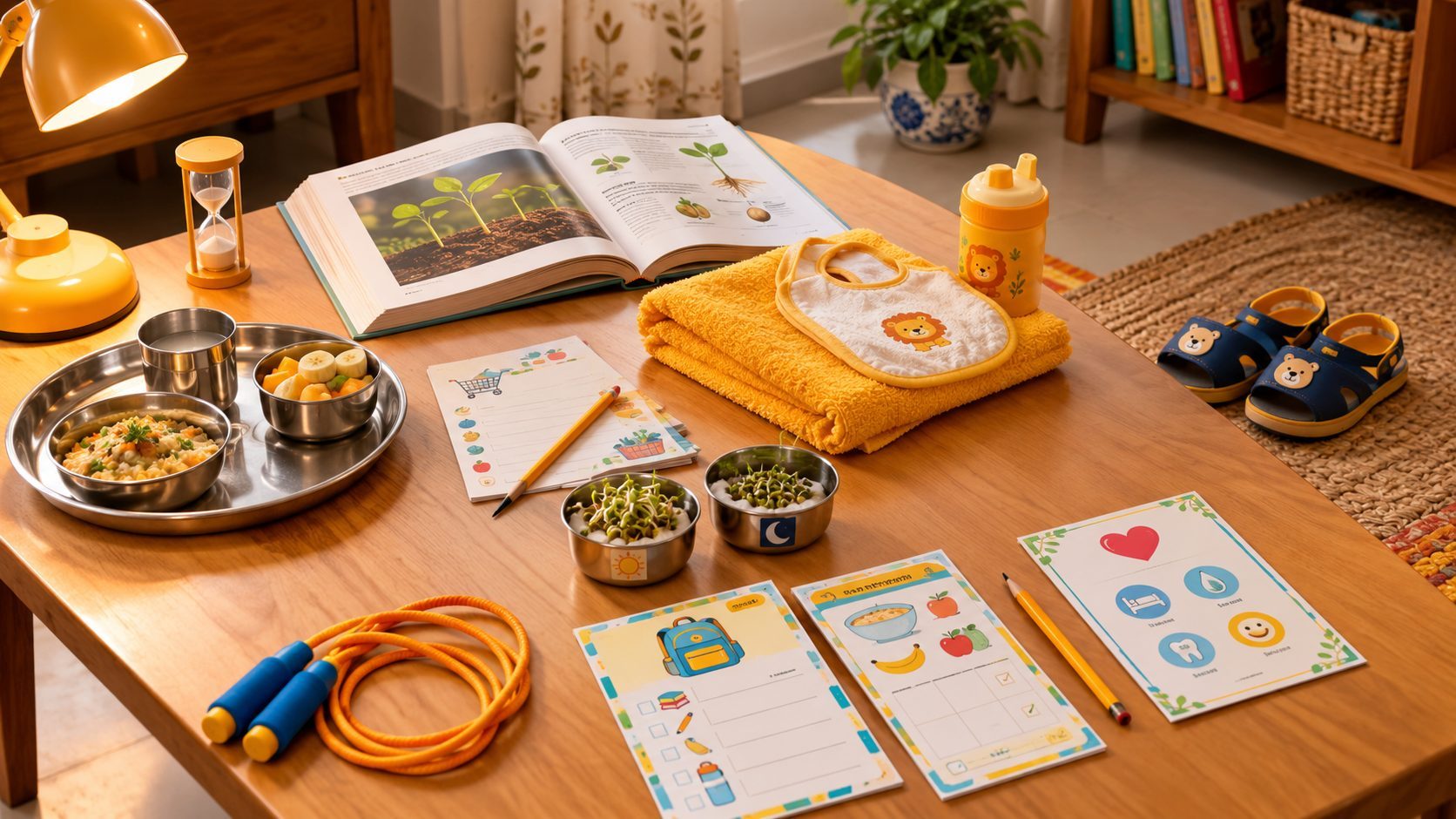
Self care activities for 8–10 year olds build independence through morning routines (checklists), clothing care (sorting and folding), money sense (coin jars), basic kitchen skills (supervised cutting and assembly), and time awareness (analog clocks). All five activities use household items already in your home—no purchases needed.
⚡ In a hurry? Our quick picks
By eight years old, children enter a stage where they're genuinely ready to take on real responsibility—not chores dressed up as games, but actual life skills that make them feel capable and trusted. Self care activities at this age aren't just about brushing teeth or getting dressed; they're about your child learning to manage their own morning, make decisions about their belongings, understand the value of money, contribute meaningfully in the kitchen, and sense how time works in their day. These aren't soft skills—they're the foundation of independence that grows straight into their teenage years and beyond.
🏆 Quick comparison: our top picks
| Product | Award | Rating | Price | |
|---|---|---|---|---|
 Kids Responsibility Chart with Magnetic Chores and Reward Stickers |
🏆 Editor's Choice | ★ 4.2 856 reviews |
₹149 | Check price → |
 Stainless Steel Coin Sorter and Storage Organizer for Kids |
💰 Best Value | ★ 4.4 512 reviews |
₹199 | Check price → |
 Child's Apron with Large Pockets and Adjustable Neck Strap |
👑 Premium Pick | ★ 4.1 445 reviews |
₹399 | Check price → |
 Analog Learning Clock with Moveable Hour and Minute Hands - Wood Frame |
🪙 Budget Pick | ★ 4.3 634 reviews |
₹319 | Check price → |
🛒 Our Top Picks
Best-reviewed overall, 4.2★ across 856 ratings.
Kids Responsibility Chart with Magnetic Chores and Reward Stickers
- ✓ Why it fits: Supports morning checklist and task-sequencing practice recommended in Activity 1
- ✓ Size: A4 format, reusable with dry-erase marker
- ✓ Includes: 20+ task magnets, reward stickers, and wall-mount hook
* We earn a small commission — at no extra cost to you.
Top rating for the price, 4.4★ at ₹199.
Stainless Steel Coin Sorter and Storage Organizer for Kids
- ✓ Why it fits: Speeds up coin sorting and counting for Activity 3 (Money Jar), building number sense without frustration
- ✓ Slots for: 1 rupee, 2 rupee, 5 rupee, and 10 rupee coins
- ✓ Material: Stainless steel with safe, rounded edges for ages 8+
* We earn a small commission — at no extra cost to you.
Top of the range, for parents who want the best features.
Child's Apron with Large Pockets and Adjustable Neck Strap
- ✓ Why it fits: Builds kitchen helper identity and keeps clothes clean during Activity 4 (kitchen tasks), encouraging repeated practice without laundry worry
- ✓ Size: Sized for ages 8–10, fits over most clothing
- ✓ Pockets: Two large pockets for tools or ingredients, machine-washable cotton or cotton-blend
* We earn a small commission — at no extra cost to you.
Lowest price that still clears our 3.8★ / 100-review bar.
Analog Learning Clock with Moveable Hour and Minute Hands - Wood Frame
- ✓ Why it fits: Makes clock-reading practice in Activity 5 clear and tactile; children move hands to set times and understand hour/minute progression
- ✓ Display: Large numbers 1–12, bold hour and minute hands, no battery needed
- ✓ Frame: Durable wood, safe for supervised use by ages 8–10
* We earn a small commission — at no extra cost to you.
Daily baby tips, exclusive Amazon deals & real parent advice — free forever.
According to the National Education Policy (NEP) 2020 and the National Curriculum Framework for Foundational Stage (NCF-FS) 2022, self-reliance and personal responsibility are core developmental aims for this age group. This guide walks you through five self care activities for 8–10 year olds that you can start today using things already in your home: a notebook, your kitchen table, loose change, kitchen tools with supervision, and an analog clock.
What's happening at this age
Eight to ten year olds are moving past the "because I said so" phase and entering a stage where they can understand cause and effect, manage tasks with a clear structure, and take genuine pride in doing something properly. Their hands are stronger and more coordinated. Their memory is sharper. They're starting to feel the weight of real decisions—what to wear, how to spend pocket money, whether their bag is packed for school. This is when you'll notice them correcting themselves, asking "Am I doing this right?", and actually caring about the answer. NEP 2020 emphasizes this stage as critical for building life competencies and self-reliance through structured, meaningful tasks. They're not too old for play-based learning, but they're ready for real responsibility alongside it.
Try this at home
Activity 1: Morning Checklist Chart
You need: A sheet of paper or cardboard, a pen, a pencil for checking off, items already around your home (dressing table mirror, toothbrush, school bag, uniform).
How: Write or draw together a simple checklist of morning tasks: brush teeth, get dressed, eat breakfast, pack bag, check shoes. Laminate it with clear tape if you want it to last, or just pin it on their bedroom wall. Each morning, your child ticks off or marks each task. At first, you stay nearby; by week two, most children can run through the list independently while you're making tea. The chart becomes their checklist, not your nag-list.
What it builds: Time awareness, task sequencing, independence from reminders, sense of accomplishment. Self care means taking charge of your own morning without an adult listing everything.
Easier: Use pictures or emoji instead of words. Harder: Add a second checklist for after-school tasks (homework, dinner, bedtime routine).
Activity 2: Clothing Sort and Fold Game
You need: A basket of clean clothes (mixed up on purpose), your child's cupboard or drawers, a flat surface like the bed.
How: Empty a basket of washed clothes onto the bed and ask your child to sort by type—all t-shirts together, all trousers together, all socks together. Then, one category at a time, teach them to fold. Start with t-shirts (fold in half, fold in half again, done). Once they're steady, move to trousers (fold lengthwise, fold in half). The goal isn't perfection; it's ownership. They fold their own pile, then put it away in the right drawer or shelf. This takes 15 minutes the first time, 8 minutes by week three.
What it builds: Care for belongings, sorting and organizing skills, fine motor control, responsibility for their own wardrobe. Self care includes knowing where your clothes are and keeping them neat.
Easier: Start with just socks and t-shirts. Harder: Rotate responsibility—one week they fold, the next week they put everything away without help.
Activity 3: Money Jar and Coin Sorting
You need: An empty glass or plastic jar, any loose coins from home (1 rupee, 5 rupee pieces), paper and a pen to track.
How: Give your child a small weekly "pocket money" (even 20–50 rupees is meaningful at this age) in coins. They drop it into their jar. Once a week, they empty the jar, sort the coins by type (all 1-rupee coins together, all 5-rupee coins), count them, and write down the total on a piece of paper taped to the jar. After two or three weeks, they'll start to see how it adds up. This is where you introduce a tiny goal: "If you save for four weeks, you'll have enough for that notebook you wanted."
What it builds: Number sense, delayed gratification, money awareness, decision-making (spend now or save for later). Self care includes understanding the value of money and making conscious choices about it.
Easier: Use just one type of coin at first. Harder: Introduce three "savings buckets"—spend now, save for two weeks, save for a month—and let them decide how to split their pocket money.
Activity 4: Kitchen Helper Task—Sandwich or Toast Assembly
You need: Bread, spreading ingredients (paneer, peanut butter, or jam—things they can safely spread), a butter knife or child-safe spreader, a cutting board, a plate, supervision.
How: Show them once how to place bread on a cutting board, spread gently without tearing, cut diagonally, and plate it up. Then step back. You're in the kitchen, but they're leading. If they make a mess, that's the point—they're learning. If the spread goes on thick, that's their choice. This is not about a perfect sandwich; it's about them being able to make something simple to eat without asking. Start with spreading and assembly (no knife use), then, if they're steady and careful over a few weeks, introduce a child-safe serrated knife for cutting with you right there.
What it builds: Basic food preparation, confidence, independence, fine motor control. Self care in the kitchen means being able to make yourself a simple snack safely.
Easier: Pre-cut bread, pre-portioned spreads. Harder: Let them choose ingredients and plan a simple snack plate for a sibling or parent.
Activity 5: Analog Clock Time Tracker
You need: An analog wall clock (any working clock in your home), a piece of paper, a pen, sticky notes.
How: Point to the clock and mark the time when school starts, when they usually eat lunch, when they finish homework. Use sticky notes to label these times. Over a week, help them notice: "School starts at 9 o'clock. Look—the small hand is on the 9. Lunch is at 1 o'clock. The small hand moves to the 1." Don't rush this. By week two, they'll start glancing at the clock unprompted to see if it's time for their favorite show or if there's still time to finish a game. This builds time awareness without digital screens.
What it builds: Time sense, clock-reading skills, transition readiness, internal structure. Self care includes knowing roughly where you are in your day and managing transitions.
Easier: Use only hour times (no minutes). Harder: Introduce half-past times and ask them to set a simple alarm on an analog learning clock.
What "getting it" looks like
You'll notice your child moving through their morning checklist without reminders by week three. They'll start folding their own clothes without being asked. They'll drop pocket money into the jar and track it unprompted. They'll ask to make their own snack. They'll glance at the clock and say, "It's 3 o'clock—my show starts at 3:30." These aren't flawless performances; a shirt might be folded lopsided, they might take 20 minutes to make a sandwich, or they might count coins wrong once in a while. That's normal and valuable. The marker isn't perfection—it's the shift from "Mum/Dad, what do I do?" to "I can do this."
When to move on, and when to ask
Most 8–10 year olds solidify one skill every 2–3 weeks if you practice together. Once they're running through their morning checklist independently and folding without reminders, you can add a new activity or raise the difficulty (longer checklists, more clothing items, higher savings goals). If your child is resisting or seeming overwhelmed after two weeks of gentle practice, slow down—pick just one activity, extend the timeline, and chat with your paediatrician if you notice persistent difficulty with coordination, memory, or task focus. This is general information, not medical advice.
If you're homeschooling
Weave these self care activities into your weekly structure: Monday morning checklist practice, Wednesday clothing sort after laundry, Thursday money jar count, Tuesday or Friday a kitchen task as part of a practical life lesson, and daily clock-reading. These aren't separate from learning—they're life skills, and NEP 2020 explicitly values them as part of foundational competencies. They take 20–30 minutes a week total and anchor your child in real responsibility.
What helps at home (optional)
Every activity above works beautifully with household items you already have. If you'd like to simplify or expand a skill, a few things can help: a printed responsibility chart or chore board (saves paper and ink over time), a simple coin sorter (makes money counting faster for children still building fine motor control), an analog learning clock with moveable hands (teaches time reading more clearly than a digital display), or a child-sized apron for kitchen tasks (keeps clothes cleaner and builds the identity of "kitchen helper"). None are necessary—but if any appeal to you, they're small tools that make practice smoother.
What IAP and WHO Guidance Says
- IAP (Indian Academy of Pediatrics) emphasizes that self-care and life skills are as important as academic learning in building confident, capable children. Activities like these support healthy psychosocial development.
- WHO recognizes that children aged 8–10 who engage in structured, meaningful tasks show better emotional regulation and decision-making skills. Regular, age-appropriate responsibility builds resilience.