
Complete Baby Proofing Checklist for Indian Homes: Room-by-Room Safety Guide for 6-12 Month Crawlers
⚡ In a hurry? Our quick picks


When my daughter started crawling at 7 months, I thought our Mumbai apartment was reasonably safe. Then I watched her make a beeline for the balcony grill, attempt to pull down my mother-in-law's brass lamps from the pooja mandir, and somehow locate every single electrical socket in the living room within her first week of mobility. That weekend became an emergency baby proofing marathon, and I learned the hard way that Indian homes have unique safety challenges you won't find in those imported parenting books.
🏆 Quick comparison: our top picks
| Product | Award | Rating | Price | |
|---|---|---|---|---|
 Safe-O-Kid Electrical Outlet Covers 10-Pack Safe-O-Kid Electrical Outlet Covers 10-Pack
|
🏆 Editor's Choice | ★ 4.3 3,847 reviews |
₹199 | Check price → |
 Baybee Baby Safety Lock Set for Cabinets and Drawers Baybee Baby Safety Lock Set for Cabinets and Drawers
|
👑 Premium Pick | No ratings yet | ₹284 | Check price → |
 Syga Corner Guards with 3M Adhesive L-Shaped Syga Corner Guards with 3M Adhesive L-Shaped
|
🪙 Budget Pick | No ratings yet | ₹195 | See alternatives → |
🛒 Our Top Picks

Best-reviewed overall, 4.3★ across 3,847 ratings.
Safe-O-Kid Electrical Outlet Covers 10-Pack
- ✓ Fits Indian 3-pin and 2-pin sockets
- ✓ Strong adhesive backing
- ✓ Difficult for babies, easy for adults
* We earn a small commission — at no extra cost to you.

Top of the range, for parents who want the best features.
Baybee Baby Safety Lock Set for Cabinets and Drawers
- ✓ Compatible with most Indian cabinet types
- ✓ Strong adhesive plus safety latch
- ✓ Set of 8 locks
* We earn a small commission — at no extra cost to you.

Lowest price that still clears our 3.8★ / 100-review bar.
Syga Corner Guards with 3M Adhesive L-Shaped
- ✓ Transparent L-shaped design
- ✓ 3M adhesive for strong hold
- ✓ Works on wood, glass, and marble
* We earn a small commission — at no extra cost to you.
Daily baby tips, exclusive Amazon deals & real parent advice — free forever.
This baby proofing checklist is specifically designed for Indian homes-whether you live in a Bengaluru high-rise, a Delhi independent house, or a Pune apartment. We're covering real hazards like marble flooring, open kitchen layouts, balconies without child-safe railings, and yes, those irresistible pooja diyas that seem to fascinate every crawler. I'll walk you through each room systematically, explain what to tackle at different mobility stages, and recommend products that actually work without breaking the bank.
The Indian Academy of Pediatrics reports that home injuries peak between 6-18 months when babies gain mobility but lack danger awareness. Most accidents happen in familiar spaces-your living room, kitchen, and bathrooms-not because parents are careless, but because we simply don't see our homes through a crawler's eyes until it's too late.
Understanding Your Baby's Mobility Stages: What to Baby Proof When
Before we dive into room-specific checklists, understanding your baby's developmental stages helps you prioritize what needs immediate attention versus what can wait a month or two. Baby proofing isn't a one-day project-it evolves as your little one's abilities grow.
Stage 1: Rolling and Scooting (4-6 Months)
At this stage, babies aren't yet crawling but can roll across rooms surprisingly fast. I remember leaving my son on his play mat in the center of our bedroom, stepping into the bathroom for literally two minutes, and returning to find him wedged under the bed, happily gumming the bed frame.
Priority areas for this stage include floor-level hazards within rolling distance of where you typically place your baby, electrical outlets at ground level, and anything with cords or cables they might grab while rolling. You don't need full house coverage yet, but secure the spaces where your baby spends supervised floor time-living room, bedroom, and any area where you do tummy time.
Start with Safe-O-Kid Electrical Outlet Covers 10-pack (Rs. 199) for all accessible sockets in main rooms. These fit standard Indian 3-pin and 2-pin sockets and are difficult for babies to remove but easy for adults. Also install Syga Corner Guards (Rs. 249) on your bed frame, low coffee tables, and any furniture at crawler height.
Stage 2: Crawling (6-9 Months)
This is when baby proofing becomes urgent. Crawlers cover ground fast, have zero sense of danger, and are driven by curiosity to explore every forbidden zone in your home. They're particularly drawn to exactly what you don't want them touching-electrical panels, kitchen cabinets, bathroom buckets, and that fascinating gas cylinder in the corner.
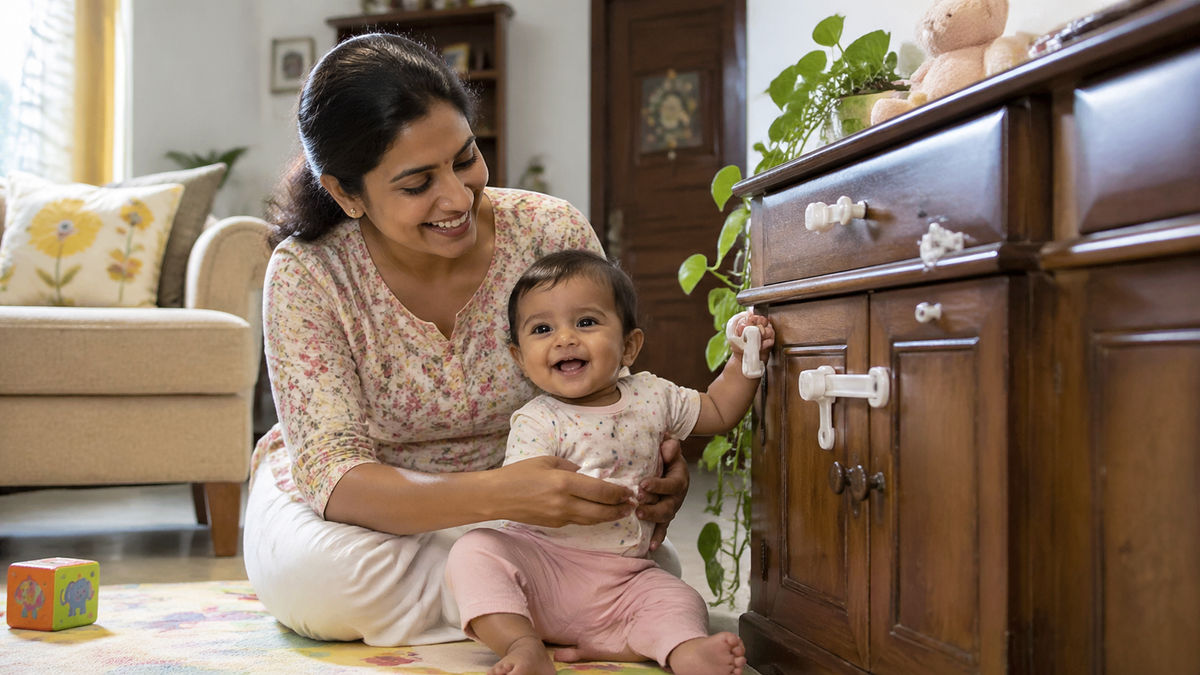
At this stage, you need comprehensive coverage. Every room your baby can access needs electrical outlet covers, corner guards on all furniture edges, cabinet locks for anything containing cleaning products or medicines, and gates blocking staircases, kitchens, and balconies. The Baybee Baby Safety Lock Set (Rs. 399) works on most Indian cabinet types-both modern soft-close and traditional wooden almirahs.
In Chennai and other South Indian cities where many homes have open kitchen layouts, this stage requires extra vigilance. A crawling baby can reach the kitchen in seconds, making physical barriers like baby gates essential rather than optional.
Stage 3: Cruising and Early Walking (9-12 Months)
Once babies start pulling themselves up on furniture, a whole new dimension of hazards appears. They can now reach countertops, pull down tablecloths with everything on them, and access higher shelves. This stage requires vertical thinking-not just floor-level protection.
Add furniture anchors to prevent tip-overs, move all hazardous items to high shelves (not just higher shelves-truly out of reach), secure window cords, and reassess your balcony safety. In cities like Jaipur and Lucknow where many homes have traditional low seating and floor-level storage, this stage means relocating medicines, cosmetics, and puja items to wall-mounted cabinets.
Living Room Baby Proofing: The Main Battlefield
Your living room is likely where your baby spends most waking hours, making it the most critical space to baby proof thoroughly. Indian living rooms often combine multiple functions-entertainment, prayer space, guest area-creating diverse hazard points.
Furniture and Sharp Corners
Marble-topped coffee tables, glass TV units, and wooden diwan corners become dangerous once babies start pulling up. I learned this when my nephew got his first forehead bump on my mother's solid wood coffee table-it looked minor but swelled within minutes, sending us to the pediatrician in panic at 10 PM.
Install Syga Corner Guards (Rs. 249) on every sharp edge at head height for a crawling or cruising baby-typically anything up to 90 cm from the floor. These transparent L-shaped guards stick firmly to wood, glass, and marble using 3M adhesive and cushion impacts effectively. For round table edges, use tube-style edge guards that wrap around curved surfaces.
Anchor all tall furniture to walls using L-brackets or furniture straps. TV units, bookcases, and display cabinets can tip if a baby pulls up using them for support. This isn't paranoia-ICMR data shows furniture tip-overs cause serious injuries in urban Indian homes, particularly in apartments where furniture isn't built-in.
Electrical Hazards and Entertainment Units
The area around your TV is a hazard cluster-multiple plugs, dangling cables, DTH boxes with flashing lights, and speaker wires create an irresistible attraction for babies. Use Safe-O-Kid Electrical Outlet Covers (Rs. 199 for 10 pieces) on all sockets in this zone.
Bundle and secure all cables using velcro cable ties or run them through cord covers mounted along baseboards. That tangled mess of TV, DTH, WiFi router, and speaker cables? It's not just an eyesore-it's a strangulation risk and a tempting toy for curious fingers. In our Bengaluru apartment, I installed a cable management box (Rs. 350 on Amazon.in) that hides the entire power strip and excess cable length behind the TV unit.
Cover or block access to the power strip itself. Babies are fascinated by the small red light and will try to poke fingers into unused sockets or pull out plugs to mouth them.
Pooja Room and Mandir Safety
This is uniquely relevant to Indian homes and often overlooked in baby proofing discussions. The pooja space contains multiple hazards-open flames from diyas, small decorative items that are choking hazards, fragile brass or glass objects, incense sticks, camphor, and kumkum or sindoor powders.
If your pooja area is in the living room at floor level, install a physical barrier-a small decorative gate or simply reorganize to move daily puja items to a wall-mounted shelf at least 120 cm high. Never leave diyas or agarbatti burning unattended when your baby is mobile. I switched to electric diyas for daily puja during the crawler phase-yes, less traditional, but my peace of mind was worth it.
Store kumkum, vibhuti, and especially camphor in locked containers on high shelves. Camphor is particularly dangerous if ingested by babies. Small brass bells, decorative elephants, and other puja items that could be choking hazards need to be moved out of reach.
Windows and Balcony Access
Open balconies are common in Indian apartments, and the standard grill spacing often allows a baby's head or body to fit through. Mumbai and Pune high-rises particularly need vigilance here. Install additional netting or acrylic panels if your balcony grill bars are spaced more than 10 cm apart.
For windows, remove any furniture that babies could use as climbing aids. That decorative window seat or low console table? It's now a launching pad. Window locks that prevent windows from opening more than 10 cm are available on Amazon.in for Rs. 150-200 and provide an extra safety layer.
Kitchen Baby Proofing: Managing Indian Cooking Hazards
Indian kitchens present unique challenges-open flames, hot oil splatter from tadkas, pressure cookers, gas cylinders, and ground-level storage common in many homes. This room requires maximum vigilance and preferably, a physical barrier preventing independent baby access.
Gas Cylinders and Stove Safety
The LPG cylinder is often stored in a bottom cabinet or corner, making it accessible to crawlers. While the cylinder itself won't harm them, the regulator, pipes, and knobs are concerning. Use the Baybee Baby Safety Lock Set (Rs. 399) to secure the cabinet door if your cylinder is enclosed. If it's in an open corner, create a physical barrier or use tension-mounted gates to block that section.
For the gas stove, always use back burners when cooking with a baby in the house. Turn pot handles inward so they don't extend over the counter edge where curious hands might grab them. Install stove knob covers (Rs. 180 for a 5-pack on Amazon.in) so babies can't accidentally turn on the gas-these transparent covers require an adult squeeze to remove before turning knobs.
Never carry hot liquids or pots while holding or stepping over a baby. This sounds obvious, but in the chaos of Indian household cooking-making chai while comforting a fussy baby-it happens more than we admit. In our extended family WhatsApp group, we've heard of three separate scalding incidents, all from momentary multitasking lapses.
Cabinet and Drawer Locks
Under-sink storage typically contains dish soap, cleaning liquids, steel scrubbers, and sometimes even mosquito repellent liquids-all hazardous if accessed by babies. The Baybee Baby Safety Lock Set works on various cabinet types and uses strong adhesive plus an additional safety latch mechanism.
Lock drawers containing knives, graters, and other sharp utensils. Babies are surprisingly strong and persistent-they will eventually figure out how to open unsecured drawers. Also secure any cabinets storing medicines, even if you think they're too high-cruising babies will surprise you with their climbing abilities.
In traditional South Indian homes, ground-level atta containers and rice bins need attention. Babies can open these, creating a mess but more importantly, posing a suffocation risk if they dive in headfirst. Move these to higher counters during the mobile months or secure them with childproof locks.
Refrigerator and Appliances
Bottom-freezer refrigerators or mini-fridges at baby height need locks. Babies can get trapped inside or pull the door onto themselves. Appliance locks for refrigerators cost around Rs. 150 and prevent this entirely.
Unplug countertop appliances when not in use, especially mixers, grinders, and electric kettles. Wrap cords and store them in high cabinets. That dangling mixer cord is a pull-down hazard waiting to happen.
Bedroom and Bathroom Safety: The Overlooked Spaces
These rooms often get less attention during baby proofing because we assume we supervise babies here, but many accidents occur during those brief moments you're grabbing a towel or answering the door.
Bedroom Hazards
Dressers and wardrobes must be anchored to walls-these cause the most serious furniture tip-over injuries. Even traditional Indian almirahs that seem heavy can topple if a baby uses open drawers as ladder rungs to climb. Use L-brackets (Rs. 200 for a set of 4) to secure furniture to walls.
Outlets near the bed need covers, especially if you charge phones overnight. Babies wake early and explore while you're still drowsy-that's when accidents happen. Also secure window blind cords or curtain strings that could pose strangulation risks. In Chennai and other humid cities where we use ceiling fans extensively, ensure the fan regulator is either too high for babies or covered.
Remove or secure all cosmetics, perfumes, and medicines from bedside tables and dresser tops. Even lip balm can be harmful if a baby consumes the entire tube. These items belong in locked drawers or cabinets at least 120 cm high.
Bathroom Safety
Bathrooms contain multiple hazards-water buckets, cleaning chemicals, razors, medicines in cabinets, and slippery floors. The simplest solution is keeping the bathroom door closed always with a hook latch at adult height.
If you store water in buckets-common in cities like Delhi and Bengaluru with irregular water supply-these pose drowning risks. Babies can fall into even partially filled buckets and lack the strength to pull themselves out. Always empty buckets immediately after use or store them inverted. If you must keep water stored, use covered containers rather than open buckets.
Install non-slip mats on bathroom floors, especially if you have marble or tile flooring. Lock all cabinets containing medicines, cosmetics, and cleaning products using cabinet locks. Move razors, hair removal creams, and other personal care items to high shelves or locked drawers.
Toilet locks (Rs. 120 on Amazon.in) prevent babies from lifting the toilet lid-important because babies explore toilets and can fall in. Also, toilet water contains bacteria you definitely don't want your baby exposed to.
Specific Indian Home Hazards and Solutions
Beyond standard baby proofing, Indian homes have specific architectural and cultural elements that need attention-things you won't find mentioned in Western baby proofing guides.
Marble and Tile Flooring
Unlike Western homes with carpeting, most Indian homes have hard marble, granite, or tile flooring. This means every fall is potentially more dangerous. You cannot carpet your entire home, but you can create safe play zones using foam play mats or area rugs in spaces where your baby spends most time.
Keep floors dry always-water splashed from kitchen or bathroom creates slip hazards. In monsoon season, which affects Mumbai, Chennai, and coastal cities significantly, floors can become slippery from humidity alone. Extra vigilance during these months is essential.
Open Floor Plans and Multi-Level Homes
Many Indian homes, especially independent houses in cities like Jaipur, Lucknow, and Pune, have stairs connecting floors without doors separating them. Pressure-mounted safety gates (Rs. 2,500-4,500 on Amazon.in) at top and bottom of staircases are non-negotiable once your baby starts crawling.
Some homes have sunken living rooms or single-step level changes-these need highlighting with bright tape or small gates so babies don't tumble down during the cruising phase.
Balcony and Terrace Access
Indian apartments often have utility balconies for drying clothes or storing items, separate from main balconies. These service balconies may have wider grill spacing or lower railings. Ensure every balcony or terrace access point has a secure latch at adult height or a gate preventing baby access.
Also check if you store anything on balconies that could be climbing aids-stools, planters, storage boxes. A baby who manages to reach the balcony could use these to climb higher, increasing fall risk.
Dr. Meena Sharma, a Delhi-based pediatrician with 15 years of experience, emphasizes that most home injuries are preventable with simple precautions. According to the Indian Academy of Pediatrics, the peak age for home injuries is 6-18 months when babies are mobile but lack awareness of danger. Parents should physically get down to baby's eye level and crawl through each room to identify hazards they might miss from adult height.
- Electrical safety is paramount: All accessible outlets should have covers, and electrical panels must be completely inaccessible. Even minor shocks can cause serious cardiac issues in infants.
- Choking hazards hide everywhere: Items smaller than a toilet paper roll's diameter are choking risks. This includes coins, buttons, small toys from older siblings, and traditional items like supari or small puja decorations.
- Water safety extends beyond pools: In Indian homes, buckets pose significant drowning risks. A baby can drown in just 5 cm of water in under two minutes, often silently without splashing or calling for help.
Room-by-Room Quick Checklist
Here's a comprehensive checklist you can print and work through room by roomroom by roomroom by roomroom by roomroom by roomroom by roomroom by roomroom by roomroom by room. Don't try to complete everything in one day-prioritize based on your baby's current mobility stage and the rooms they access most frequently.
Living Room Checklist
- Install outlet covers on all sockets using Safe-O-Kid Electrical Outlet Covers
- Apply Syga Corner Guards to all furniture with sharp edges
- Anchor TV unit, bookcases, and tall furniture to walls
- Bundle and secure all cables and cords
- Move pooja items, diyas, and agarbatti to high shelves
- Check window locks and balcony grill spacing
- Remove or secure small decorative items that are choking hazards
- Ensure no tablecloths that can be pulled down
Kitchen Checklist
- Install Baybee Baby Safety Lock Set on all low cabinets
- Add stove knob covers
- Secure or barrier-protect the gas cylinder area
- Lock cabinets containing cleaning products and chemicals
- Install refrigerator lock if applicable
- Remove or secure all sharp objects from low drawers
- Install a baby gate at kitchen entrance if possible
- Ensure no dangling appliance cords
Bedroom Checklist
- Anchor dresser and wardrobe to walls
- Install outlet covers, especially near bed
- Secure window blind cords
- Move all medicines, cosmetics, and personal care items to high locked storage
- Check under bed for small items or hazards
- Ensure fan regulators are out of reach
- Remove or secure any floor-level power strips
Bathroom Checklist
- Install door latch at adult height to keep bathroom inaccessible
- Empty or cover all water buckets after use
- Install cabinet locks on all storage
- Add toilet lock
- Place non-slip mats on floors
- Move razors, scissors, and sharp items to high storage
- Lock all medicines in high cabinets
- Check for and remove small items like soap pieces, hairpins, or cotton buds from accessible areas
Product Investment Guide: What to Buy First
Baby proofing can feel expensive, but prioritizing purchases helps manage costs while keeping your baby safe. Here's how to approach it strategically.
Start with the essential trio: Safe-O-Kid Electrical Outlet Covers 10-pack (Rs. 199), Syga Corner Guards (Rs. 249), and Baybee Baby Safety Lock Set (Rs. 399). These three products cover the most common and serious hazards for under Rs. 850 total.
Next priority is baby gates if you have stairs, open kitchens, or balcony access points. A good pressure-mounted gate costs Rs. 2,500-3,500 but prevents the most dangerous scenarios-falls down stairs or access to fire hazards in kitchens.
Furniture anchors and anti-tip straps are next-these cost around Rs. 200-400 for a set but prevent the potentially fatal furniture tip-over accidents. Don't skip this step, especially if you have the common IKEA-style or modern Indian furniture with center of gravity higher than traditional wooden pieces.
Finally, consider convenience items like door knob covers, appliance locks, and cabinet latches for upper cabinets as your baby approaches the cruising and walking phases. These add another Rs. 500-1,000 to your total investment.
Realistically, thorough baby proofing for a 2-3 bedroom Indian apartment costs Rs. 3,000-5,000 in products, which is minimal compared to a single emergency room visit. Many items can be reused for subsequent children or passed to relatives, making them good value investments.
Buy in bulk where possible-outlet covers, corner guards, and cabinet locks are almost always cheaper per unit when bought in larger packs. Also watch for Amazon.in sales during festive seasons when baby safety products often see 20-30% discounts.
Common Baby Proofing Mistakes Indian Parents Make
Even well-intentioned parents miss things. Here are the most common mistakes I've observed in my own journey and from talking to other parents across Delhi, Mumbai, and Bengaluru.
Underestimating baby's reach and climbing ability is the biggest mistake. That shelf you think is too high? Your baby will surprise you. Always add 20-30 cm buffer height to what you consider out of reach. By 11-12 months, babies can push chairs or stools to climb, creating multi-step solutions to access forbidden items.
Delay in implementation is another common issue. Many parents wait until their baby actually starts crawling or has a first accident before baby proofing. By then, you're playing catch-up in panic mode. Start baby proofing when your baby is around 4-5 months, before mobility begins. It's easier to baby proof when you're not constantly supervising a mobile baby.
Inconsistent application across all spaces is problematic. Parents baby proof the living room thoroughly but neglect guest bedrooms or grandparents' rooms. Babies explore everywhere, especially new spaces. If relatives visit and stay in a room, baby proof it before they arrive because your baby will definitely enter that room.
Overlooking visitor belongings causes issues too. Guests may leave handbags, medicines, or other items on low tables or sofas. Brief visitors on baby safety and designate a high counter or closed room for their belongings. I learned this when my baby found my aunt's handbag and scattered loose pills across the floor within minutes of her arrival.
Finally, not reassessing as baby grows leads to complacency. Baby proofing isn't a one-time task-what works for a 6-month-old crawler doesn't work for a 12-month-old climber. Every month, get down to your baby's level and look for new hazards they can now reach.
Remember that baby proofing isn't about creating a padded, sterile environment where nothing can happen-that's impossible and also prevents babies from learning natural consequences of their actions. It's about eliminating serious hazards while allowing safe exploration. Your baby will still get minor bumps and bruises, and that's actually developmentally appropriate. What baby proofing prevents is the serious injuries-electrical shocks, poisoning, drowning, falls from heights, or furniture crushes.
Take it room by room, prioritize based on your baby's current abilities and the spaces they access most, and remember that you're doing great. Baby proofing feels overwhelming initially but becomes second nature within weeks. Your awareness heightens, and you start automatically scanning spaces for hazards wherever you go. That parent instinct, combined with these practical steps, will keep your little explorer safe as they discover their world.
Frequently Asked Questions
At what age should I start baby proofing my Indian home?
Are standard baby proofing products suitable for Indian electrical outlets and furniture?
How do I baby proof open balconies with wide grill spacing in my apartment?
Is it safe to use electric diyas instead of traditional oil lamps during the baby crawler phase?
What's the biggest overlooked hazard in Indian homes for crawling babies?
Daily baby tips, exclusive Amazon deals & real parent advice — free forever.