
Sleep Routine for 1-2 Year Olds: 5 Bedtime Wind-Down Activities Using Household Items
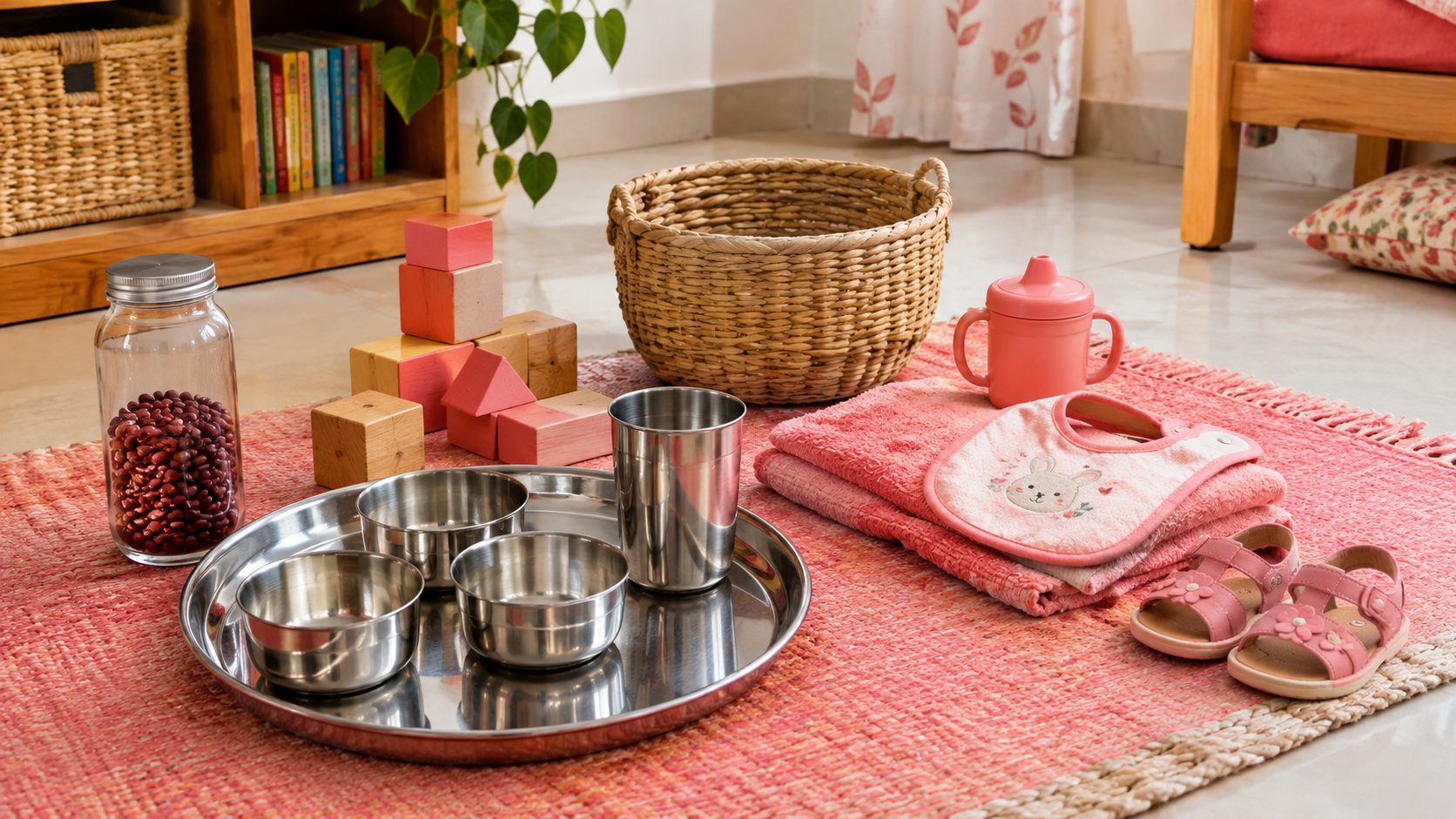
A predictable 30-45 minute wind-down routine starting 1 hour before bed—dim lights, warm bath, gentle massage, a comfort object, a lullaby, and a picture sequence of sleep steps—helps toddlers 12-24 months shift from play to rest. All activities use things most homes already have.
⚡ In a hurry? Our quick picks


Around 18 months, your toddler's body is waking up to routines—not because she understands a timetable, but because her brain is learning to predict what comes next. When you do the same thing every evening in the same order, her nervous system learns to calm down instead of resist. This isn't about strict discipline; it's about giving her brain a signal: "Rest is coming, and it's safe."
🛒 Our Top Picks
Jagjit Singh Soft Cotton Dupatta / Scarf (2 metres)
- ✓ Why it fits: Soft comfort object that becomes a consistent sleep cue; can be held during wind-down routine and left in crib as a tactile anchor.
- ✓ 100% cotton, machine washable, no dyes or finishes that irritate sensitive skin
- ✓ 2 metres length—long enough for child to hold and explore without tangling risk
* We earn a small commission — at no extra cost to you.
Montessori Concepts Wooden Peg Board with Large Pegs & Picture Cards (bedtime sequence set)
- ✓ Why it fits: Interactive visual sequencing tool to teach bedtime steps (bath, dry, clothes, bed); toddlers at 18+ months begin matching pictures to routines.
- ✓ 12 large wooden pegs (no small parts or choking hazards), 6 illustrated cards showing daily self-care routines
- ✓ Develops order awareness and predictability; doubles as a reusable evening check-in activity
* We earn a small commission — at no extra cost to you.
Babymoov Soft Night Light with Warm Glow (Timer-enabled, dimmable)
- ✓ Why it fits: Emits warm, dim light that supports circadian rhythm shift without overstimulation; toddlers learn darkness is safe when soft light is predictable.
- ✓ Warm white light (not blue), dimmable, includes 30-minute or 60-minute auto-off timer
- ✓ Safe silicone body (no sharp edges), placed out of reach on a shelf or dresser, not in the crib
* We earn a small commission — at no extra cost to you.

Board Book Set: 'Goodnight Moon', 'Dear Zoo', & 'Very Hungry Caterpillar' (Indian editions, soft covers)
- ✓ Why it fits: Calming picture books with simple, repetitive text to look at after lullaby; keeps child engaged without active stimulation; supports language and predictability.
- ✓ Soft cardboard covers, large sturdy pages (no small pieces or detachable parts), warm, familiar illustrations
- ✓ Recommended to read the same book 2–3 nights in a row during wind-down, then rotate; repetition is calming for toddlers
* We earn a small commission — at no extra cost to you.
Daily baby tips, exclusive Amazon deals & real parent advice — free forever.
That signal matters, especially in joint-family homes where someone is always cooking, talking, or moving about. A strong evening ritual creates a psychological "buffer zone"—a few minutes where nothing else matters except the two of you and sleep. The five activities below are drawn from what paediatricians recommend and what Indian families already do naturally. No fancy equipment needed.
What's happening at this age
Toddlers aged 12–24 months are building something called circadian awareness—a sense that day and night are different, and that their body should behave differently at each. Their sleep drive (the biological urge to rest) is real, but it's not automatic like it was at 6 months. Now, their brain is developing executive functions: the ability to shift gears, wait, and settle. The National Education Policy 2020 and early-childhood frameworks emphasise that routines at this age build emotional regulation—the foundation for learning, focus, and social behaviour. A child who practices calming down at bedtime is literally training her nervous system to handle transitions throughout the day.
At this age, most toddlers still need 11–14 hours of sleep in 24 hours, often split between one daytime nap (after age 18 months, sometimes down to 1–2 hours) and 10–12 hours at night. That target is easier to hit when the transition into sleep feels safe and predictable, not forced.
Try this at home
Dim light ritual (starting 1 hour before bed)
You need: Existing ceiling lights, a cloth or dupatta, or simply switch to a single small table lamp in one corner of the room.
How: At the same time each evening (say, 7 p.m.), dim the main room where your child plays. If you have a dimmer switch, gradually lower it. If not, switch off the ceiling light and use only a soft side light or cover a lamp with a thin cotton cloth (keeping it safe from heat). Keep the routine consistent: same time, same light level. This signals the brain that playtime is ending.
What it builds: Circadian rhythm awareness—the biological clock that tells the body when to wind down. Dim light suppresses daytime alertness hormones like cortisol.
Easier: Just switch off one light. Harder: Use a timer and dim lights gradually every 10 minutes during the hour, so the shift is very gradual.
Warm bath and gentle massage (15–20 minutes)
You need: Warm water, a small steel or plastic bucket, a soft cotton cloth, and coconut or sesame oil (traditional practice, optional—the warm water alone is enough).
How: Fill a bucket or tub with warm (not hot—test on your inner wrist) water. Let your child splash for 3–5 minutes. Then, lift her out, wrap her in a soft towel, and do a gentle 5-minute massage on her arms, legs, and back using long, slow strokes. Talk softly or sing. No rushing. If using oil, warm it slightly between your hands first; never pour cold oil on a child. This is not a vigorous cleanse—it's about warm, slow touch.
What it builds: Tactile comfort and trust. Warm water and slow touch activate the parasympathetic nervous system (the "rest and digest" mode). Many Indian families already do this; the bedtime version is simply slower and more deliberate than a daytime wash.
Easier: Skip the massage; just warm bath and wrap in a soft cloth. Harder: Add gentle humming or singing during the massage to deepen the calming effect.
Soft comfort object or "transition toy" (always present at this stage)
You need: One soft cloth (a dupatta, old cotton scarf, or flannel cloth), or a soft stuffed toy your child already loves.
How: Choose one object your child sees only at bedtime. It doesn't need to be new or special—a worn cotton dupatta or an old soft toy works perfectly. As you dim the lights or start the bath routine, bring out this object. Let her hold it. Talk about it: "This is your sleepy cloth. It stays with you while you rest." Use the same words every night. By week 2–3, the object itself becomes a cue: when she sees it, her brain starts to expect sleep.
What it builds: Object constancy and predictability. Toddlers at this age are starting to understand that objects exist even when hidden; a consistent comfort object becomes an anchor.
Easier: Just introduce the object; no explanation needed. Harder: Let her choose between two objects each night, so she feels some control.
Lullaby in your mother tongue (5 minutes)
You need: Your voice and a simple, familiar song—any lullaby from your own childhood (Hindi, Marathi, Bengali, Tamil, Telugu, Punjabi, Gujarati, Kannada, Malayalam, or any language your family speaks).
How: After the bath and massage, settle your child on your lap or beside you on the bed. Sing the same lullaby every night—same melody, same words. It doesn't matter if you think you can't sing; your child loves your voice, not a performance. Sing quietly, slowly, and repetitively. If you don't remember a full lullaby, any simple, slow song works: a hymn, a folk song, even a slowed-down version of a nursery rhyme. The key is consistency and tone—slow and gentle.
What it builds: Language and emotional security. Lullabies in a child's mother tongue carry cultural familiarity and deep comfort. The rhythm and repetition slow breathing naturally.
Easier: Hum instead of sing, or play a soft recording if you prefer. Harder: Teach your child a simple gesture (like hand-waving) to do along with the song, so she's actively participating.
Picture sequence of bedtime steps (3–5 minutes)
You need: Paper or cardboard, a pen or marker, and simple line drawings or magazine cutouts showing: bath → dry off → put on sleep clothes → drink water → into bed → lights off.
How: Draw or paste simple pictures on a strip of paper showing the steps that come next. You don't need artistic skill—stick figures work. As you go through each step, point to the picture and say what comes next: "First, warm bath," (point) "then, cosy clothes," (point) "then, into bed." This gives your toddler a visual roadmap. By knowing what's coming, she feels less resistant. Some families laminate this or stick it on the bedroom wall; others keep it on a clipboard and go through it each night.
What it builds: Sequencing and predictability. Toddlers at 18 months start to understand visual symbols; this activity gives her a sense of control ("I know what's next") and language development (you name each step).
Easier: Just talk through the steps without pictures. Harder: Let her help draw or colour the pictures, turning it into a daytime activity that she then uses at night.
What "getting it" looks like
By 3–4 weeks of a consistent routine, you'll notice: your toddler yawning or relaxing her body when she sees the dim light; moving toward the bath area without resistance; holding or reaching for her comfort object without you prompting; quieting down during the lullaby; and pointing at or looking toward the picture sequence before you show it. She may not sleep perfectly, but her nervous system is learning that this sequence means rest is safe. That's the win.
When to move on, and when to ask for help
Use this routine for at least 4–6 weeks before deciding if it's working. Sleep changes don't happen overnight. However, if your 18-month-old is waking more than 3 times per night after a full month of a consistent routine, or if she's resisting the routine aggressively every night despite your calm approach, chat with your paediatrician. Occasional night waking is normal, but a pattern of severe resistance or very frequent waking can point to discomfort (teething, ear infection, developmental leap) that needs attention. This is general information, not medical advice.
If you're homeschooling or doing structured learning at home
Fit this routine into your weekly rhythm by anchoring it to the same time every evening (e.g., always after dinner, before any structured play). The consistency matters more than the time—pick a slot your family can protect, and keep it the same 7 days a week, including weekends. This regularity builds the strongest sleep foundation.
What helps at home (optional)
Every activity above works with things you already own. However, a few items can make the wind-down easier: a set of board books with soft, calming images (animals, nature, simple shapes) to look at after the lullaby instead of active play; a small night light that emits a warm, dim glow so your child isn't afraid of darkness but isn't stimulated by bright light; and a child-sized sleep sack or wearable blanket so she stays warm without loose blankets that pose a safety risk. None of these are essential, but they can be helpful additions if you have the space or budget.
What IAP and WHO Guidance Says
• Sleep needs: IAP recommends 11–14 hours of sleep in 24 hours for children aged 1–2 years, often as 10–12 hours at night plus a 1–2 hour nap.
• Routine importance: WHO emphasises that predictable daily routines during ages 12–24 months support emotional regulation and reduce behavioural sleep resistance. Consistency in timing and sequence is more important than perfection in execution.
FAQs
These are covered in the JSON faq field below.
📚 Reviewed against
This guide was checked against the sources below. It is general parenting guidance, not medical advice — for any concern about your child's development, talk to your paediatrician.
- Indian Academy of Pediatrics (IAP) Sleep Guidelines — Recommended sleep duration and patterns for 1-2 year olds; supports circadian rhythm development.
- WHO Early Childhood Development Guidance (2023) — Emphasises role of predictable routines in building self-regulation and emotional stability in toddlers 12-24 months.
- National Education Policy (NEP) 2020 – Foundational Stage — Foundation for learning development; supports sequential, routine-based approaches to building circadian awareness and self-care skills.
- Indian Academy of Pediatrics – Tactile Development and Touch in Infants — Supports safe, warm-water bathing and gentle massage as sensory development and bonding tools for sleep preparation.
- UNICEF India – Early Childhood Care and Development — Contextualises bedtime routines within broader early childhood development and self-regulation in Indian family settings.
Last reviewed 24 Nov 2026
Frequently Asked Questions
What time should a 1.5 year old go to bed?
What is the 5-3-3 rule for babies?
Should a 1 year old sleep 12 hours at night?
Is 8:30 p.m. too late for a 2 year old to go to bed?
How do I handle naps if my toddler fights the routine?
Can I use the same routine on weekends and while traveling?
Daily baby tips, exclusive Amazon deals & real parent advice — free forever.