
Creative Activities for 8-Year-Olds at Home Without Screen: 5 DIY Projects Using Household Items
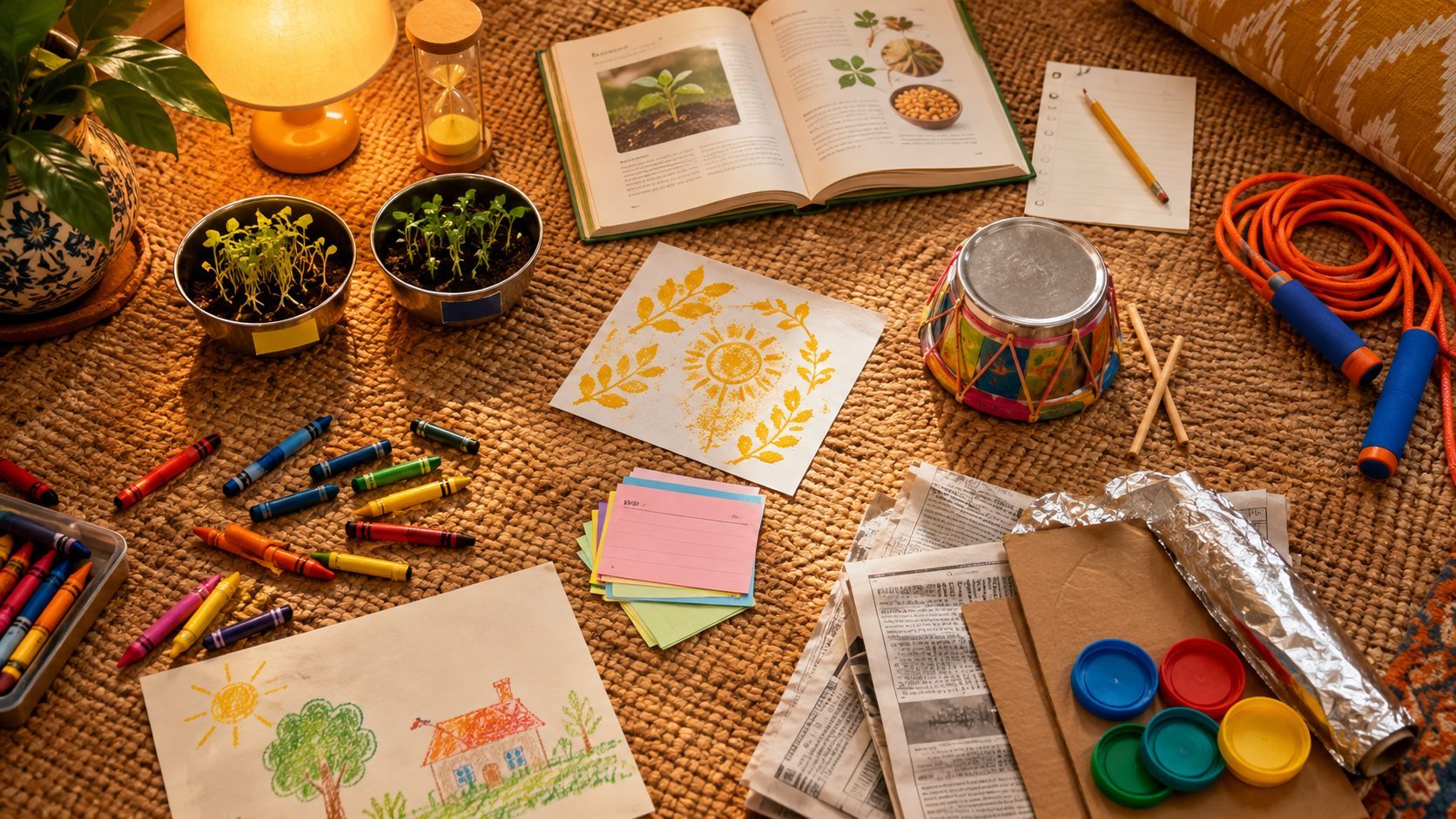
Five screen-free creative projects for 8-year-olds: rolled newspaper sculpture, shadow art with a torch, nature collage from garden finds, comic strip storytelling, and scale floor plans to reimagine a room. All use household items and take 20–45 minutes each. Each builds divergent thinking, self-expression, and problem-solving skills that NEP 2020 identifies as core to middle-stage learning.
⚡ In a hurry? Our quick picks

Eight-year-olds are at a sweet spot—old enough to follow multi-step instructions and manage fine motor work, but still young enough that their imagination hasn't yet been shaped by algorithms and recommendation feeds. This is also the age when screen time begins to crowd out unstructured creative play, exactly when children need it most. Creative activities that ask "what else could this be?" or "how would you solve this?" are the antidote. They don't require permission, they don't need charging, and they often surprise you with what your child actually thinks about.
🏆 Quick comparison: our top picks
| Product | Award | Price | |
|---|---|---|---|
|
Faber-Castell Art Kit, 35-Piece (Pencils, Crayons, Sharpener, Eraser, Sketcher)
|
👑 Premium Pick | ₹291 | Check price → |
 Faber-Castell Connector Felt-Tip Pens Set, 24 Colors |
🪙 Budget Pick | ₹186 | Check price → |
 Doms A3 Sketch Pad, 100 GSM Paper, 50 Sheets |
See on Amazon | Check price → | |
 Camel Poster Colors Set, 18 Shades (Non-Toxic, BIS-Certified) |
See on Amazon | Check price → |
🛒 Our Top Picks
The highest-priced option in this guide.
Faber-Castell Art Kit, 35-Piece (Pencils, Crayons, Sharpener, Eraser, Sketcher)
- ✓ Why it fits: Comprehensive kit covers sketching, coloring, and planning all five projects without buying separate items
- ✓ Includes 24 crayons, 6 colored pencils, HB and 2B graphite pencils, sharpener, eraser, and sketch pad
- ✓ Durable wooden case keeps supplies organized and portable for carrying between rooms or outdoors
* We earn a small commission — at no extra cost to you.
The lowest-priced option in this guide.
Faber-Castell Connector Felt-Tip Pens Set, 24 Colors
- ✓ Why it fits: Adds color detail and labeling to comic strips, collages, and room plans without needing crayons or markers
- ✓ 24 washable colors with ergonomic grip for 8-year-old hands
- ✓ Connector caps allow tips to join for extended drawing and building towers (doubles as a creative toy)
* We earn a small commission — at no extra cost to you.
Doms A3 Sketch Pad, 100 GSM Paper, 50 Sheets
- ✓ Why it fits: Larger A3 format ideal for floor plans, comic strips, and collage work; paper weight holds glue without warping
- ✓ 100 GSM paper suitable for pencil, marker, paint, and light glue application
- ✓ 50 sheets provide room for multiple projects and iteration without running out
* We earn a small commission — at no extra cost to you.
Camel Poster Colors Set, 18 Shades (Non-Toxic, BIS-Certified)
- ✓ Why it fits: Allows painting and color decoration on newspaper sculptures, shadow art, and collage projects after construction
- ✓ 18 vibrant poster colors in tubes; easy for 8-year-olds to squeeze and mix
- ✓ Non-toxic, BIS-marked, water-based formula—washes from clothes and hands easily
* We earn a small commission — at no extra cost to you.
Daily baby tips, exclusive Amazon deals & real parent advice — free forever.
What's happening at this age
By 8 years old, children are developing divergent thinking—the ability to generate multiple solutions to an open-ended problem, rather than finding one "right answer." The National Education Policy (NEP) 2020 emphasises this as a foundation skill for the middle stage (grades 3–5), alongside creativity and self-expression. Your child can now manage sequences ("first I do this, then that"), express ideas through media other than words, and begin to understand that their own perspective is valid and worth exploring. Fine motor control is solid; they can cut, glue, fold, and draw with intention. This is the window to let them lead their own creative direction.
Try this at home
1. Newspaper Sculpture — Rolling, Twisting, Building
You need: Old newspapers (any language, any section), a glue stick or white craft glue, scissors, and sticky tape. Optional: water-based markers or crayons to paint finished pieces.
How: Show your child how to roll a sheet of newspaper tightly into a pole, then twist or coil it into a shape—a spiral, a loop, an arch. Cut the poles to different lengths. Glue or tape them together to build a structure: a tower, a bridge, an abstract shape, even a sculptural animal. Let them decide what it becomes. This takes about 30 minutes.
What it builds: Spatial reasoning, motor control, and the confidence to try something that doesn't need to "look like" anything. Newspaper is forgiving; there's no waste, no cost.
Easier: Pre-roll some poles; your child just assembles and glues. Harder: Challenge them to build the tallest freestanding tower, or ask them to tell a story about what their sculpture represents.
2. Shadow Art — Torch, Paper, and Imagination
You need: A mobile torch (or even a phone torch), white paper or cardboard, scissors, and something to cast a shadow—toys, kitchen utensils, their own hands, paper cutouts.
How: Darken one corner of a room. Pin or hold white paper on a wall or window. Hold the torch behind an object so its shadow falls on the paper. Your child traces the shadow with a pencil or marker, then colours or decorates it. They can create a whole scene: a torch-lit story with multiple shadows, moving objects to change the shape, or layering shadows to tell a narrative. This works especially well after sunset.
What it builds: Understanding light and shape, fine observation, and playful problem-solving. Shadow art also introduces the idea that the same object can look completely different depending on perspective.
Easier: Trace simple hand shadows together. Harder: Create a multi-layer shadow scene, or use the torch to tell a shadow story that they narrate aloud.
3. Nature Collage — From Garden to Canvas
You need: Paper or cardboard (old envelopes, magazines, or actual craft paper), glue, and things from outside: leaves, flower petals, twigs, bark pieces, stones, dried grass. If you don't have a garden, a park walk works too.
How: Take your child on a "treasure hunt" to collect interesting natural materials. Back home, arrange them on paper to create a collage—a picture, a pattern, an abstract design, or a representation of something they've seen. Glue each piece down. This can be done in 25–40 minutes depending on how long the hunt takes.
What it builds: Observation skills, an eye for colour and texture, and connection to the natural world. Collage is also very forgiving; odd shapes and irregular pieces often look better than perfectly matched ones.
Easier: You arrange pieces; they glue. Harder: Challenge them to create a portrait, a landscape, or a creature using only natural materials, without pre-drawing it.
4. Story Comic Strip — Old Magazines and Sequential Thinking
You need: Old magazines, newspapers, or printed images; scissors; paper or cardboard; glue; and markers for labels or dialogue.
How: Help your child cut out images from magazines—people, animals, objects, scenery. On a large paper, divide it into 4–6 boxes (like a comic strip). Arrange and glue the cut-outs into a sequence that tells a story. Add dialogue bubbles, captions, or labels with markers. The story can be funny, adventurous, mysterious, or surreal. This takes about 40–50 minutes.
What it builds: Sequencing, narrative thinking, and the understanding that a story has a beginning, middle, and end. It also encourages them to edit and refine—"does this picture work here, or should it go there?"
Easier: Provide 4 specific images; they arrange and glue. Harder: Ask them to write the story first, then hunt for images that match it, or challenge them to create a silent comic (no words, just pictures that tell the story).
5. Room Redesign — Floor Plan and Scale Thinking
You need: Paper, pencil, ruler (optional but helpful), and either small objects (building blocks, LEGO, folded paper shapes) or coloured paper squares to represent furniture.
How: Ask your child to measure their bedroom or another room (you can do the measuring together with a tape measure, or estimate in arm-lengths or steps). Draw a simple bird's-eye map of the room on paper. Using small cut-out shapes, toys, or blocks, help them rearrange the "furniture." How would they redesign it? Where would the bed go? The desk? The play corner? This is open-ended problem-solving: "If I move this here, do I still have space to walk?" Younger kids might just push blocks around; older kids can actually sketch plans and explain their choices. This takes 30–45 minutes.
What it builds: Spatial reasoning, practical problem-solving, planning, and the ability to think in 2D and 3D simultaneously. It's also a window into how they think about their own space and what matters to them.
Easier: Just move toys around the actual room without drawing. Harder: Challenge them to fit more activities into the same space, or redesign a shared family area.
What 'getting it' looks like
You'll know these projects are landing when your child asks to do them again, when they come up with variations you didn't suggest, or when they show you their work unprompted. You'll also notice them beginning to problem-solve independently—"this piece won't stick; what if I use more glue?" or "I want the shadow to look like a dragon—how do I hold it differently?" The goal is not a museum-quality end product; it's the confidence that their ideas are worth exploring and that they can make mistakes and keep going.
When to move on, and when to ask
Most 8-year-olds are ready for these projects, but watch for signs of frustration or disinterest—some children prefer hands-on building (blocks, LEGO) to art, and that's fine. Others might need more structure: instead of "make anything you want," try "make something that makes people smile." If your child seems stuck, anxious about "getting it right," or refuses to try, talk to your child's class teacher or a school counsellor. Persistent anxiety around creative tasks is worth a brief conversation, though most children simply bloom with permission to experiment.
If you're homeschooling
These projects fit beautifully into a weekly creative block. Assign one per week, or cluster them into a "creativity sprint" where your child chooses two or three and works through them over a few days. They can be documented with photos (which becomes a portfolio), or saved in a folder. Each one feeds into the other—a comic strip idea might become a shadow play, or a room redesign might inspire a newspaper sculpture to put in it.
What helps at home (optional)
Every activity above works completely with household items—old newspapers, glue, markers, and things from the garden. If you want to expand the toolkit, a basic art set (quality crayons, sketch paper, and poster colors) makes it easier to refine ideas, and a dedicated creativity journal gives your child a place to sketch, plan, or paste photos of finished work. These aren't necessary, but they do signal to your child that their creative work matters enough to keep and collect.
What IAP and WHO Guidance Says
Screen-free play and creative expression: The Indian Academy of Pediatrics (IAP) emphasises that unstructured creative play is critical for cognitive and emotional development in the 6–12 age group, and identifies divergent thinking (the ability to generate multiple ideas) as a protective factor against anxiety and rigid thinking patterns. WHO guidance on child development similarly stresses that arts and crafts activities strengthen fine motor control, spatial reasoning, and self-regulation—skills that support academic learning across all subjects.
📚 Reviewed against
This guide was checked against the sources below. It is general parenting guidance, not medical advice — for any concern about your child's development, talk to your paediatrician.
- National Education Policy (NEP) 2020 — Ministry of Education, India — Defines divergent thinking and creative expression as core competencies for middle-stage learning (grades 3–5).
- IAP Handbook on Child Development and Parenting — Indian Academy of Pediatrics — Emphasises unstructured creative play and open-ended activities for cognitive and emotional health in 6–12 year-olds.
- WHO Developmental Milestones and Play — World Health Organization — Supports arts, crafts, and fine motor activities as foundational to physical development and self-regulation in middle childhood.
- National Curriculum Framework for Foundation Stage (NCF-FS) 2022 — NCERT — Outlines creativity, self-expression, and playful learning as central to India's educational philosophy.
Last reviewed 07 Nov 2026
Frequently Asked Questions
What are some non-screen activities for 8-year-olds?
How can I engage my 8-year-old without screens?
What are some fun activities I can do with my 8-year-old at home?
What are some creative ideas for 8-year-olds?
How much time should an 8-year-old spend on creative activities?
Do kids need art supplies or special materials for creative activities?
Daily baby tips, exclusive Amazon deals & real parent advice — free forever.