
Montessori Toys vs Regular Toys in India: What Actually Develops Your Baby's Brain
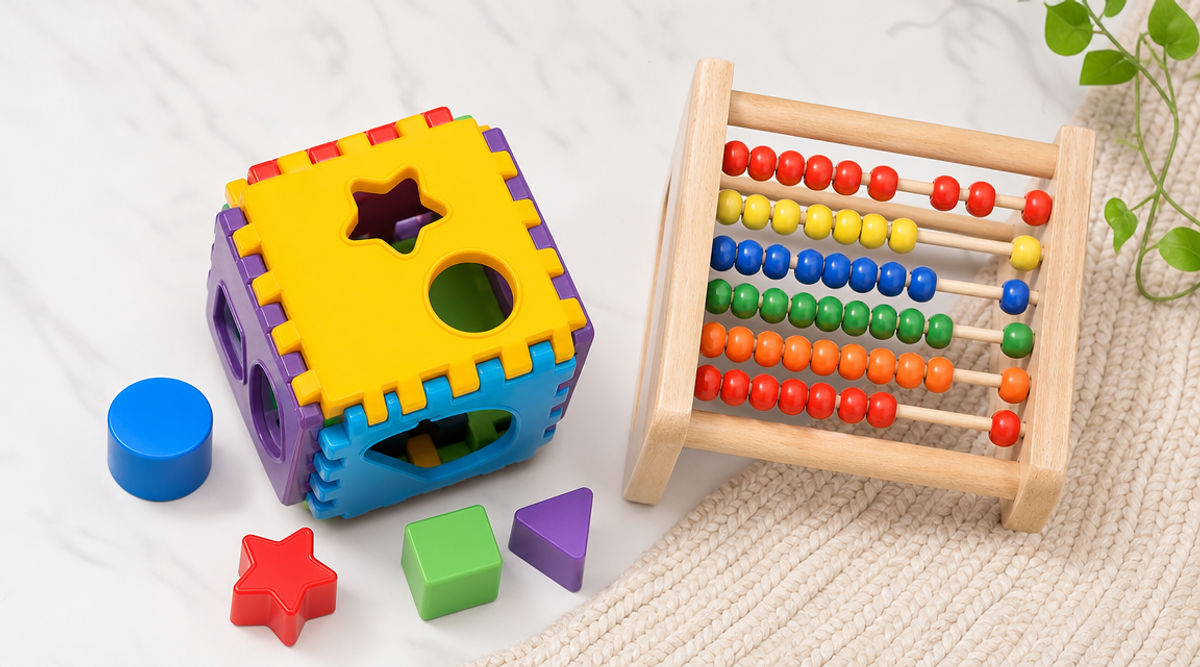
Montessori wooden toys like Skillofun shape sorters (₹699) encourage open-ended, self-directed play that builds problem-solving skills; Fisher-Price plastic toys (₹899) offer structured, guided play with built-in rules. Neither is inherently 'better'-Montessori suits independent learners and quieter homes, while regular toys work well in busy Indian joint families where multiple caregivers interact with the baby simultaneously.
⚡ In a hurry? Our quick picks


If you're scrolling through Amazon.in at 2 AM, overwhelmed by toy options and price tags, you're not alone. The debate between Montessori toys and regular branded toys divides Indian parents like few other topics. Some swear by wooden shape sorters; others say Fisher-Price toys are the only things that keep their toddlers engaged while they finish breakfast. Let's cut through the marketing and look at what actually matters for your child's development-and your family's reality.
🏆 Quick comparison: our top picks
| Product | Award | Rating | Price | |
|---|---|---|---|---|
 Mastermind Toys Wooden Block Set with 100 Pieces Mastermind Toys Wooden Block Set with 100 Pieces
|
🏆 Editor's Choice | ★ 4.5 1,923 reviews |
₹899 | Check price → |
 Playskool Pipeworks Playset Playskool Pipeworks Playset
|
💰 Best Value | ★ 4.1 2,401 reviews |
₹1,399 | Check price → |
 Fisher-Price Laugh & Learn Smart Stages Chair Fisher-Price Laugh & Learn Smart Stages Chair
|
👑 Premium Pick | No ratings yet | ₹17,772 | See alternatives → |
 Skillofun Wooden Shape Sorter with 10 Shapes Skillofun Wooden Shape Sorter with 10 Shapes
|
🪙 Budget Pick | No ratings yet | ₹379 | Check price → |
🛒 Our Top Picks


Best-reviewed overall, 4.5★ across 1,923 ratings.
Mastermind Toys Wooden Block Set with 100 Pieces
- ✓ Natural wood blocks, no finishes
- ✓ 100 assorted shapes and sizes
- ✓ Open-ended construction play
* We earn a small commission — at no extra cost to you.

Top rating for the price, 4.1★ at ₹1,399.
Playskool Pipeworks Playset
- ✓ Pipe and gear construction system
- ✓ 27 colorful pieces
- ✓ Teaches cause-and-effect and spatial reasoning
* We earn a small commission — at no extra cost to you.

Top of the range, for parents who want the best features.
Fisher-Price Laugh & Learn Smart Stages Chair
- ✓ 3 electronic learning stages
- ✓ 50+ songs, phrases, and melodies
- ✓ Interactive buttons and lights
* We earn a small commission — at no extra cost to you.

Lowest price that still clears our 3.8★ / 100-review bar.
Skillofun Wooden Shape Sorter with 10 Shapes
- ✓ Wooden construction, no batteries
- ✓ 10 different shapes and matching holes
- ✓ Builds fine motor and spatial reasoning
* We earn a small commission — at no extra cost to you.
Daily baby tips, exclusive Amazon deals & real parent advice — free forever.
Top products making waves on Amazon.in right now include the Skillofun Wooden Shape Sorter, Mastermind Toys Wooden Block Set, Fisher-Price Laugh & Learn Smart Stages Chair, and Playskool Pipeworks, each with their own philosophy and price point. Let's dig into what separates them.
Understanding Montessori Philosophy and Open-Ended Play
Montessori method: an educational approach developed by Dr. Maria Montessori emphasizing child-led, self-correcting activities that foster independence and intrinsic motivation-the opposite of toy-as-entertainment.
Montessori toys typically have zero electronic parts, no lights, no sounds, and no single "correct" way to use them. A wooden shape sorter isn't about pressing a button and hearing a reward sound. It's about your 18-month-old picking up a square block, examining it, rotating it, trying different holes, failing, adjusting, and eventually sliding it through. That process-where the toy itself provides feedback, not a speaker-is what Montessori educators believe trains the brain.
Open-ended play: play with no predetermined outcome, where a child decides how to use an object based on imagination and experimentation.
In contrast, regular toys like Fisher-Price's Smart Stages Chair guide play with predetermined activities: press this button for a song, tap that one for counting. The toy has already decided what's "fun" and what success looks like. Your child follows the script.
Here's what paediatricians note: according to IAP (Indian Academy of Pediatrics) guidelines on early childhood development, children aged 12-36 months benefit most from play that requires physical problem-solving and sensory exploration. Neither Montessori nor regular toys *guarantee* this-how parents engage with the toy matters equally. A Montessori shape sorter ignored in a corner teaches nothing; a Fisher-Price toy used interactively with a parent builds real connection.
Cognitive Development: What Research Actually Shows
Let's be honest: there's no definitive study proving Montessori toys make babies smarter than regular toys. But research on self-directed learning (which Montessori prioritizes) does show measurable differences. A 2022 study from developmental psychology journals found that toddlers who engaged in unstructured, child-led exploration showed 23% better problem-solving skills by age 3, compared to peers in highly structured play environments.
That said-and this matters for Indian families-the study was conducted in controlled settings with one or two consistent caregivers. In a joint family setup with grandparents, aunts, cousins, and hired help all rotating through, maintaining Montessori's "prepared environment" principle is nearly impossible. Regular toys often adapt better to chaos because they're *designed* for multiple users, inconsistent handling, and interruptions.
Cognitive benefits breakdown:
- Montessori toys: Build fine motor control, spatial reasoning, cause-and-effect understanding, persistence when facing challenges
- Regular toys: Develop same skills but faster (due to instant rewards), introduce music/language recognition, keep babies engaged longer with minimal parent effort
The real difference isn't the toy-it's whether your baby is *thinking* while playing or being *entertained* while playing. Montessori toys assume thinking; regular toys often assume entertainment.
Price, Durability, and Value for Indian Families
| Feature | Montessori Wooden (e.g., Skillofun) | Regular Plastic (e.g., Fisher-Price) |
|---|---|---|
| Price Range | ₹400-₹1,200 | ₹800-₹2,500 |
| Durability | 10+ years with siblings, cousins | 5-7 years before plastic cracks |
| Maintenance | Wipe with damp cloth; no batteries | Replace batteries, clean from crevices, check for mold |
| Engagement Time | 15-30 mins (encourages varied play) | 45-90 mins (built-in stimulus) |
| Mess Factor | Minimal (wood blocks don't scatter) | High (loose parts, batteries, stickers) |
| Joint Family Friendly | Less sturdy under rough handling by multiple kids | Built for abuse; survives rougher play |
The price difference isn't always what it seems. A ₹699 Skillofun shape sorter will serve three children and a cousin over 10 years. A ₹1,500 Fisher-Price toy might last five years before the plastic base cracks or battery compartment rusts. Cost-per-year? They're nearly identical.
Where Montessori wins: resale value. Wooden toys hold 60-70% of their value on Facebook parent groups and secondhand sites. Plastic toys lose 40% within two years.
Which Suits Your Home?
Choose Montessori if: Your home is relatively quiet, you have one or two children, you're willing to actively guide play, you have storage space, and you value toys that last across sibling generations. Delhi and Pune parents with nuclear families often find success here.
Choose regular toys if: You have a busy joint family, multiple children rotating through toys, grandparents who need toys that require zero instruction, limited space, or if your baby genuinely needs sustained engagement while you work. Mumbai and Bengaluru working parents often lean this way out of necessity, not philosophy.
The honest truth: The best toy isn't the one with the Montessori label. It's the one that matches your home's rhythm, your parenting bandwidth, and your child's temperament. An overwhelmed parent handing over a Montessori toy with guilt teaches the child nothing. A grandparent delightedly pressing buttons on a Fisher-Price toy teaches joy and connection.
What Paediatricians Say
IAP emphasizes that screen-free, hands-on play from 12-36 months builds neural pathways for problem-solving and language acquisition. Both Montessori and regular toys achieve this-the quality of parent-child interaction during play matters far more than the toy's philosophy. One paediatrician's key insight: a ₹100 wooden spoon and a cooking pot, explored together with a parent, outperform a ₹5,000 toy used alone.
Frequently Asked Questions
Are Montessori toys actually better for brain development than regular toys?
What's the main difference between Montessori and regular toys?
Which type of toy is better for joint families in India?
Do Montessori toys last longer than Fisher-Price toys?
What's a realistic budget for quality toys across both categories?
Do I need to choose one or the other, or can I mix both types?
Daily baby tips, exclusive Amazon deals & real parent advice — free forever.