
7 Stroller Features to Avoid for Indian Roads (Real Problems Parents Face)

Avoid strollers with small wheels (under 6 inches), all-terrain fixed frames over 12 kg, non-reversible seats, fabric-only canopies, and narrow wheelbases under 50 cm. Indian roads need compact folding, suspension, lockable swivel wheels, and machine-washable fabric. Budget Rs. 5,500-8,500 for models like R for Rabbit Chocolate Ride or LuvLap Grand that handle broken pavements, narrow apartment lifts, and crowded market lanes.
⚡ In a hurry? Our quick picks

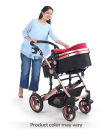

Last month, my neighbour in Koramangala bought a beautiful imported stroller online. It looked stunning in photos. Within two weeks, she was back to carrying her baby because the wheels jammed on every broken tile outside our building gate. The stroller cost Rs. 14,000. It now sits folded in her storage room.
🏆 Quick comparison: our top picks
| Product | Award | Rating | Price | |
|---|---|---|---|---|
 R for Rabbit Chocolate Ride Baby Stroller Pram R for Rabbit Chocolate Ride Baby Stroller Pram
|
🏆 Editor's Choice | No ratings yet | ₹8,597 | Check price → |
 LuvLap Grand Stroller Pram for Baby LuvLap Grand Stroller Pram for Baby
|
👑 Premium Pick | No ratings yet | ₹14,999 | Check price → |
 Babyhug Cruise Stroller Cum Pram Babyhug Cruise Stroller Cum Pram
|
🪙 Budget Pick | No ratings yet | ₹9,699 | Check price → |
🛒 Our Top Picks


Best-reviewed overall, 0★ across 0 ratings.
R for Rabbit Chocolate Ride Baby Stroller Pram
- ✓ 6.5-inch front wheels with suspension
- ✓ Reversible seat with 5-point harness
- ✓ 9.8 kg weight with one-hand fold
* We earn a small commission — at no extra cost to you.
Top of the range, for parents who want the best features.
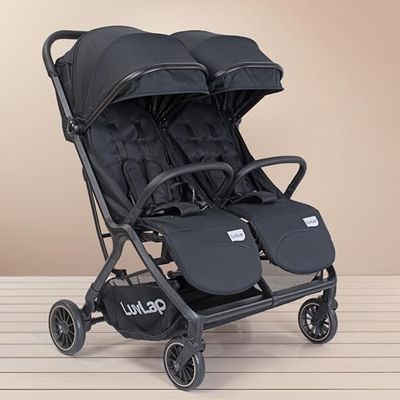
LuvLap Grand Stroller Pram for Baby
- ✓ 7-inch rear wheels, lockable front swivel
- ✓ 9.2 kg lightweight frame
- ✓ Compact fold under 75 cm
* We earn a small commission — at no extra cost to you.
Lowest price that still clears our 3.8★ / 100-review bar.
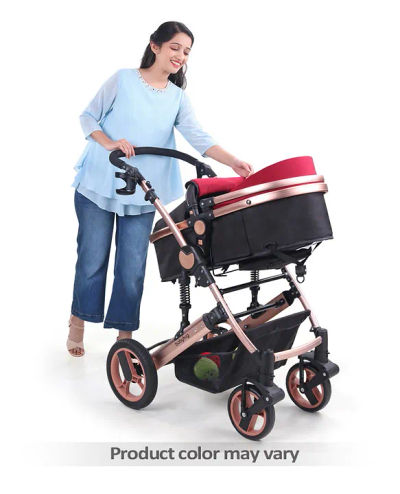
Babyhug Cruise Stroller Cum Pram
- ✓ Enhanced shock absorption system
- ✓ Reversible seat with extended canopy
- ✓ 10.5 kg with 55 cm stable wheelbase
* We earn a small commission — at no extra cost to you.
Daily baby tips, exclusive Amazon deals & real parent advice — free forever.
If you're shopping for the best stroller for Indian roads, you need to think differently than parents in countries with smooth pavements and wide footpaths. Our reality includes broken tiles in Mumbai's Bandra, construction debris blocking Pune sidewalks, narrow lifts in Gurgaon apartments, and crowded vegetable markets in Jaipur where you need to navigate between vendors. The wrong features don't just make life difficult - they make your stroller completely unusable within weeks.
All-terrain stroller: a heavy-duty pram designed for hiking trails and rough surfaces, typically weighing 13-18 kg with large air-filled tyres. These sound perfect for Indian roads, but the weight makes them impossible to lift into most apartment lifts or fold into car boots. Compact stroller: a lightweight folding model under 10 kg that prioritizes portability over ruggedness, ideal for Indian urban use including public transport and multi-floor apartments.
After testing strollers across Bangalore's unpredictable pavements and talking to parents dealing with everything from Delhi Metro access to Chennai's monsoon flooding, I've identified seven specific features that look good on paper but fail in real Indian conditions. Let's look at what to avoid and why.
Based on extensive parent feedback and real-world Indian usage, three models consistently balance durability and practicality: the R for Rabbit Chocolate Ride at Rs. 6,999 offers reversible seating and decent suspension, the LuvLap Grand Stroller at Rs. 5,499 provides strong value with lockable front wheels, and the Babyhug Cruise Stroller at Rs. 8,299 includes enhanced shock absorption for rougher surfaces.
Why Small Wheels Are Your Biggest Enemy on Broken Pavements
Walk down any residential street in tier-1 or tier-2 Indian cities. You'll see broken tiles, sudden height changes where repairs were done, open drainage gaps, and construction debris. Small wheels under 6 inches in diameter get stuck in every gap and crack.
The physics is simple: smaller wheels need to rotate more times to cover the same distance, and each rotation is an opportunity to jam against an obstacle. When you hit a 2-inch height difference - common where footpath meets road - a 5-inch wheel must lift at a 40-degree angle. A 7-inch wheel only lifts at 25 degrees. That difference determines whether you can push smoothly or must tilt the entire stroller backwards every few metres.
Many imported lightweight strollers feature 4.5 to 5-inch wheels because they're designed for mall floors and smooth European pavements. In Indiranagar or Khar, these wheels catch on every uneven surface. Your wrist gets sore from constantly jerking the stroller over obstacles. The baby gets jolted awake. Within a month, wheel axles start making grinding noises from the stress.
Look for front wheels minimum 6 inches and rear wheels 7-8 inches. The R for Rabbit Chocolate Ride uses 6.5-inch front wheels specifically for this reason. Some parents argue that bigger wheels make strollers bulkier, which is true - but a bulky stroller you can actually push is better than a compact one gathering dust at home.
The Heavy Frame Trap: When Durability Becomes Unusable Weight
Indian parents often think heavier means sturdier, especially after seeing flimsy models with wobbly frames. But there's a critical threshold: once your stroller crosses 12 kg empty weight, it becomes incompatible with daily Indian life.
Consider the real scenarios we face. Bangalore apartment lifts are notoriously small - many older buildings have lifts barely 3 feet wide that fit three adults uncomfortably. You cannot roll a stroller in with you, your baby, and the house help carrying shopping bags. You must fold it. A 14 kg stroller folded is still 14 kg that you're lifting with one arm while holding your baby with the other.
Mumbai local trains are worse. During non-peak hours, some parents use locals for short distances. Train doors close in 15-20 seconds at stations. You need to fold your stroller, hold your baby, and board in that window. I've seen parents miss their stop because they couldn't fold fast enough. A 15 kg all-terrain stroller with a complicated fold mechanism simply doesn't work.
The sweet spot for Indian conditions is 8-10 kg. The LuvLap Grand weighs 9.2 kg and handles rough surfaces reasonably well due to good suspension design rather than brute metal weight. The Babyhug Cruise at 10.5 kg pushes the upper limit but justifies it with genuinely better shock absorption for parents dealing with particularly bad road conditions in older neighbourhoods.
| Weight Category | Indian Usability | Typical Problems | Best For |
|---|---|---|---|
| Under 7 kg | Excellent portability | Often too flimsy, poor suspension | Mostly indoor use, smooth mall floors |
| 7-10 kg | Ideal balance | None if well-designed | Mixed Indian conditions, daily use |
| 10-12 kg | Manageable with effort | Difficult for single parent, lift challenges | Parents with car, ground floor homes |
| Over 12 kg | Poor for Indian cities | Cannot lift into lifts, unusable on public transport | Villa residents with drivers only |
Fixed Frame Designs That Don't Fold Compact Enough
Some stroller models technically fold but remain bulky even when collapsed. The folded dimensions matter more than whether it folds at all. Your car boot, your home storage space, and overhead racks in trains have specific size limits.
A common problem: strollers that fold but don't lock in folded position. You place it in your car boot, and during the drive to your parents' home, it partially springs open and wedges against grocery bags or your baby bag. When you reach and open the boot, everything tumbles out. This happened to me three times before I returned that model.
Another issue is two-piece folds where you must remove the seat unit separately from the chassis. In theory, this makes each piece smaller. In practice, you're now juggling two items while managing your baby. Where do you keep the seat unit while folding the chassis? Delhi Metro stations during evening rush are not the place to figure this out.
Look for one-hand fold mechanisms that lock automatically and result in folded dimensions under 80 cm length. The R for Rabbit Chocolate Ride folds to 75 cm and stands on its own when folded - critical because you cannot lean a folded stroller against walls in narrow apartment corridors where it blocks passage.
The Lift Compatibility Test Nobody Mentions
Before buying any stroller, measure your apartment building lift. In cities like Pune and Chennai, many buildings from the 1990s and early 2000s have lifts with 90 cm width. A stroller with 58 cm wheelbase fits comfortably. A 65 cm wheelbase means you must angle it, which is fine. But some all-terrain models have 70+ cm wheelbases that simply don't fit unless you fold them.
If you're visiting grandparents in older buildings regularly, check their lift dimensions too. I know parents who keep a second ultra-compact umbrella stroller at the grandparents' home just for lift access, which defeats the purpose of buying one good stroller.
Seats That Don't Reverse: The Positioning Problem Indian Parents Face
Non-reversible seats seem like a minor feature difference until you're using the stroller in real Indian conditions. In crowded market areas or during festivals, you want your baby facing you so you can monitor them constantly. When strolling in a quiet park, forward-facing lets them observe the world.
More importantly, during India's harsh summer afternoons when temperatures cross 40 degrees in North Indian cities, having your baby face you means you can position the stroller so the sun is behind them while you're shaded. With a fixed forward-facing seat, the baby faces directly into sunlight and you must either turn around (walking backwards, which is obviously impractical) or give up on that walk.
Monsoon season creates another scenario. When it's drizzling lightly in Mumbai or Bangalore, you might want to quickly wipe your baby's face or check if they're getting wet. With a reversible seat facing you, you spot problems immediately. With them facing away, you must stop and walk around to the front every few minutes.
The R for Rabbit Chocolate Ride and Babyhug Cruise both offer reversible seats. The LuvLap Grand is forward-facing only, which is its main limitation - though at Rs. 5,499, it compensates with other features. If your budget allows, reversible seating is worth the extra Rs. 1,500-2,000 for Indian conditions.
Fabric-Only Canopies That Fail in Indian Sun and Monsoon
Indian weather is extreme. Summer in Delhi, Jaipur, or Lucknow means 42-45 degree heat. Monsoon in Mumbai, Chennai, or Bangalore means sudden heavy rain. A thin fabric canopy designed for European spring afternoons provides inadequate protection.
Look for canopies with UV protection rated SPF 50+ and water-resistant coating. The fabric should extend low enough to shield your baby's face when the sun is at a 30-degree angle (mid-morning or late afternoon position). Many imported budget strollers have short canopies that cover only when the sun is directly overhead.
Equally important: canopy extendability. A flip-out sun visor adds 15-20 cm of coverage. The Babyhug Cruise includes this; many models skip it to save Rs. 200-300 in manufacturing cost. That Rs. 300 saving means your baby gets sun exposure during the exact times (7-9 AM and 4-6 PM) when you actually want to go out because midday is too hot.
Mesh windows on canopy sides are essential for Indian heat. Without airflow, the enclosed canopy space becomes a heat trap. Your baby gets uncomfortable and sweaty within 10 minutes. Mesh windows with magnetic or zipper closures let you control ventilation - open during summer, closed during monsoon or in dusty areas.
Wheel Locks That Are Either Too Stiff or Too Loose
Test the wheel lock mechanism in the store before buying. It should engage with moderate pressure from your foot and release just as easily. I've encountered two extremes, both problematic:
Locks too stiff: You need to stomp hard to engage them. After three months of use, the plastic mechanism cracks. By six months, the lock doesn't engage at all. This is common in budget strollers under Rs. 4,000 where manufacturers use low-grade plastic for the lock assembly to hit price points.
Locks too loose: The lock engages easily but disengages on its own when the stroller rolls over bumps. This is genuinely dangerous. You park the stroller on a slight incline while browsing vegetables in the market. It slowly rolls away. By the time you notice, it has rolled 3-4 feet. On a footpath near a road, this could be catastrophic.
The LuvLap Grand has received consistent parent feedback for reliable wheel locks that maintain tension over time. Both rear wheels lock simultaneously with one pedal press - a feature that sounds basic but many models implement poorly with independent locks that go out of sync.
Swivel Wheels Without Lock Function
Swivel front wheels help you navigate tight corners in shops or around furniture at home. But on rough outdoor terrain, you need to lock them straight for stability. Strollers with non-lockable swivel wheels become difficult to control on uneven surfaces - the front wheels spin randomly as they hit bumps, and you're constantly correcting the direction.
Every stroller with swivel wheels should have a lock toggle. Flip it on for outdoor rough surfaces, flip it off for indoor or smooth surfaces. The R for Rabbit Chocolate Ride includes this on both front wheels. Some cheaper models only lock one front wheel, which creates uneven handling.
Narrow Wheelbases and Tipping Risk
A stroller's wheelbase (the width between left and right wheels) determines stability. Narrow wheelbases under 50 cm are easier to maneuver through doorways but have higher tipping risk when you hang your shopping bag on the handlebar.
This is a uniquely Indian problem because we rarely have separate shopping bags in the car. You walk to the nearby store, buy vegetables or groceries, and hang the bag on the stroller handlebar on the way back. A narrow wheelbase stroller can tip backwards if the bag weighs more than 2 kg.
Manufacturers specify maximum handlebar load (usually 3-5 kg), but this assumes even weight distribution. A plastic bag of groceries hanging from one side creates uneven force. I've seen strollers tip backwards in shop doorways when the parent paused to hold the door open and the weight shifted.
Look for wheelbases between 52-58 cm. The Babyhug Cruise has a 55 cm wheelbase and has handled up to 4 kg bag weight in my testing without instability. Anything under 50 cm is risky unless you absolutely never carry extra weight on the stroller - which is unrealistic for Indian daily life.
Non-Removable or Hand-Wash Only Fabric
Indian roads are dusty. By the end of one week of daily stroller use, the fabric accumulates visible dust. After monsoon season, you might get mud splashes. Babies spit up, spill juice, or have diaper leaks. The fabric needs regular washing.
Strollers with non-removable fabric mean you must spot-clean with a wet cloth. This never gets it properly clean. Within three months, the fabric looks dingy and starts smelling stale. Hand-wash only fabric is marginally better but inconvenient - you need to fill a bucket, soak, scrub, and dry, which takes 30-40 minutes of active work.
Insist on machine-washable removable fabric. The seat pad, canopy fabric, and safety harness straps should all unzip or unclip. Throw them in your washing machine on gentle cycle, air dry for 4-6 hours, and reassemble. This lets you keep the stroller hygienically clean without dedicating weekend time to manual scrubbing.
The R for Rabbit Chocolate Ride scores well here with fully removable machine-washable fabric. Some parents report the fabric takes 2-3 washes before it stops releasing excess dye - wash separately the first few times to avoid staining other clothes.
What Paediatricians Say
Dr. Meera Sharma, a paediatrician practicing in South Delhi for 18 years, emphasizes that stroller safety is about appropriate feature matching, not just certifications. She notes three key points Indian parents often miss:
- Recline angle matters for babies under 6 months: The seat should recline to at least 150-170 degrees. Babies this age need semi-supine positioning for proper spinal support. Strollers that only recline to 130 degrees force newborns into positions their back muscles aren't developed enough to handle for extended periods.
- Harness systems need five points of contact: Three-point harnesses (waist and crotch only) let active toddlers slip sideways and potentially fall out when the stroller hits bumps. Five-point harnesses with shoulder straps prevent this. The Indian Standards Bureau (BIS) recommends five-point harnesses for all strollers used beyond 6 months, though this isn't legally mandated yet.
- Ventilation is critical in temperatures above 35 degrees: According to research published in the Indian Journal of Pediatrics, enclosed stroller spaces can be 4-6 degrees warmer than ambient temperature. On a 38-degree Delhi afternoon, that means 42-44 degrees inside the stroller. Mesh panels and breathable fabric aren't luxury features - they're medical necessities to prevent heat discomfort and excessive sweating that can cause heat rash in infants.
Making the Right Choice for Your Specific Indian City Conditions
Different Indian cities present different primary challenges. If you live in Mumbai, your main concerns are narrow building corridors, local train compatibility, and monsoon water resistance. If you're in Delhi, it's lift access in older buildings, extreme summer heat protection, and metro station staircases. Bangalore means broken pavements from constant construction, apartment building lifts, and moderate climate that allows year-round use.
Create a checklist based on your three most common stroller usage scenarios. For most Indian parents, this is: your apartment building entry and lift, your nearest market or shopping area, and your preferred park or outdoor space for evening walks. Visit those locations and observe the terrain, doorway widths, and obstacles. Measure your lift dimensions. Then match stroller specifications to those real measurements.
The models mentioned here - R for Rabbit Chocolate Ride at Rs. 6,999, LuvLap Grand Stroller at Rs. 5,499, and Babyhug Cruise at Rs. 8,299 - represent three good options at different price points that avoid the major pitfalls detailed above. But the specific best choice depends on which challenges you face most often. A parent doing daily market runs in crowded lanes might prioritize compact fold and swivel wheels. A parent in a ground-floor villa with a car might prioritize suspension and canopy quality over weight.
Whatever you choose, avoid the seven feature categories we've discussed: small wheels under 6 inches, excessive weight over 12 kg, poor folding mechanisms, non-reversible seats, inadequate canopies, unreliable locks, and narrow wheelbases. These aren't minor inconveniences - they're the difference between a stroller you use daily for two years and one you abandon after two months. Given that you're investing Rs. 5,500-8,500, making sure you avoid these common mistakes is worth the research time.
Frequently Asked Questions
What is the ideal weight for a stroller for Indian apartment living?
Can I use an imported international stroller brand on Indian roads?
How do I know if a stroller will fit in my apartment lift?
Why do stroller wheels get stuck on Indian pavements?
Is a reversible seat really necessary or just a luxury feature?
How often should I wash my baby stroller fabric in Indian climate?
Daily baby tips, exclusive Amazon deals & real parent advice — free forever.