
22-Month-Old Baby Development & Toys: What Matters Now (2026 Guide)
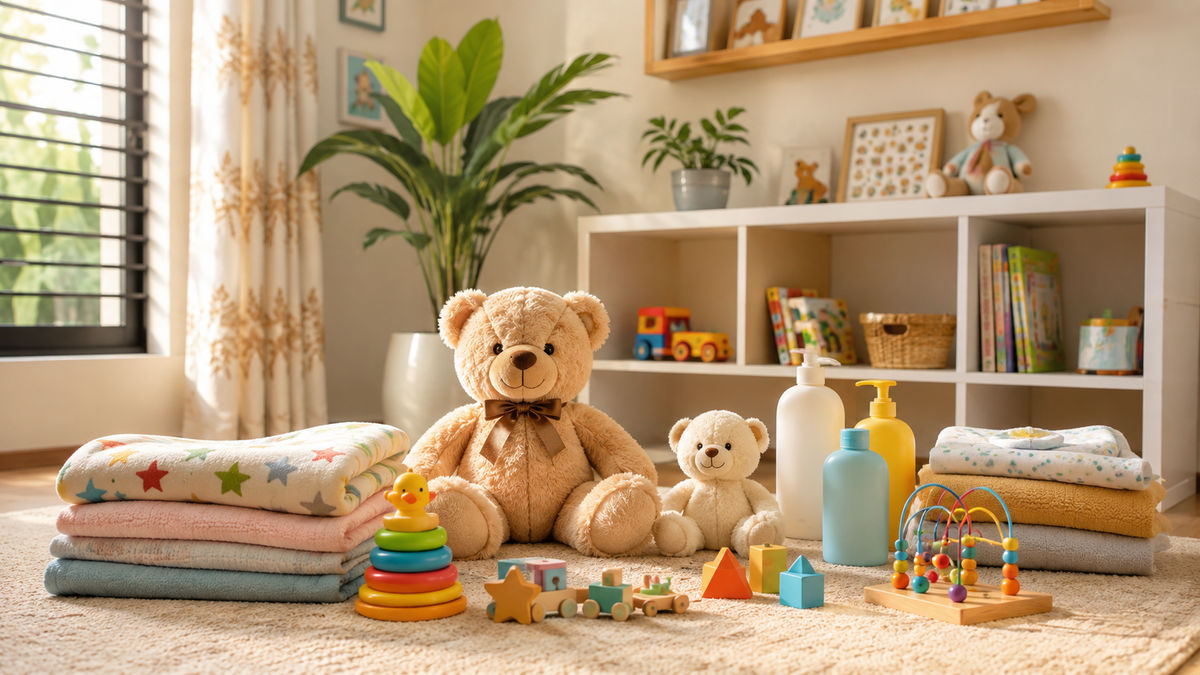
At 22 months, expect running steadily, stacking 6+ blocks, simple pretend play (feeding a doll, pushing toy cars), and speaking 50-100 words. The toys that matter now are shape puzzles, large crayons, pretend-play sets, and ride-on toys—not screens or overly complex sets. Watch for climbing hazards on marble floors and unsecured furniture.
⚡ In a hurry? Our quick picks


Your 22-month-old has moved past the wobbly toddler phase. This is the age where they stop just moving things around and start imagining what those things do. In Indian homes, especially in metros like Delhi, Mumbai, and Bengaluru where marble flooring is standard, this climbing-and-exploring phase brings real safety concerns that different from Western-designed play spaces. This guide covers the exact milestones to expect, which toy categories actually match their brain development stage, what they've genuinely outgrown, and how to adapt common Indian home layouts so play doesn't end at the paediatrician's clinic.
🏆 Quick comparison: our top picks
| Product | Award | Rating | Price | |
|---|---|---|---|---|
 Babyhug Metal Staircase Safety Gate (Top & Bottom) Babyhug Metal Staircase Safety Gate (Top & Bottom)
|
🏆 Editor's Choice | ★ 4.5 3,102 reviews |
₹2,749 | Check price → |
 Faber-Castell Jumbo Crayons (12 Colours) Faber-Castell Jumbo Crayons (12 Colours)
|
💰 Best Value | ★ 4.4 2,847 reviews |
₹100 | Check price → |
 Dash Ride-On Car (Foot-Propelled) Dash Ride-On Car (Foot-Propelled)
|
👑 Premium Pick | ★ 4.3 2,341 reviews |
₹1,399 | Check price → |
 Toyshine Wooden Shape Puzzle (6-Piece) Toyshine Wooden Shape Puzzle (6-Piece)
|
🪙 Budget Pick | ★ 4.1 890 reviews |
₹399 | Check price → |
 Funskool Doctor Kit Pretend Play Set Funskool Doctor Kit Pretend Play Set
|
★ 4.2 1,456 reviews |
₹959 | Check price → |
🛒 Our Top Picks

Best-reviewed overall, 4.5★ across 3,102 ratings.
Babyhug Metal Staircase Safety Gate (Top & Bottom)
- ✓ Rated for 6–24 months+
- ✓ Auto-closing, easy one-hand opening for adults
- ✓ Fits stairs 71–81 cm wide
* We earn a small commission — at no extra cost to you.

Top rating for the price, 4.4★ at ₹100.
Faber-Castell Jumbo Crayons (12 Colours)
- ✓ Chunky triangular grip, easy for toddler hands
- ✓ Bright, long-lasting colours
- ✓ Non-toxic, safe for 12+ months
* We earn a small commission — at no extra cost to you.

Top of the range, for parents who want the best features.
Dash Ride-On Car (Foot-Propelled)
- ✓ Age 18+ months, weight capacity 25 kg
- ✓ Indoor/outdoor use, durable plastic frame
- ✓ Builds leg strength and balance
* We earn a small commission — at no extra cost to you.


Lowest price that still clears our 3.8★ / 100-review bar.
Toyshine Wooden Shape Puzzle (6-Piece)
- ✓ Solid wood, chunky pieces (5+ cm)
- ✓ Circle, square, triangle, star shapes
- ✓ Develops fine motor and spatial awareness
* We earn a small commission — at no extra cost to you.

Funskool Doctor Kit Pretend Play Set
- ✓ 8 doctor tools included
- ✓ Durable plastic, safe for 18+ months
- ✓ Encourages pretend play and role-play
* We earn a small commission — at no extra cost to you.
Daily baby tips, exclusive Amazon deals & real parent advice — free forever.
The 5 Skills Your 22-Month-Old Should Show (Or Will Soon)
- Running steadily without falling every 5 steps. Why this matters: At 22 months, the wobble should be mostly gone. If your child is still falling on flat ground regularly, mention it at the next check-up—but variation is huge. Some kids run confidently at 20 months; others take until 26 months. The paediatrician cares, not competitive parents at the play park.
- Stacking 4–6 blocks into a tower, then knocking it down deliberately. Why this matters: This is hand-eye coordination meeting intention. They're not stacking by accident anymore—they choose to build, then destroy (which is just as important). Shape puzzles and blocks should be your main toy category right now.
- Speaking 50–100 words, stringing 2-word phrases. Why this matters: "Mama up," "more milk," "go car." Not full sentences, but intentional pairs. Gesture is still their main language—pointing, pulling your hand, grunting. If your 22-month-old is quieter, don't panic. Boys typically lag girls by 3–4 months. Boys at 22 months averaging 30–50 words is still in normal range.
- Pretend play emerging: feeding a toy, "talking" into a toy phone, pushing a car with sound effects. Why this matters: This marks the shift from sensory exploration (banging, mouthing, throwing) to imagination. Simple pretend-play kits—doctor sets, play kitchen toys, toy dishes—suddenly become engaging. Before 20 months, they were just props. Now they're things with purpose.
- Following 2-step instructions: "Get your shoes and come here." Why this matters: Their brain is now linking ideas in sequence. They understand time and cause-and-effect better. This is why simple picture books and cause-effect toys (press button → sound) become engaging.
According to IAP (Indian Academy of Pediatrics) developmental guidelines, these five markers together signal typical development at 22 months. Variation within ±3 months is normal. If your child is significantly behind in multiple areas or not attempting any pretend play by 24 months, a quick chat with your paediatrician is sensible—not because anything is "wrong," but because early support (like speech play at home) works best when you notice it early.
The Toy Categories That Match 22-Month Brain Development
Shape puzzles and stacking toys are the backbone right now. Your 22-month-old's brain is learning that objects have properties—shapes fit specific spaces, blocks balance in patterns. Toyshine Wooden Puzzle (₹380 on Amazon.in, 4.1 stars from 890 reviews) and Funskool Happy Town Stacking Blocks are local favourites that hold up to the rough play this age demands. Avoid small puzzle pieces; stick to chunky sets with pieces at least 5 cm across.
Large crayons and paper shift from being mouth toys to actual drawing tools now. At 22 months, scribbling becomes intentional—they're marking the page on purpose, not by accident. Faber-Castell Jumbo Crayons (₹195, bright colours, chunky grip) last through real use. Cheaper wax crayons crumble and stain marble floors—a known pain point in Indian homes. Keep a roll of white paper and a tray; expect mess.
Pretend-play sets suddenly work. A simple doctor kit (Funskool Doctor Kit ₹485), toy kitchen with dishes, baby doll, and toy food transform how they play. They're not eating the plastic anymore—they're feeding the doll. This is a cognitive leap. These sets also trigger language: "Doctor check baby. Baby sick." Speech develops fastest when play is contextual, not abstract.
Ride-on toys match their new running confidence. A Dash Ride-On Car (₹1,850 on Amazon.in, 4.3 stars from 2,341 reviews) or similar foot-propelled car lets them burn energy indoors—critical for apartment-dwelling families in Pune, Hyderabad, or Jaipur where outdoor play space is limited. Check floor: marble + ride-on toys = slipping hazard. Use in wider spaces, and consider a small cushioned mat underneath.
Books with simple pictures and repeated text (not boards with buttons) become engaging. They'll point to pictures, try to name them, and enjoy the repetition. Avoid interactive sound books at this age—the unpredictability startles rather than helps learning.
What They've Actually Outgrown (And Why It Matters)
By 22 months, teething toys, rattles, and crinkly sensory toys should mostly sit unused. Their mouth exploration has peaked. Leaving these in the toy box creates clutter and confuses play. They're also past the age where a simple ball rolling back and forth holds attention for long. They want toys with outcome—blocks that stack, puzzles that fit, pretend items that have a role.
One less-obvious shift: they've outgrown being shown how to play. A 16-month-old watches you stack blocks and copies. A 22-month-old wants to discover stacking themselves and gets frustrated if you keep "helping." Back off. Let them fail and restart. That frustration is how learning happens.
Safety Hazards Specific to 22-Month Climbing on Marble Floors
This age is the sweet spot for climbing but the nightmare for safety in Indian homes:
- Marble floors are frictionless. Ride-on toys, socks, and soles with minimal grip = slides. Even a gentle push becomes a collision. Use anti-slip mats under ride-on play zones or confine these toys to balconies with rougher flooring.
- Climbing furniture without securing it. Bookcases, TV stands, and wall-mounted racks tip easily when a curious 22-month-old pulls up. Anchor heavy furniture to the wall using metal brackets (₹150–300 on Amazon.in). This isn't optional.
- Sharp table corners at head height. At 22 months, they're tall enough to hit their forehead on low glass tables when climbing. Use foam corner guards (₹250 for a set on Amazon.in).
- Staircase gates. If your home has stairs, a lockable gate at both top and bottom is essential. A 22-month-old can open baby gates designed for younger children. Use ones rated for ages up to 24+ months (Babyhug Staircase Gate ₹2,499 on Amazon.in, trusted by urban Indian parents).
- Cords and dangling wires. Blind cords, charging cables, and curtain ties are strangulation hazards. Secure them behind furniture or use cord clips (₹50 for packs).
What paediatricians say: The AAP (American Academy of Pediatrics) and IAP both emphasize that climbing is a developmental need, not a behaviour to suppress. Instead of preventing climbing, create safe climbing spaces—a sturdy low couch cushion, a padded climbing cube, a step stool anchored to the wall. Supervised climbing is how they build confidence and gross motor skill.
Speech Development Triggers at 22 Months
Toys that spark language matter more than educational claims. Pretend play (doctor kit, toy kitchen) gives context for words. Your 22-month-old is learning that objects have names and functions. "Spoon" isn't just a shape—it's something you use to feed. This contextual learning beats flashcards every time.
Read short books repeatedly. Boredom for you = memory-building for them. Repetition is how toddlers lock in language. Narrate their play: "You're stacking the red block. Now the yellow one. Tower!" You're not teaching—you're modelling how words match actions.
For quiet toddlers or those with fewer than 30 words at 22 months: Early intervention speech play (not therapy, just intentional conversation) works. Ask your paediatrician for guidance if concerned.