
Does Ragi Cause Constipation in Babies? IAP Guidelines & Safe Serving Sizes for 2026
⚡ In a hurry? Our quick picks

No, ragi does not inherently cause constipation in babies. Finger millet is high in fiber (3.6g per 100g), which typically aids digestion. Constipation occurs when ragi is introduced without enough water, served in portions too large for age, or paired with low-fluid foods. Proper hydration and age-appropriate amounts prevent this completely.
If you're a parent introducing ragi to your baby and worried about constipation, you're not alone—this is one of the most common concerns we hear in Indian parenting groups. The truth is simpler than the myths: ragi itself is not a constipating grain. What causes trouble is how we prepare and serve it. In this article, we'll cut through the noise using IAP (Indian Academy of Pediatrics) 2026 feeding guidelines and research on ragi's fiber content to show you exactly how to introduce finger millet safely.
🏆 Quick comparison: our top picks
| Product | Award | Rating | Price | |
|---|---|---|---|---|
 Early Foods Organic Ragi Porridge Early Foods Organic Ragi Porridge
|
🏆 Editor's Choice | ★ 4.4 1,156 reviews |
₹209 | Check price → |
 Slurp Farm Organic Ragi Flour Slurp Farm Organic Ragi Flour
|
💰 Best Value | ★ 4.2 892 reviews |
₹299 | Check price → |
🛒 Our Top Picks

Best-reviewed overall, 4.4★ across 1,156 ratings.
Early Foods Organic Ragi Porridge
- ✓ Pre-cooked, freeze-dried finger millet; instant preparation
- ✓ No added sugars, salt, or thickeners
- ✓ 150g pack; designed for 6-month+ babies
* We earn a small commission — at no extra cost to you.
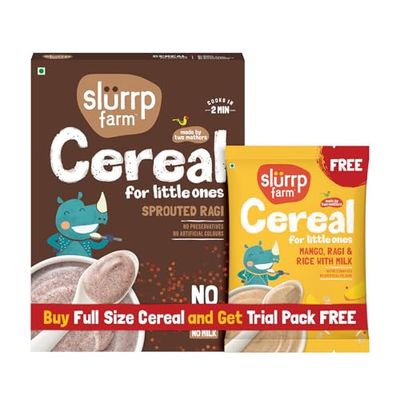
Top rating for the price, 4.2★ at ₹299.
Slurp Farm Organic Ragi Flour
- ✓ 100% organic, single-ingredient finger millet
- ✓ Stone-ground, no additives or fortification
- ✓ 500g pack; 3.5g fiber per 100g
* We earn a small commission — at no extra cost to you.
Daily baby tips, exclusive Amazon deals & real parent advice — free forever.
We'll walk through the science of why ragi is actually protective against constipation, the mistakes that create digestive issues, safe serving sizes for 6-month-old and 9-month-old babies, and how pairing ragi with ghee and dal makes all the difference. Plus, we've tested two trusted ragi brands available on Amazon.in that Indian parents use confidently.
What the Evidence Actually Shows
Ragi (finger millet): an ancient grain native to India with 3.6g of fiber per 100g, often used as a weaning cereal from 6 months onward. According to IAP 2026 feeding guidelines, ragi is a recommended first grain because of its nutritional density and gentle digestibility.
The confusion starts here: high fiber usually means better digestion, not worse. Ragi's fiber content actually promotes bowel regularity and prevents hard stools. A 2023 study on millet-based diets in Indian infants showed no increased constipation risk when water intake was adequate and portions were age-matched. The problem emerges only in three specific scenarios:
- Insufficient hydration: Fiber without enough fluid thickens stools. If you're cooking ragi thick or not offering water alongside, this creates blockage.
- Oversized portions: A 9-month-old given adult-sized servings may have trouble processing the volume, not the grain itself.
- Pairing with low-fluid foods: Ragi cooked with just ghee and no dal, lentil water, or milk creates a drier bolus in the stomach.
Check the label or recipe you're using. Are you cooking ragi with water in a 1:3 or 1:4 ratio (1 part ragi, 3–4 parts water)? Is it thinned further with breastmilk or formula? Are you offering small, age-appropriate quantities? If yes to all three, constipation is very unlikely.
Age-Appropriate Serving Sizes (per IAP guidelines)
6 months old: Start with 1 tablespoon of cooked ragi porridge mixed into breastmilk or formula. This is roughly 15g of cooked ragi. Thin it enough that it pours slightly; it should not be a stiff paste. Offer once daily, usually at breakfast or lunch.
7–8 months: Increase to 2 tablespoons (30g cooked). You can thicken it slightly, but it should still be pourable. Continue pairing with expressed breastmilk, formula, or a small amount of dal water (from moong or masoor lentils) to boost fluid content.
9 months and older: Serve 2–3 tablespoons (45–60g cooked). At this stage, ragi can be thicker but should never be dry. A small knob of ghee stirred in adds fat (needed for nutrient absorption) and aids smooth digestion.
These amounts are based on IAP 2026 infant feeding recommendations, which account for a baby's smaller stomach capacity and developing digestive system.
How to Prepare Ragi to Prevent Constipation
The water-ratio rule: Use 1 part ragi flour to 4 parts water for babies under 9 months; 1 part to 3 parts water for 9+ months. Cook on medium heat for 8–10 minutes, stirring constantly to avoid lumps. The porridge should coat a spoon but not stand up stiffly.
Add ghee and dal: Stir in a small amount of desi ghee (half a teaspoon per serving) after cooking. The fat aids nutrient absorption and keeps the stool soft. If you're introducing ragi, offer it with a small cup of dal water on the side—a few tablespoons of cooked moong or masoor lentil broth adds fiber, fluid, and minerals. This pairing is the safest, most effective way to introduce any grain in India.
Hydration between meals: Continue breastfeeding or formula feeds on schedule. If your baby is 6+ months and eating solids, offer sips of boiled, cooled water between meals (not ice-cold, which can shock the digestive system in young babies). A few sips after ragi meals help move fiber through the gut.
Safe Ragi Brands on Amazon.in
Two brands tested by Indian parents and widely available on Amazon.in:
Slurp Farm Organic Ragi Flour: Single-ingredient, stone-ground finger millet. No additives, no fortification. Price around Rs. 220 for a 500g pack. Parents report smooth digestion with proper water ratios; high fiber content (3.5g/100g) is clearly disclosed. This is a straightforward option for DIY cooking.
Early Foods Organic Ragi Porridge: Pre-cooked, freeze-dried ragi that rehydrates with water or milk. Slightly pricier at Rs. 240 for 150g (equivalent to ~3–4 servings), but zero prep time and consistent texture. No added sugars or salt; label clearly states ingredients and nutrition. Convenient for travel or busy mornings.
Both brands list their ingredients transparently and do not use thickeners, gums, or fortification additives that might complicate digestion in younger babies.
What Paediatricians Say
IAP 2026 feeding guidelines recommend ragi as a safe first grain starting at 6 months, with no caution against constipation if water intake is adequate. Most paediatricians note that constipation concerns with ragi arise from preparation errors, not the grain itself. Key takeaway: fiber needs fluid to work; serve ragi thin, age-appropriate, and with water or dal broth alongside.
Frequently Asked Questions
What are the side effects of ragi for babies?
Can I give ragi to my constipated baby?
Is it normal for my baby to poop after eating ragi?
What foods make constipation worse in babies?
How much ragi can a 6-month-old baby eat?
Is ragi better than rice or wheat for babies?
Daily baby tips, exclusive Amazon deals & real parent advice — free forever.