
Do You Need a Baby Sterilizer? Boiling vs Steam vs Electric—Full 2026 Guide
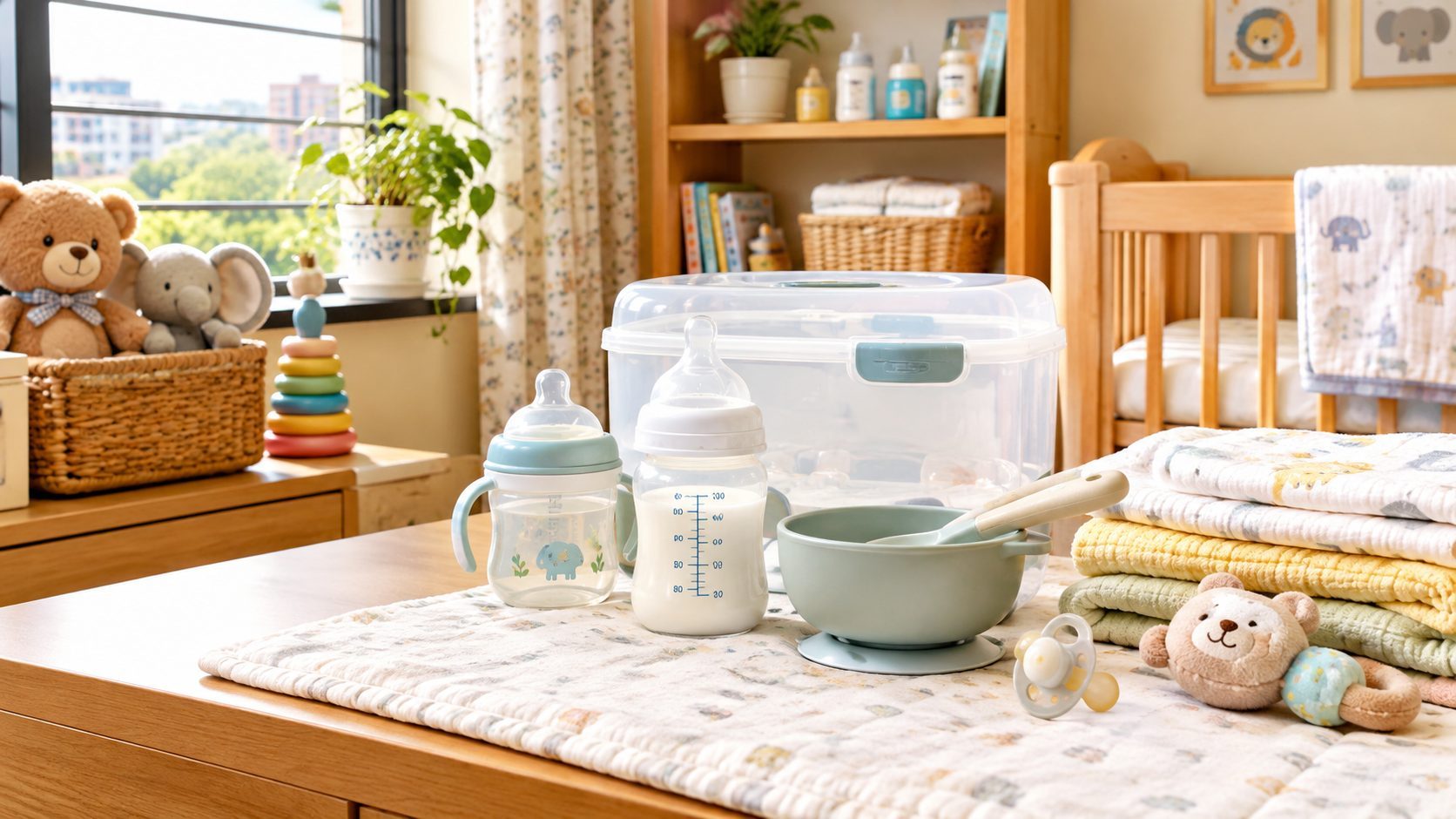
You don't always need a sterilizer. Boiling bottles in hot water is free and works just as well for most households. Electric sterilizers help only if you have hard water, no cooktop space, frequent power cuts make it impractical, or you're doing formula feeds on a strict schedule. Most Indian parents stop sterilizing around 12 months.
ℹ️ General information, not medical advice. If your baby seems unwell or anything worries you, talk to your paediatrician. Medical disclaimer
⚡ In a hurry? Our quick picks

First-time parents hear "sterilize your bottles" and assume it means buying a machine. It doesn't. A bottle sterilizer is any method that kills germs on feeding equipment using heat or UV light. The question isn't whether sterilizers exist—it's whether you need to spend Rs. 1,500–3,500 on an electric one, or whether boiling (free) and steam bags (Rs. 150–300) solve your life.
🏆 Quick comparison: our top picks
| Product | Award | Price | |
|---|---|---|---|
 Munchkin Reusable Microwave Steam Bags (Pack of 2) |
👑 Premium Pick | ₹5,097 | See alternatives → |
 Pigeon Electric Bottle Sterilizer |
🪙 Budget Pick | ₹1,899 | Check price → |
 Philips Avent Electric Sterilizer 3-in-1 |
₹4,999 | Check price → | |
 Chicco Electric Steam Sterilizer |
₹1,937 | Check price → |
🛒 Our Top Picks
The highest-priced option in this guide.
Munchkin Reusable Microwave Steam Bags (Pack of 2)
- ✓ Reusable 20+ times
- ✓ Fits 4 bottles per bag
- ✓ 3-minute microwave cycle
* We earn a small commission — at no extra cost to you.


The lowest-priced option in this guide.
Pigeon Electric Bottle Sterilizer
- ✓ Holds 6 bottles
- ✓ Heating and drying function
- ✓ 8-minute cycle
* We earn a small commission — at no extra cost to you.
Philips Avent Electric Sterilizer 3-in-1
- ✓ Sterilizes, heats, and cools bottles
- ✓ Holds 6 bottles
- ✓ Quick 6-minute cycle
* We earn a small commission — at no extra cost to you.
Chicco Electric Steam Sterilizer
- ✓ Holds 4 bottles
- ✓ Heating function
- ✓ 10-minute sterilization
* We earn a small commission — at no extra cost to you.
Daily baby tips, exclusive Amazon deals & real parent advice — free forever.
This guide walks through when sterilizing actually matters, which method fits your kitchen and budget, and when you can stop altogether. We'll compare real methods, real Indian prices, and the actual deciding factors—hard water, power cuts, kitchen space, and how you're feeding your baby—because those change everything.
When Do You Actually Need to Sterilize Bottles?
Sterilizing matters in two windows: newborn age (0–3 months) and formula feeding. Newborns have immature immune systems, so any germ on a bottle poses a small real risk. Breastfed babies over 3 months old, eating directly from the breast, don't need sterilized bottles at all—just regular hot-water washing. And once your baby hits 12 months, the infection risk drops sharply enough that most parents stop sterilizing even if they're still using bottles.
The real deciding factors are five: baby's age, feeding method (breast or formula), your kitchen setup, whether power cuts happen often in your area, and whether your tap water is hard (chalky, mineral-heavy). We'll walk through each.
Do I Need a Baby Bottle Sterilizer? The Honest Flowchart
Start here: Is your baby under 3 months old and formula-fed?
- Yes: You need to sterilize. Go to method choice below.
- No (breastfed or over 3 months): Regular hot-water washing usually works. Sterilize only if your tap water is heavily discoloured or your baby has diarrhea—both are hygiene red flags.
Next: Do you have reliable electricity and kitchen counter space?
- Yes: An electric sterilizer might save time if you're doing 6+ bottles daily. Otherwise, boiling is free.
- No: Stick to boiling or steam bags. Electric sterilizers need constant power and plug space.
Finally: Is your tap water hard (white scale inside kettles or taps)?
- Yes: Boiling leaves mineral residue on bottles. Steam bags or electric sterilizers bypass this. Consider it Rs. 150–3,500 well spent.
- No: Boiling works perfectly. Skip the sterilizer.
The Four Sterilization Methods: Costs and Trade-Offs
Boiling (Free) remains the gold standard for most households. Immerse bottles in a pot of boiling water for 5–10 minutes. Kills all bacteria. No equipment. Works anywhere—your mother-in-law's kitchen, grandparents' house, travel. Downside: hard water leaves white scale inside bottles, making them look dirty (not actually unhygienic, but parents hate it). Also, if your stovetop is already crowded or you're doing 8 bottles daily, boiling becomes a chore.
Steam Bags (Rs. 150–300) are single-use or reusable pouches you fill with a little water and microwave for 3–5 minutes. Kills germs. No hard water residue. Takes minimal space. Cost per use is negligible if you buy reusable bags. Many Amazon.in reviews praise them for travel and daycare drop-offs. Downside: you need a microwave, and the plastic breaks after 20–30 uses, so it's not truly one-time. Also slower than boiling if you're doing multiple batches.
Electric Sterilizers (Rs. 1,500–3,500) hold 4–6 bottles, steam them in one cycle (8–15 minutes), and keep them warm or cool. Time-saver if you're formulae-feeding exclusively and doing repeated cycles. Brands like Philips Avent, Chicco, Pigeon, and MAM sell units on Amazon.in. Downside: takes up counter or cabinet space, needs electricity (bad during power cuts), leaves mineral scale on bottles in hard-water areas, and the cost averages Rs. 50–80 per month if used daily for 12 months. That's Rs. 600–960 just for convenience.
UV Sterilizers (Rs. 2,000–4,000) use ultraviolet light instead of heat. No heat means no hard-water scale and faster cycles. But they don't kill germs inside bottles—only on surfaces exposed to light. They also require electricity and won't work during daylight hours or if bottles are stacked. Parents often buy them and stop using them within weeks. Not recommended for newborns 0–3 months.
Real Monthly Cost Comparison
Assuming you sterilize for 12 months (0–12 months old):
| Method | Upfront Cost | Electricity/Supplies | Total 12 Months | Cost Per Month |
|---|---|---|---|---|
| Boiling | 0 | Negligible gas/electricity | ~50–100 | 5–10 |
| Reusable Steam Bags | 200–250 | Microwave electricity | ~250–350 | 21–29 |
| Electric Sterilizer | 1800–3000 | Electricity (Rs. 300–400/year) | ~2100–3400 | 175–283 |
| UV Sterilizer | 2000–3500 | Electricity (Rs. 400–500/year) | ~2400–4000 | 200–333 |
Bottom line: boiling costs nearly nothing. Steam bags add convenience for Rs. 25/month. Electric and UV sterilizers run Rs. 175–330/month—justified only if you're doing 8+ bottles daily in hard water with no cooktop space.
Hard Water, Power Cuts, and Kitchen Space: The Real Deal-Breakers
Hard Water. If your tap water leaves white scale on kettle lips or inside taps, boiling and UV sterilizing will deposit that scale inside bottles, making them look cloudy and stained (not unsafe, but frustrating). Steam bags and electric sterilizers that use filtered or distilled water avoid this. This is a genuine reason to pick steam bags over boiling.
Power Cuts. If your city or neighbourhood has regular outages (especially in tier-2 and tier-3 cities, or monsoon seasons), electric and UV sterilizers sit idle. Boiling and steam bags work regardless. Parents in Bengaluru, Mumbai, or well-serviced Delhi may not think about this; parents in Lucknow, Patna, or smaller towns know power cuts matter.
Kitchen Space. A typical Indian kitchen—especially in flats—has limited counter and cabinet room. An electric sterilizer takes up shelf space permanently. If you're in a 2BHK flat and storage is already tight, that Rs. 1,800 sterilizer might sit unused after three months. Boiling uses a pot you already own.
When to Stop Sterilizing
Around 12 months, stop. IAP guidelines on infant feeding note that immune systems mature significantly after 6 months, and by 12 months, the infection risk from non-sterilized bottles drops sharply. Most Indian parents move to just hot-water washing with dish soap after the first birthday. Some continue until 18 months if the baby is still taking bottles, but it's not necessary—it's habit.
If your baby has diarrhea or diagnosed infection, resume sterilizing until the infection clears. Otherwise, 12 months is your checkpoint to stop buying electricity and counter space.
What IAP and WHO Guidance Says
IAP (Indian Academy of Pediatrics): Recommends sterilizing bottles for formula-fed babies under 3 months and when water safety is in question. WHO: Advises that boiling and proper hot-water washing are sufficient for most households; sterilizers are optional convenience, not medical necessity. Both bodies emphasize clean water access matters more than sterilizer brand.
Products Parents Actually Use in India (2026)
If you decide a sterilizer makes sense for your setup, these are the real choices on Amazon.in: Philips Avent (electric, Rs. 2,200–2,800), Pigeon (electric, Rs. 1,500–2,000), Chicco (electric, Rs. 1,800–2,400), and MAM (electric, Rs. 2,000–2,500). Reusable steam bags from brands like Munchkin or Dr. Brown's run Rs. 180–350 on Amazon.in and are often restocked. Most reviews highlight that parents buy sterilizers with best intentions and use them for 2–3 months, then switch back to boiling—which suggests that if you're fence-sitting, just boil.
When to See a Doctor
If your baby shows signs of gastrointestinal infection—persistent diarrhea, vomiting, fever over 38°C, or blood in stool—contact your pediatrician immediately. This is general information, not medical advice. Bottle hygiene matters, but a sterilizer doesn't prevent every illness; handwashing and clean water access do most of the work.
📚 Sources
The guidance in this article draws on the sources below. It is general information, not medical advice: for any concern about your child's health, talk to your paediatrician.
- Indian Academy of Pediatrics—Infant Feeding Guidelines — Sterilization recommendations for formula-fed infants under 3 months
- WHO Safe Food Handling and Water Safety — Guidelines on water quality and hygiene in infant feeding
Last updated 16 Nov 2026
Frequently Asked Questions
Do I need a baby bottle sterilizer?
What are the downsides of using a UV sterilizer?
Can you UV sterilise MAM bottles?
What is the best bottle dryer and sterilizer combination?
Is sterilizing bottles necessary after 6 months?
Will hard water damage my sterilizer?
Daily baby tips, exclusive Amazon deals & real parent advice — free forever.