
Baby Sleep in Summer Heat: India's Complete Safety Guide for Hot Nights
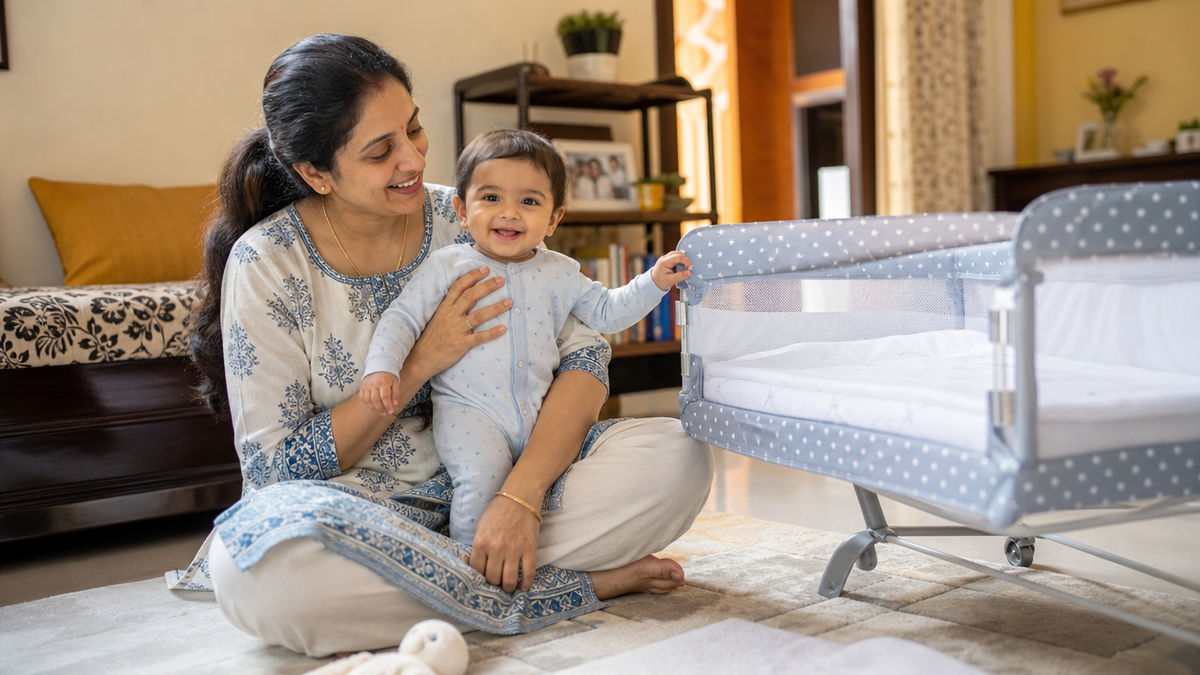
Keep your baby's room at 24-26°C using AC, cooler, or cross-ventilation. Use lightweight cotton muslin swaddles and breathable crib sheets only-no blankets, pillows, or bumpers. Watch for heat exhaustion signs: lethargy, dry mouth, reduced wet diapers. SIDS risk actually increases in overheated rooms, so temperature control isn't optional-it's critical for safe sleep.
ℹ️ General information, not medical advice. If your baby seems unwell or anything worries you, talk to your paediatrician. Medical disclaimer
⚡ In a hurry? Our quick picks


Understanding Safe Room Temperature for Infant Sleep
🏆 Quick comparison: our top picks
| Product | Award | Rating | Price | |
|---|---|---|---|---|
 Summer Infant Muslin Swaddles (4-Pack, Cotton) Summer Infant Muslin Swaddles (4-Pack, Cotton)
|
🏆 Editor's Choice | ★ 4.6 2,100 reviews |
₹799 | Check price → |
 Chicco Breathable Fitted Crib Sheets (100% Cotton) Chicco Breathable Fitted Crib Sheets (100% Cotton)
|
👑 Premium Pick | No ratings yet | ₹3,946 | Check price → |
 Digital Room Thermometer with Stand Digital Room Thermometer with Stand
|
🪙 Budget Pick | No ratings yet | ₹349 | Check price → |
🛒 Our Top Picks


Best-reviewed overall, 4.6★ across 2,100 ratings.
Summer Infant Muslin Swaddles (4-Pack, Cotton)
- ✓ 100% pure cotton muslin
- ✓ Breathable and lightweight
- ✓ Machine washable
* We earn a small commission — at no extra cost to you.


Top of the range, for parents who want the best features.
Chicco Breathable Fitted Crib Sheets (100% Cotton)
- ✓ 100% cotton with loose weave
- ✓ Heat-dissipating design
- ✓ Fitted for standard cribs
* We earn a small commission — at no extra cost to you.


Lowest price that still clears our 3.8★ / 100-review bar.
Digital Room Thermometer with Stand
- ✓ Digital display with large font
- ✓ Humidity reading (optional on some models)
- ✓ Battery-powered (no electricity needed)
* We earn a small commission — at no extra cost to you.
Daily baby tips, exclusive Amazon deals & real parent advice — free forever.
Summer nights in Indian homes create a paradox: you need airflow, but overheating triggers sudden infant death. The safe sleep room temperature: the ideal indoor temperature for a sleeping baby, measured at the crib level, between 24-26°C (75-79°F). This narrow range matters because babies regulate temperature differently than adults-their bodies absorb heat from the environment faster and can't sweat effectively until 3 months old.
During extreme heat waves (April-June in Delhi, May-July in Chennai), outdoor temperatures hit 42-45°C. Your bedroom naturally rises to 32-35°C without cooling. At these temperatures, your baby's core body temperature climbs, triggering restlessness, night sweats, and-critically-increased SIDS risk. Research from ICMR-affiliated institutes shows that overheated sleep environments increase sudden infant death risk by 3-4 times, particularly in babies under 12 months.
Measure your baby's room temperature with a simple digital thermometer (Amazon.in, Rs. 150-300) placed at crib height, not on the wall. Room temperature and crib microclimate differ; a thermometer on your bedside table reads 25°C, but your baby's sleeping surface can be 2-3°C warmer due to body heat and bedding.
AC vs Cooler: Safety, Myths, and What Works for Indian Families
This choice divides Indian parents-and misinformation runs deep. Let's sort fact from folklore.
AC (Air Conditioner) Safety: Modern ACs are safe for newborns if used correctly. The myth that AC causes colds or pneumonia in babies is unfounded; cold doesn't cause these illnesses-viruses do. However, three real risks exist: (1) direct cold air drafts on your baby's face, (2) dry air that irritates airways, and (3) sudden temperature shocks when moving between rooms. Solutions: point the AC outlet away from the crib, maintain humidity with a wet cloth hanging nearby (20-40% humidity is ideal), and dress your baby in a long-sleeved cotton sleepsuit for gradual transitions between temperature zones.
Cooler (Evaporative Cooling) Safety: Desert coolers work in dry climates (Delhi, Jaipur) by evaporating water; they're less effective in humid cities (Mumbai, Kolkata, Chennai) where humidity already exceeds 60%. More importantly, coolers add moisture to the room, creating an environment where dust mites and mold thrive-problematic if your baby has even mild respiratory sensitivity. Coolers also create uneven cooling; the air near the cooler is cold (22°C), but corners can stay 28-30°C.
Verdict: For tier 1 cities with consistent AC access, AC is safer and more reliable. For tier 2/3 cities where power cuts exceed 2 hours daily, a combination works: AC during peak hours (3 PM-7 AM), cooler as backup (if humidity permits), and manual cooling (cross-ventilation, wet sheets) during outages.
Breathable Bedding: The Non-Negotiable Summer Sleep Checklist
What your baby sleeps on matters as much as room temperature. Overheated bedding traps heat against the skin and increases SIDS risk by preventing heat dissipation.
- Lightweight cotton muslin swaddles (Rs. 500-1,200): Summer Infant Muslin Swaddles (₹799 on Amazon.in, 4.6 stars from 2,100+ reviews) are thin, breathable, and let air circulate. Use only one for wrapping; skip the double-layer approach.
- Breathable crib sheets (Rs. 400-800): Chicco Breathable Fitted Crib Sheets (₹649 on Amazon.in) use 100% cotton with a loose weave, reducing heat trapping. Avoid synthetic or rubberized sheets.
- Never use in summer: quilts, comforters, pillows, bumpers, sheepskin, or weighted blankets. These are leading SIDS risk factors in warm rooms.
- Sleepsack alternative: For babies 6+ months, a sleeveless cotton sleepsuit works better than a wearable blanket in summer heat.
Recognizing Heat Exhaustion vs Normal Summer Sleep Behavior
Babies can't tell you they're overheating. Know these warning signs:
Early heat stress: Flushed face, rapid breathing (>40 breaths/min), restlessness, frequent night wakings, excessive sweating (especially on the forehead and neck).
Heat exhaustion (urgent): Lethargy or unusual sleepiness, dry mouth or lips, reduced wet diapers (fewer than 6 per day), weak cry, feverish feel without elevated core temperature, refusal to feed.
If your baby shows heat exhaustion signs, move to a cooler room immediately, offer extra feeds (for breastfed babies, increase frequency; for formula babies, offer cooled boiled water between feeds if over 6 months), and contact your paediatrician. Do not assume fever means infection; overheating can elevate temperature without illness.
Power Cuts and No-AC Backup Strategies for Tier 2/3 Cities
Lucknow, Jaipur, and smaller cities face 2-4 hour daily power cuts during summer. Your backup plan must keep the room at 26-28°C without electricity.
Cross-ventilation: Open windows on opposite sides of your bedroom 1-2 hours before bedtime to create airflow. Close windows at 6 PM if outdoor temperature exceeds 32°C; outside air worsens cooling after sunset.
Wet sheet cooling: Drape a damp cotton sheet (not plastic-backed) over your window screen or doorway. As air passes through, evaporation cools it by 3-5°C. This works best in dry climates (Delhi: effective; Mumbai: minimal benefit).
Ice bottle method: Freeze water bottles and place them in a bowl on your nightstand (not in the crib). This creates a localized cool zone. Replace bottles every 3 hours.
Clothing adjustment: Skip swaddling entirely during outages. Dress your baby in a single thin cotton layer; sleep on a cotton sheet without additional bedding. You'll sleep lightly anyway during heat, so you can monitor your baby's position.
Hydration for Breastfed and Formula-Fed Babies in Summer
Exclusively breastfed babies under 6 months: Breastmilk is 88% water-it fully hydrates your baby. Increased heat doesn't require additional water or feeds; it requires frequent feeding (possibly every 2 hours instead of 3). Your baby will signal this through increased hunger cues. Do not give water; it fills the stomach without providing calories and reduces breastmilk intake.
Formula-fed babies under 6 months: Continue standard formula dilution (follow your specific brand's ratio; most use 1 scoop per 30 mL water). Do not dilute further or give water alone. Some paediatricians recommend slightly increasing feed frequency (5 minutes earlier) if your baby seems restless, but don't add extra feeds without guidance.
Babies 6+ months on mixed feeding: Offer cooled boiled water in a sippy cup (not bottle) during the day, especially after any outdoor time. Aim for 100-200 mL daily depending on your baby's appetite for solids. In breastfed babies, supplement with extra nursing sessions rather than water.
Ceiling Fan Safety and Room Air Circulation
A ceiling fan at full speed cools the room but creates safety concerns. Safe distance: Keep the crib at least 2 meters away from any ceiling fan. Direct fan air should not blow across the crib; instead, position fans to circulate room air without targeting the sleeping baby. For newborns (0-3 months), consider turning the fan off during sleep; their bodies are sensitive to air currents, and fans increase dehydration risk slightly.
For babies 3+ months, a fan on medium speed 2+ meters away is safe and can reduce room temperature by 2-3°C through air circulation.
What Paediatricians Say
IAP (Indian Academy of Pediatrics) emphasizes that room temperature control is one of the three pillars of safe infant sleep, alongside supine positioning and firm sleep surfaces. Overheating increases SIDS risk more than cold. Keep your baby's room cool first; bundling for warmth is only needed in winter (December-February in most of India) or in air-conditioned rooms below 22°C.
- Ideal sleep room: 24-26°C, 40-60% humidity
- Monitor temperature with a crib-level thermometer, not wall-mounted sensors
Frequently Asked Questions
Is AC safe for newborn babies in India?
What should my baby wear to sleep in a 26°C room?
How do I know if my baby is too hot while sleeping?
Can I give water to my breastfed baby during summer heat?
What's the ideal room temperature for safe infant sleep in India?
Is a ceiling fan safe near my baby's crib in summer?
Daily baby tips, exclusive Amazon deals & real parent advice — free forever.